Thank you for visiting SNEWPapers!
Sign up free
Literary
October 16, 1920
Albuquerque Morning Journal
Albuquerque, Bernalillo County, New Mexico
What is this article about?
Aldo Leopold addresses university students on the value of leisure time spent in pursuit of adventure, arguing that inability to enjoy leisure indicates ignorance, while such pursuits lead to true education and contributions to knowledge, illustrated by historical quotes and examples like a fisherman studying optics or a collector of fossils.
Clipping
OCR Quality
95%
Excellent
Full Text
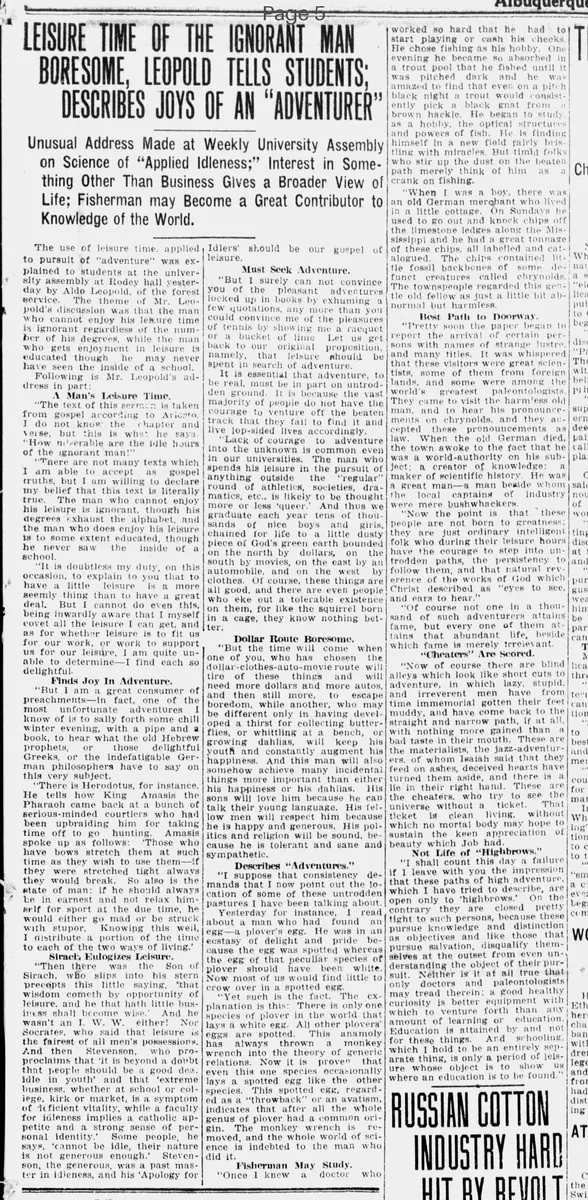
LEISURE TIME OF THE IGNORANT MAN
BORESOME, LEOPOLD TELLS STUDENTS:
DESCRIBES JOYS OF AN "ADVENTURER"
Unusual Address Made at Weekly University Assembly on Science of "Applied Idleness;" Interest in Something Other Than Business Gives a Broader View of Life; Fisherman may Become a Great Contributor to Knowledge of the World.
The use of leisure time, applied to pursuit of "adventure" was explained to students at the university assembly at Rodey hall yesterday by Aldo Leopold of the forest service. The theme of Mr. Leopold's discussion was that the man who cannot enjoy his leisure time is ignorant regardless of the number of his degrees, while the man who gets enjoyment in leisure is educated though he may never have seen the inside of a school.
Following is Mr. Leopold's address in part:
A Man's Leisure Time.
"The text of this sermon is taken from gospel according to Aristoto. I do not know the chapter and verse, but this is what he says: 'How miserable are the idle hours of the ignorant man!'
"There are not many texts which I am able to accept as gospel truths, but I am willing to declare my belief that this text is literally true. The man who cannot enjoy his leisure is ignorant, though his degrees exhaust the alphabet, and the man who does enjoy his leisure is to some extent educated, though he never saw the inside of a school.
"It is doubtless my duty, on this occasion, to explain to you that to have a little leisure is a more seemly thing than to have a great deal. But I cannot do even this, being inwardly aware that I myself covet all the leisure I can get, and as for whether leisure is to fit us for our work, or work to support us for our leisure, I am quite unable to determine—I find each so delightful.
Finds Joy In Adventure.
"But I am a great consumer of preachments—in fact, one of the most unfortunate adventures I know of is to sally forth some chill winter evening, with a pipe and a book, to hear what the old Hebrew prophets, or those delightful Greeks, or the indefatigable German philosophers have to say on this very subject.
"There is Herodotus, for instance. He tells how King Amasis the Pharaoh came back at a bunch of serious-minded courtiers who had been upbraiding him for taking time off to go hunting. Amasis spoke up as follows: 'Those who have bows stretch them at such time as they wish to use them—if they were stretched tight always they would break. So also is the state of man: if he should always be in earnest and not relax himself for sport at the due time, he would either go mad or be struck with stupor. Knowing this well I distribute a portion of the time to each of the two ways of living.'
Sirach Eulogizes Leisure.
"Then there was the Son of Sirach, who slips into his stern precepts this little saying, that wisdom cometh by opportunity of leisure, and he that hath little business shall become wise.' And he wasn't an I. W. W. either! Nor Socrates, who said that leisure is the fairest of all men's possessions. And then Stevenson, who proclaims that 'it is beyond a doubt that people should be a good deal idle in youth' and that 'extreme business, whether at school or college, kirk or market, is a symptom of deficient vitality, while a faculty for idleness implies a catholic appetite and a strong sense of personal identity.'
Some people, he says, cannot be idle, their nature is not generous enough.' Stevenson, the generous, was a past master in idleness, and his 'Apology for Idlers' should be our gospel of leisure.
Must Seek Adventure.
"But I surely cannot convince you of the pleasant adventures locked up in books by exhuming a few quotations, any more than you could convince me of the pleasures of tennis by showing me a racquet or a bucket of lime. Let us get back to our original proposition, namely, that leisure should be spent in search of adventure.
It is essential that adventure, to be real, must be in part on untrodden ground. It is because the vast majority of people do not have the courage to venture off the beaten track that they fail to find it and live lop-sided lives accordingly.
"Lack of courage to adventure into the unknown is common even in our universities. The man who spends his leisure in the pursuit of anything outside the "regular" round of athletics, societies, dramatics, etc., is likely to be thought more or less 'queer.' And thus we graduate each year tens of thousands of nice boys and girls, chained for life to a little dusty piece of God's green earth bounded on the north by dollars, on the south by movies, on the east by an automobile, and on the west by clothes. Of course, these things are all good, and there are even people who eke out a tolerable existence on them, for like the squirrel born in a cage, they know nothing better.
Dollar Route Boresome.
"But the time will come when one of you, who has chosen the dollar-clothes-auto-movie route will tire of these things and will need more dollars and more autos, and then still more, to escape boredom, while another, who may be different only in having developed a thirst for collecting butterflies, or whittling at a bench, or growing dahlias, will keep his youth and constantly augment his happiness. And this man will also somehow achieve many incidental things more important than either his happiness or his dahlias. His sons will love him because he can talk their young language. His fellow men will respect him because he is happy and generous. His politics and religion will be sound, because he is tolerant and sane and sympathetic.
Describes "Adventures"
"I suppose that consistency demands that I now point out the location of some of these untrodden pastures I have been talking about. Yesterday for instance, I read about a man who had found an egg—a plover's egg. He was in an ecstasy of delight and pride because the egg was spotted whereas the egg of that peculiar species of plover should have been white.
Now most of us would find little to crow over in a spotted egg.
"Yet such is the fact. The explanation is this: There is only one species of plover in the world that lays a white egg. All other plovers' eggs are spotted. This anomaly has always thrown a monkey wrench into the theory of generic relations. Now it is proven that even this one species occasionally lays a spotted egg like the other species. This spotted egg, regarded as a "throwback" or an atavism, indicates that after all the whole genus of plover had a common origin. The monkey wrench is removed, and the whole world of science is indebted to the man who did it.
Fisherman May Study.
"Once I knew a doctor who worked so hard that he had to start playing or cash his checks. He chose fishing as his hobby. One evening he became so absorbed in a trout pool that he fished until it was pitch dark and he was amazed to find that even on a pitch black night a trout would consistently pick a black gnat from brown hackle. He began to study as a hobby, the optical structures and powers of fish. He is finding himself in a new field fairly bristling with miracles. But timid folks who stir up the dust on the beaten path merely think of him as a crank on fishing.
"When I was a boy, there was an old German merchant who lived in a little cottage. On Sundays he used to go out and knock chips off the limestone ledges along the Mississippi and he had a great tonnage of these chips, all labelled and catalogued. The chips contained little fossil backbones of some defunct creatures called crinoids. The townspeople regarded this gentle old fellow as just a little bit abnormal but harmless.
Best Path to Doorway.
"Pretty soon the paper began to report the arrival of certain persons with names of strange lustre, and many titles. It was whispered that these visitors were great scientists, some of them from foreign lands, and some were among the world's greatest paleontologists. They came to visit the harmless old man, and to hear his pronouncements on crinoids, and they accepted these pronouncements as law. When the old German died, the town awoke to the fact that he was a world-authority on his subject: a creator of knowledge: a maker of scientific history. He was a great man—a man beside whom the local captains of industry were mere bushwhackers.
"Now the point is that these people are not born to greatness; they are just ordinary intelligent folk who during their leisure hours have the courage to step into untrodden paths, the persistency to follow them, and that natural reverence of the works of God which Christ described as "eyes to see and ears to hear."
"Of course not one in a thousand of such adventurers attains fame, but every one of them attains that abundant life, beside which fame is merely irrelevant.
"Cheaters" Are Scored.
"Now of course there are blind alleys which look like short cuts to adventure, in which lazy, stupid, and irreverent men have from time immemorial gotten their feet muddy, and have come back to the straight and narrow path, if at all, with nothing more gained than a bad taste in their mouth. These are the materialists, the jazz-adventurers, of whom Isaiah said that they feed on ashes, deceived hearts have turned them aside, and there is a lie in their right hand. These are the cheaters, who try to see the universe without a ticket. That ticket is clean living, without which no mortal body may hope to sustain the keen appreciation of beauty which Job had.
Not Life of "Highbrows."
"I shall count this day a failure if I leave with you the impression that these paths of high adventure, which I have tried to describe, are open only to 'highbrows.' On the contrary they are closed pretty tight to such persons, because these pursue knowledge and distinction as objectives and like those that pursue salvation, disqualify themselves at the outset from even understanding the object of their pursuit. Neither is it at all true that only doctors and paleontologists may tread therein: a good healthy curiosity is better equipment with which to venture forth than any amount of learning or education.
Education is attained by and not for these things. And schooling, which I hold to be an entirely separate thing, is only a period of leisure whose object is to show us where an education is to be found."
BORESOME, LEOPOLD TELLS STUDENTS:
DESCRIBES JOYS OF AN "ADVENTURER"
Unusual Address Made at Weekly University Assembly on Science of "Applied Idleness;" Interest in Something Other Than Business Gives a Broader View of Life; Fisherman may Become a Great Contributor to Knowledge of the World.
The use of leisure time, applied to pursuit of "adventure" was explained to students at the university assembly at Rodey hall yesterday by Aldo Leopold of the forest service. The theme of Mr. Leopold's discussion was that the man who cannot enjoy his leisure time is ignorant regardless of the number of his degrees, while the man who gets enjoyment in leisure is educated though he may never have seen the inside of a school.
Following is Mr. Leopold's address in part:
A Man's Leisure Time.
"The text of this sermon is taken from gospel according to Aristoto. I do not know the chapter and verse, but this is what he says: 'How miserable are the idle hours of the ignorant man!'
"There are not many texts which I am able to accept as gospel truths, but I am willing to declare my belief that this text is literally true. The man who cannot enjoy his leisure is ignorant, though his degrees exhaust the alphabet, and the man who does enjoy his leisure is to some extent educated, though he never saw the inside of a school.
"It is doubtless my duty, on this occasion, to explain to you that to have a little leisure is a more seemly thing than to have a great deal. But I cannot do even this, being inwardly aware that I myself covet all the leisure I can get, and as for whether leisure is to fit us for our work, or work to support us for our leisure, I am quite unable to determine—I find each so delightful.
Finds Joy In Adventure.
"But I am a great consumer of preachments—in fact, one of the most unfortunate adventures I know of is to sally forth some chill winter evening, with a pipe and a book, to hear what the old Hebrew prophets, or those delightful Greeks, or the indefatigable German philosophers have to say on this very subject.
"There is Herodotus, for instance. He tells how King Amasis the Pharaoh came back at a bunch of serious-minded courtiers who had been upbraiding him for taking time off to go hunting. Amasis spoke up as follows: 'Those who have bows stretch them at such time as they wish to use them—if they were stretched tight always they would break. So also is the state of man: if he should always be in earnest and not relax himself for sport at the due time, he would either go mad or be struck with stupor. Knowing this well I distribute a portion of the time to each of the two ways of living.'
Sirach Eulogizes Leisure.
"Then there was the Son of Sirach, who slips into his stern precepts this little saying, that wisdom cometh by opportunity of leisure, and he that hath little business shall become wise.' And he wasn't an I. W. W. either! Nor Socrates, who said that leisure is the fairest of all men's possessions. And then Stevenson, who proclaims that 'it is beyond a doubt that people should be a good deal idle in youth' and that 'extreme business, whether at school or college, kirk or market, is a symptom of deficient vitality, while a faculty for idleness implies a catholic appetite and a strong sense of personal identity.'
Some people, he says, cannot be idle, their nature is not generous enough.' Stevenson, the generous, was a past master in idleness, and his 'Apology for Idlers' should be our gospel of leisure.
Must Seek Adventure.
"But I surely cannot convince you of the pleasant adventures locked up in books by exhuming a few quotations, any more than you could convince me of the pleasures of tennis by showing me a racquet or a bucket of lime. Let us get back to our original proposition, namely, that leisure should be spent in search of adventure.
It is essential that adventure, to be real, must be in part on untrodden ground. It is because the vast majority of people do not have the courage to venture off the beaten track that they fail to find it and live lop-sided lives accordingly.
"Lack of courage to adventure into the unknown is common even in our universities. The man who spends his leisure in the pursuit of anything outside the "regular" round of athletics, societies, dramatics, etc., is likely to be thought more or less 'queer.' And thus we graduate each year tens of thousands of nice boys and girls, chained for life to a little dusty piece of God's green earth bounded on the north by dollars, on the south by movies, on the east by an automobile, and on the west by clothes. Of course, these things are all good, and there are even people who eke out a tolerable existence on them, for like the squirrel born in a cage, they know nothing better.
Dollar Route Boresome.
"But the time will come when one of you, who has chosen the dollar-clothes-auto-movie route will tire of these things and will need more dollars and more autos, and then still more, to escape boredom, while another, who may be different only in having developed a thirst for collecting butterflies, or whittling at a bench, or growing dahlias, will keep his youth and constantly augment his happiness. And this man will also somehow achieve many incidental things more important than either his happiness or his dahlias. His sons will love him because he can talk their young language. His fellow men will respect him because he is happy and generous. His politics and religion will be sound, because he is tolerant and sane and sympathetic.
Describes "Adventures"
"I suppose that consistency demands that I now point out the location of some of these untrodden pastures I have been talking about. Yesterday for instance, I read about a man who had found an egg—a plover's egg. He was in an ecstasy of delight and pride because the egg was spotted whereas the egg of that peculiar species of plover should have been white.
Now most of us would find little to crow over in a spotted egg.
"Yet such is the fact. The explanation is this: There is only one species of plover in the world that lays a white egg. All other plovers' eggs are spotted. This anomaly has always thrown a monkey wrench into the theory of generic relations. Now it is proven that even this one species occasionally lays a spotted egg like the other species. This spotted egg, regarded as a "throwback" or an atavism, indicates that after all the whole genus of plover had a common origin. The monkey wrench is removed, and the whole world of science is indebted to the man who did it.
Fisherman May Study.
"Once I knew a doctor who worked so hard that he had to start playing or cash his checks. He chose fishing as his hobby. One evening he became so absorbed in a trout pool that he fished until it was pitch dark and he was amazed to find that even on a pitch black night a trout would consistently pick a black gnat from brown hackle. He began to study as a hobby, the optical structures and powers of fish. He is finding himself in a new field fairly bristling with miracles. But timid folks who stir up the dust on the beaten path merely think of him as a crank on fishing.
"When I was a boy, there was an old German merchant who lived in a little cottage. On Sundays he used to go out and knock chips off the limestone ledges along the Mississippi and he had a great tonnage of these chips, all labelled and catalogued. The chips contained little fossil backbones of some defunct creatures called crinoids. The townspeople regarded this gentle old fellow as just a little bit abnormal but harmless.
Best Path to Doorway.
"Pretty soon the paper began to report the arrival of certain persons with names of strange lustre, and many titles. It was whispered that these visitors were great scientists, some of them from foreign lands, and some were among the world's greatest paleontologists. They came to visit the harmless old man, and to hear his pronouncements on crinoids, and they accepted these pronouncements as law. When the old German died, the town awoke to the fact that he was a world-authority on his subject: a creator of knowledge: a maker of scientific history. He was a great man—a man beside whom the local captains of industry were mere bushwhackers.
"Now the point is that these people are not born to greatness; they are just ordinary intelligent folk who during their leisure hours have the courage to step into untrodden paths, the persistency to follow them, and that natural reverence of the works of God which Christ described as "eyes to see and ears to hear."
"Of course not one in a thousand of such adventurers attains fame, but every one of them attains that abundant life, beside which fame is merely irrelevant.
"Cheaters" Are Scored.
"Now of course there are blind alleys which look like short cuts to adventure, in which lazy, stupid, and irreverent men have from time immemorial gotten their feet muddy, and have come back to the straight and narrow path, if at all, with nothing more gained than a bad taste in their mouth. These are the materialists, the jazz-adventurers, of whom Isaiah said that they feed on ashes, deceived hearts have turned them aside, and there is a lie in their right hand. These are the cheaters, who try to see the universe without a ticket. That ticket is clean living, without which no mortal body may hope to sustain the keen appreciation of beauty which Job had.
Not Life of "Highbrows."
"I shall count this day a failure if I leave with you the impression that these paths of high adventure, which I have tried to describe, are open only to 'highbrows.' On the contrary they are closed pretty tight to such persons, because these pursue knowledge and distinction as objectives and like those that pursue salvation, disqualify themselves at the outset from even understanding the object of their pursuit. Neither is it at all true that only doctors and paleontologists may tread therein: a good healthy curiosity is better equipment with which to venture forth than any amount of learning or education.
Education is attained by and not for these things. And schooling, which I hold to be an entirely separate thing, is only a period of leisure whose object is to show us where an education is to be found."
What sub-type of article is it?
Essay
What themes does it cover?
Moral Virtue
Nature
What keywords are associated?
Leisure
Adventure
Education
Ignorance
Hobbies
Nature
Scientific Discovery
Moral Instruction
What entities or persons were involved?
Aldo Leopold
Literary Details
Title
A Man's Leisure Time
Author
Aldo Leopold
Subject
Address At University Assembly On The Use Of Leisure Time For Adventure
Form / Style
Sermon Like Prose Address With Historical Quotations
Key Lines
"The Man Who Cannot Enjoy His Leisure Is Ignorant, Though His Degrees Exhaust The Alphabet, And The Man Who Does Enjoy His Leisure Is To Some Extent Educated, Though He Never Saw The Inside Of A School."
"Leisure Should Be Spent In Search Of Adventure."
"These People Are Not Born To Greatness; They Are Just Ordinary Intelligent Folk Who During Their Leisure Hours Have The Courage To Step Into Untrodden Paths..."
"Education Is Attained By And Not For These Things."