Thank you for visiting SNEWPapers!
Sign up free
The Frontiersman
Wasilla, Palmer, Alaska
What is this article about?
Historical origins of Thanksgiving trace from ancient pagan harvest festivals in the Mediterranean honoring goddesses like Ceres and Demeter, through European traditions like the Corn Mother and Martinmas, to the Pilgrims' 1621 feast in the New World after exposure in Holland.
Clipping
OCR Quality
Full Text
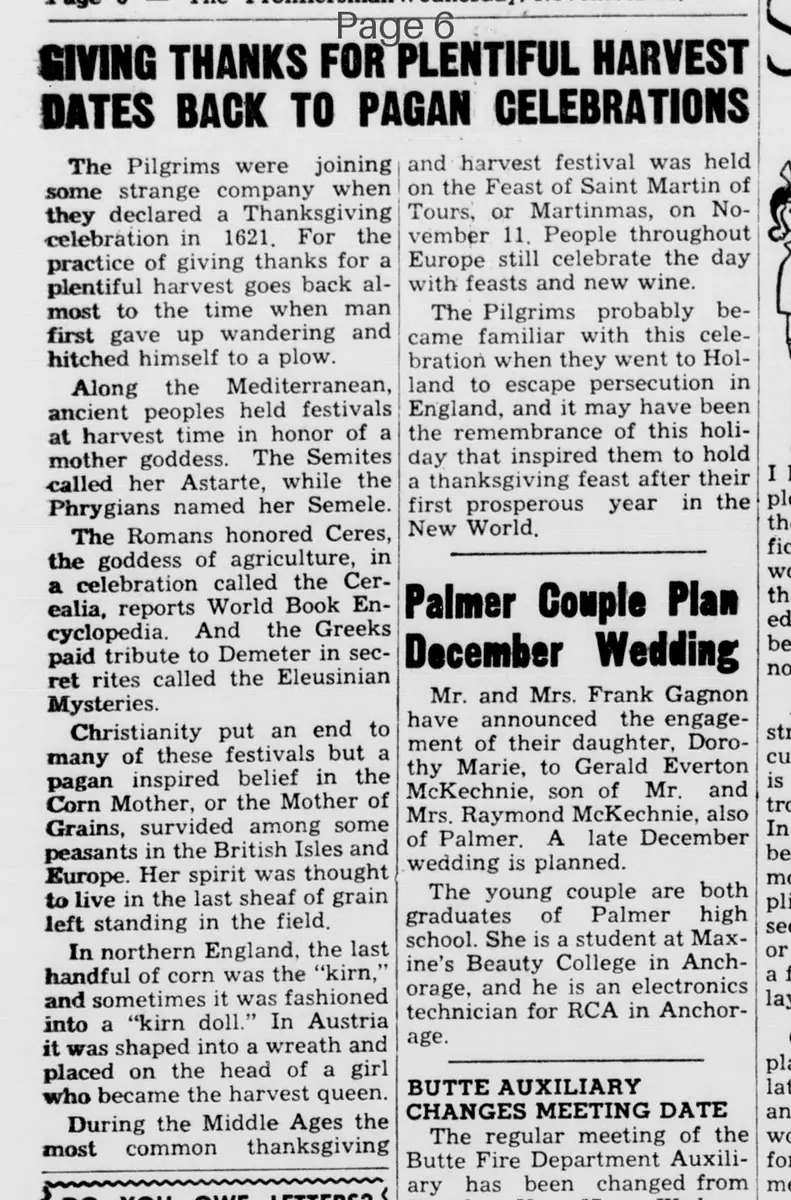
The Pilgrims were joining some strange company when they declared a Thanksgiving celebration in 1621. For the practice of giving thanks for a plentiful harvest goes back almost to the time when man first gave up wandering and hitched himself to a plow.
Along the Mediterranean, ancient peoples held festivals at harvest time in honor of a mother goddess. The Semites called her Astarte, while the Phrygians named her Semele. The Romans honored Ceres, the goddess of agriculture, in a celebration called the Cerealia, reports World Book Encyclopedia. And the Greeks paid tribute to Demeter in secret rites called the Eleusinian Mysteries.
Christianity put an end to many of these festivals but a pagan inspired belief in the Corn Mother, or the Mother of Grains, survived among some peasants in the British Isles and Europe. Her spirit was thought to live in the last sheaf of grain left standing in the field.
In northern England, the last handful of corn was the "kirn," and sometimes it was fashioned into a "kirn doll." In Austria it was shaped into a wreath and placed on the head of a girl who became the harvest queen.
During the Middle Ages the most common thanksgiving and harvest festival was held on the Feast of Saint Martin of Tours, or Martinmas, on November 11. People throughout Europe still celebrate the day with feasts and new wine.
The Pilgrims probably became familiar with this celebration when they went to Holland to escape persecution in England, and it may have been the remembrance of this holiday that inspired them to hold a thanksgiving feast after their first prosperous year in the New World.
What sub-type of article is it?
What themes does it cover?
What keywords are associated?
What entities or persons were involved?
Where did it happen?
Story Details
Key Persons
Location
Mediterranean, British Isles, Europe, Holland, New World
Event Date
1621
Story Details
The practice of giving thanks for plentiful harvests dates back to ancient pagan festivals honoring mother goddesses like Astarte, Semele, Ceres, and Demeter. These traditions persisted in Europe, including the Corn Mother belief and Martinmas on November 11. The Pilgrims, familiar with such celebrations from Holland, held a Thanksgiving feast in 1621 after their first prosperous year.