Thank you for visiting SNEWPapers!
Sign up free
Norfolk Gazette And Publick Ledger
Norfolk, Virginia
What is this article about?
In February 1811, reports from Washington detail congressional debates on amendments to the non-intercourse bill addressing British and French edicts, diplomatic updates from Mr. Russell and Mr. Morrier, expectations of presidential communication, and the unanimous Senate confirmation of John Quincy Adams' nomination to replace Judge Cushing.
Clipping
OCR Quality
Full Text
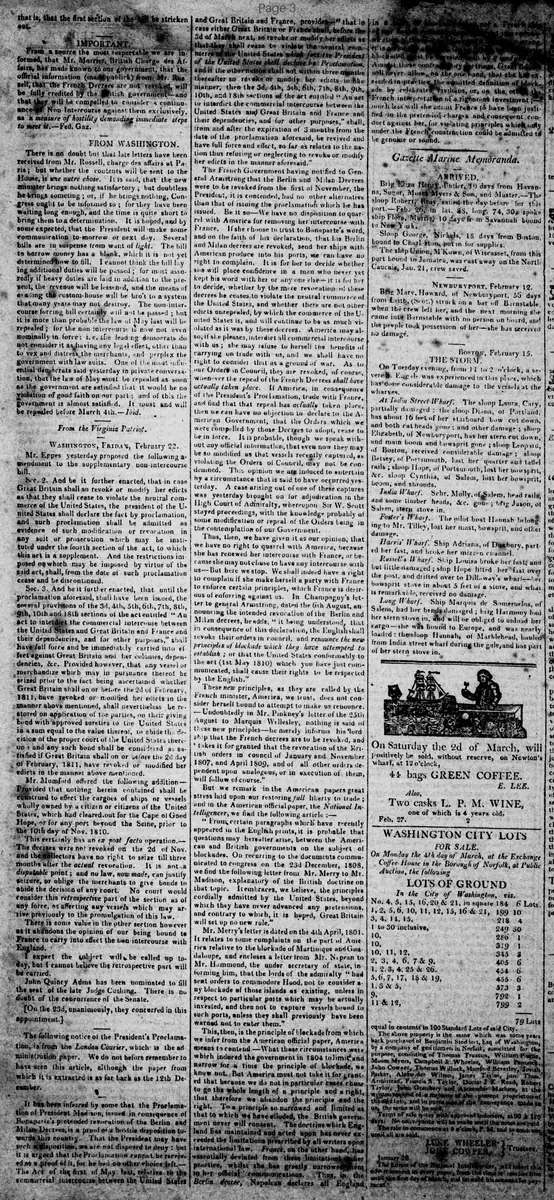
IMPORTANT
From a source that is most respectable we are informed, that Mr. Morrier, British Charge d'Affaires, has made known to our government, that the official information (made public from Mr. Russell himself, that the French Decrees are not revoked) will be fully credited by the British government--and that they will be compelled to consider a continuance of Non Intercourse against them exclusively, as a measure of hostility demanding immediate steps to meet it. Fed. Gaz.
FROM WASHINGTON.
There is no doubt but that late letters have been received from Mr. Russell, charge d'affaires at Paris; but whether the contents will be sent to the House, is another thing. It is said, that the new minister brings nothing satisfactory; but doubtless he brings something; or, if he brings nothing, Congress ought to be informed so; for they have been waiting long enough, and the time is quite short to bring them to a determination. It is hoped, and by some expected, that the President will make some communication to-morrow or next day. Several bills are in suspense from want of light. The bill to borrow money has a blank, which it is not yet determined how to fill. I cannot think the bill laying additional duties will be passed; for most assuredly if heavy duties are laid in addition to the present, the revenue will be lessened, and the means of evading the custom-house will be brought to a system that many years may not destroy. The non-intercourse forcing bill certainly will not be passed; but it is more than probable the law of May last will be repealed; or the non intercourse is now not even nominally in force: i. e. the leading democrats do not consider it as having any legal effect, other than to vex and distress the merchants, and perplex the government with law suits. One of the most influential democrats said yesterday in private conversation, that the law of May must be repealed as soon as the government are satisfied that it would be no violation of good faith on our part; and of this the government is almost satisfied. It must and will be repealed before March 4th.--Ibid.
From the Virginia Patriot.
Washington, Friday, February 22.
Mr. Eppes yesterday proposed the following amendment to the supplementary non-intercourse bill.
Sec. 2. And be it further enacted, that in case Great Britain shall so revoke or modify her edicts as that they shall cease to violate the neutral commerce of the United States, the president of the United States shall declare the fact by proclamation, and such proclamation shall be admitted as evidence of such modification or revocation in any suit or prosecution which may be instituted under the fourth section of the act, to which this act is a supplement. And the restrictions imposed or which may be imposed by virtue of the said act, shall, from the date of such proclamation cease and be discontinued.
Sec. 3. And be it further enacted, that until the proclamation aforesaid, shall have been issued, the several provisions of the 3d, 4th, 5th, 6th, 7th, 8th, 9th, 10th and 18th sections of the act entitled "An act to interdict the commercial intercourse between the United States and Great Britain and France and their dependencies, and for other purposes," shall have full force and be immediately carried into effect against Great Britain and her colonies, dependencies, &c. Provided however, that any vessel or merchandize which may in pursuance thereof be seized prior to the fact being ascertained whether Great Britain shall on or before the 2d of February, 1811, have revoked or modified her edicts in the manner above mentioned, shall nevertheless be restored on application of the parties, on their giving bond with approved sureties to the United States in a sum equal to the value thereof, to abide the decision of the proper court of the United States thereon; and any such bond shall be considered as satisfied if Great Britain shall on or before the 2d day of February, 1811, have revoked or modified her edicts in the manner above mentioned.
Mr. Alston offered the following addition-- Provided that nothing herein contained shall be construed to affect the cargoes of ships or vessels wholly owned by a citizen or citizens of the United States, which had cleared out for the Cape of Good Hope, or for any port beyond the Seine, prior to the 20th day of Nov. 1810.
This certainly has an ex post facto operation.-- The decrees were not revoked on the 2d of Nov. and the collectors have no right to seize till three months after the actual revocation. It is not a disputable point; and no law, now made, can justify seizure, or oblige the merchants to give bonds to abide the decision of any court. No court would consider this retrospective part of the section as of any force, as affecting any vessels which may arrive previously to the promulgation of this law.
There is some value in the other section however as it abandons the opinion of our being bound to France to carry into effect the non intercourse with England.
I expect the subject will be called up to-day, but I cannot believe the retrospective part will be carried.
John Quincy Adams has been nominated to fill the seat of the late Judge Cushing. There is no doubt of the concurrence of the Senate. [On the 23d, unanimously, they concurred in this appointment.]
The following notice of the President's Proclamation, is from the London Courier, which is the administration paper. We do not before remember to have seen this article, although the paper from which it is extracted is as far back as the 12th December.
It has been inferred by some that the Proclamation of President Madison, issued in consequence of Bonaparte's pretended revocation of the Berlin and Milan Decrees, is a proof of a hostile disposition towards this country. That the President may have such a disposition, we are not disposed to deny; but it is argued that the Proclamation cannot be received as a proof of it, for he had no other choice left. The Act of the 1st of May last, relative to the commercial intercourse between the United States and Great Britain and France, provided that in case either Great Britain or France shall before the 3d of March next, so revoke or modify her edicts as that they shall cease to violate the neutral commerce of the United States, the President of the United States shall declare by Proclamation, and if the other nation shall not within three months thereafter so revoke or modify her edicts in like manner, then the 3d, 4th, 5th, 6th, 7th, 8th, 9th, 10th, and 18th sections of the act entitled "An act to interdict the commercial intercourse between the United States and Great Britain and France and their dependencies, and for other purposes," shall, from and after the expiration of 3 months from the date of the proclamation aforesaid, be revived and have full force and effect, so far as relates to the nation thus refusing or neglecting to revoke or modify her edicts in the manner aforesaid."
The French Government having notified to General Armstrong that the Berlin and Milan Decrees were to be revoked from the first of November, the President, it is contended, had no other alternative than that of issuing the proclamation which he has issued. Be it so--We have no disposition to quarrel with America for removing her intercourse with France. If she choose to trust to Bonaparte's word, and on the faith of his declaration, that his Berlin and Milan decrees are revoked, send her ships with American produce into his ports, we can have no right to complain. It is for her to decide whether she will place confidence in a man who never yet kept his word with her or any one else; it is for her to decide, whether by the mere revocation of these decrees he ceases to violate the neutral commerce of the United States, and whether there are not other edicts unrepealed, by which the commerce of the U. nited States is, and will continue to be as much violated as it was by these decrees. America may also, if she pleases, interdict all commercial intercourse with us; she may refuse to herself the benefits of carrying on trade with us, and we shall have no right to consider that as a ground of war. As to our Orders in Council, they are revoked, of course, whenever the repeal of the French Decrees shall have actually taken place. If America, in consequence of the President's Proclamation, trade with France, and find that that repeal has actually taken place, then we can have no objection to declare to the American Government, that the Orders which we were compelled by those Decrees to adopt, cease to be in force. It is probable, though we speak without any official information, that even now they may be so modified as that vessels recently captured, as violating the Orders of Council, may not be condemned. This opinion we are induced to entertain by a circumstance that is said to have occurred yesterday. A case arising out of one of these captures was yesterday brought on for adjudication in the High Court of Admiralty, whereupon Sir W. Scott stayed proceedings, with the knowledge probably of some modification or repeal of the Orders being in the contemplation of our Government.
Thus, then, we have given it as our opinion, that we have no right to quarrel with America, because she has renewed her intercourse with France, or because she may not choose to have any intercourse with us--But here we stop. We shall indeed have a right to complain if she make herself a party with France to enforce certain principles, which France is desirous of enforcing against us. In Champagny's letter to general Armstrong, dated the 6th August, announcing the intended revocation of the Berlin and Milan decrees, he adds, "it being understood, that in consequence of this declaration, the English shall revoke their orders in council, and renounce the new principles of blockade which they have attempted to establish; or that the United States conformably to the act (1st May 1810) which you have just communicated, shall cause their rights to be respected by the English."
These new principles, as they are called by the French minister, America, we trust, does not consider herself bound to attempt to make us renounce. --Undoubtedly in Mr. Pinkney's letter of the 25th August to Marquis Wellesley, nothing is said of these new principles--he merely informs his lordship that the French decrees are to be revoked, and takes it for granted that the revocation of the British orders in council of January and November 1807, and April 1809, and of all other orders dependent upon or in execution of them, will follow of course.
But we remark in the American papers great stress laid upon our restoring full liberty to trade; and in the American official paper, the National Intelligencer, we find the following article:--
"From certain paragraphs which have recently appeared in the English prints, it is probable that questions may hereafter arise, between the American and British governments on the subject of blockades. On recurring to the documents communicated to congress on the 23d December, 1808, we find the following letter from Mr. Merry to Mr. Madison, explanatory of the British doctrine on that topic. It embraces, we believe, the principles cordially admitted by the United States, beyond which they have never advanced any pretensions, and contrary to which, it is hoped, Great Britain will set up no new rule."
Mr. Merry's letter is dated on the 4th April, 1804. It relates to some complaints on the part of America relative to the blockade of Martinique and Guadaloupe, and encloses a letter from Mr. Nepean to Mr. Hammond, the under secretary of state, informing him, that the lords of the admiralty "had sent orders to commodore Hood, not to consider any blockade of those islands as existing, unless in respect to particular ports which may be actually invested, and then not to capture vessels bound to such ports, unless they shall previously have been warned not to enter them."
This, then, is the principle of blockade from which we infer from the American official paper, America means to contend.--What those circumstances were which induced the government in 1804 to limit and narrow for a time the principle of blockade, we know not. But America must not take it for granted that because we do not in particular cases choose to go the whole length of a principle and a right, that therefore we abandon the principle and the right.- The principle so narrowed and limited as that to which we have alluded, the British government never will consent. The doctrine which England has maintained and acted upon has never exceeded the limitations prescribed by all writers upon international law. France, on the other hand has essentially deviated from these limitations. Ther practice, whilst she bee greatly narrowed hen in her ofhot f /commumetions Thus, in the Berlin decree, Napoleon declares all: England
What sub-type of article is it?
What keywords are associated?
What entities or persons were involved?
Where did it happen?
Domestic News Details
Primary Location
Washington
Event Date
February 22, 1811
Key Persons
Outcome
john quincy adams' nomination unanimously confirmed by senate on february 23, 1811; ongoing debates on non-intercourse bill amendments, with expectations of repeal of may 1810 law before march 4, 1811.
Event Details
Congressional debates and proposed amendments by Mr. Eppes and Mr. Alston to the supplementary non-intercourse bill concerning British and French edicts; diplomatic updates from Mr. Russell in Paris and Mr. Morrier indicating British view of continued non-intercourse as hostility; anticipation of presidential communication; excerpt from London Courier analyzing President's Proclamation and implications for trade and blockades.