Thank you for visiting SNEWPapers!
Sign up free
Letter to Editor
February 25, 1763
The New Hampshire Gazette
Portsmouth, Rockingham County, New Hampshire
What is this article about?
Letter to the New-Hampshire Gazette publisher recommending the insertion of an extract from Philosophical Transactions on using sea shells to manure boggy and heath lands in Irish counties of Londonderry and Donnegall, as described by the Archbishop of Dublin, to benefit coastal farmers.
Clipping
OCR Quality
98%
Excellent
Full Text
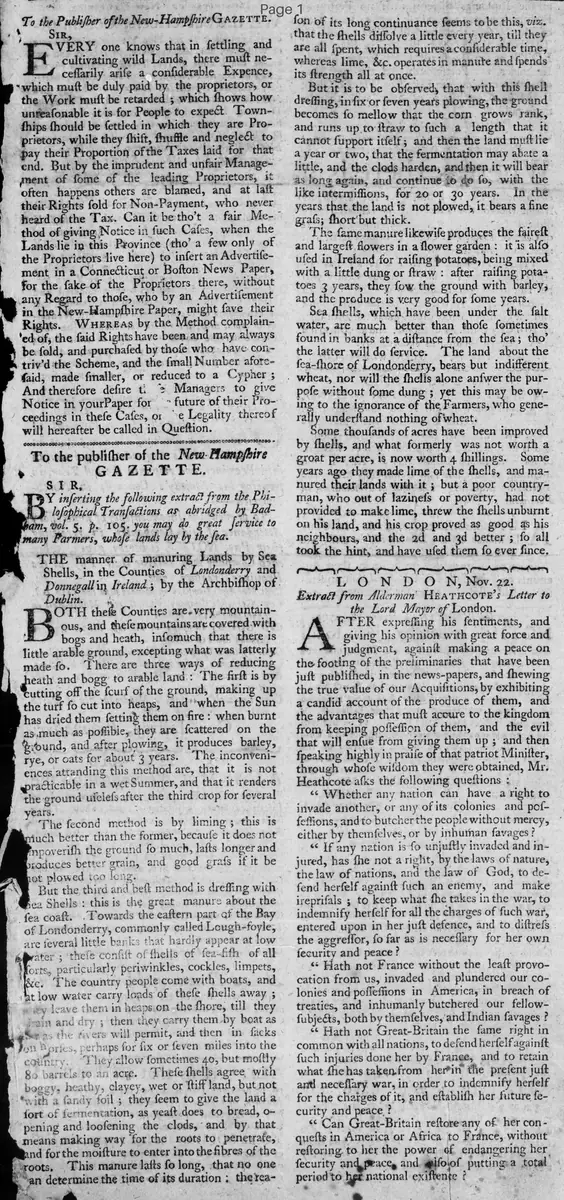
To the publisher of the New-Hampshire GAZETTE.
SIR,
By inserting the following extract from the Philosophical Transactions as abridged by Baddam, vol. 5. p. 105. you may do great service to many Farmers, whose lands lay by the sea.
THE manner of manuring Lands by Sea Shells, in the Counties of Londonderry and Donnegall in Ireland; by the Archbishop of Dublin.
BOTH these Counties are very mountainous, and these mountains are covered with bogs and heath, insomuch that there is little arable ground, excepting what was latterly made o. There are three ways of reducing heath and bog to arable land: The first is by cutting off the sward of the ground, making up the turf so cut into heaps, and when the Sun has dried them setting them on fire: when burnt as much as possible, they are scattered on the ground, and after plowing, it produces barley, rye, or oats for about 3 years. The inconveniences attending this method are, that it is not practicable in a wet Summer, and that it renders the ground useless after the third crop for several years.
The second method is by liming; this is much better than the former, because it does not impoverish the ground so much, lasts longer and produces better grain, and good grass if it be not plowed too long.
But the third and best method is dressing with Sea Shells: this is the great manure about the sea coast. Towards the eastern part of the Bay of Londonderry, commonly called Lough-Foyle, are several little banks that hardly appear at low water; these consist of shells of sea-fish of all sorts, particularly periwinkles, cockles, limpets, &c. The country people come with boats, and at low water carry loads of these shells away; they leave them in heaps on the shore, till they drain and dry; then they carry them by boat as far as the rivers will permit, and then in sacks on horse backs, perhaps for six or seven miles into the country. They allow sometimes 40, but mostly 80 barrels to an acre. These shells agree with boggy, heath, clayey, wet or stiff land, but not with a sandy soil; they seem to give the land a sort of fermentation, as yeast does to bread, opening and loosening the clods, and by that means making way for the roots to penetrate, and for the moisture to enter into the fibres of the roots. This manure lasts so long, that no one can determine the time of its duration: the reason of its long continuance seems to be this, viz. that the shells dissolve a little every year, till they are all spent, which requires a considerable time, whereas lime, &c. operates in manure and spends its strength all at once.
But it is to be observed, that with this shell dressing, in six or seven years plowing, the ground becomes so mellow that the corn grows rank, and runs up to straw to such a length that it cannot support itself; and then the land must lie a year or two, that the fermentation may abate a little, and the clods harden, and then it will bear as long again, and continue so to do so, with the like intermissions, for 20 or 30 years. In the years that the land is not plowed, it bears a fine grass; short but thick.
The same manure likewise produces the fairest and largest flowers in a flower garden: it is also used in Ireland for raising potatoes, being mixed with a little dung or straw: after raising potatoes 3 years, they sow the ground with barley, and the produce is very good for some years.
Sea shells, which have been under the salt water, are much better than those sometimes found in banks at a distance from the sea; tho' the latter will do service. The land about the Sea-shore of Londonderry, bears but indifferent wheat, nor will the shells alone answer the purpose without some dung; yet this may be owing to the ignorance of the Farmers, who generally understand nothing of wheat.
Some thousands of acres have been improved by shells, and what formerly was not worth a groat per acre, is now worth 4 shillings. Some years ago they made lime of the shells, and manured their lands with it; but a poor countryman, who out of laziness or poverty, had not provided to make lime, threw the shells unburnt on his land, and his crop proved as good as his neighbours, and the 2d and 3d better; so all took the hint, and have used them so ever since.
SIR,
By inserting the following extract from the Philosophical Transactions as abridged by Baddam, vol. 5. p. 105. you may do great service to many Farmers, whose lands lay by the sea.
THE manner of manuring Lands by Sea Shells, in the Counties of Londonderry and Donnegall in Ireland; by the Archbishop of Dublin.
BOTH these Counties are very mountainous, and these mountains are covered with bogs and heath, insomuch that there is little arable ground, excepting what was latterly made o. There are three ways of reducing heath and bog to arable land: The first is by cutting off the sward of the ground, making up the turf so cut into heaps, and when the Sun has dried them setting them on fire: when burnt as much as possible, they are scattered on the ground, and after plowing, it produces barley, rye, or oats for about 3 years. The inconveniences attending this method are, that it is not practicable in a wet Summer, and that it renders the ground useless after the third crop for several years.
The second method is by liming; this is much better than the former, because it does not impoverish the ground so much, lasts longer and produces better grain, and good grass if it be not plowed too long.
But the third and best method is dressing with Sea Shells: this is the great manure about the sea coast. Towards the eastern part of the Bay of Londonderry, commonly called Lough-Foyle, are several little banks that hardly appear at low water; these consist of shells of sea-fish of all sorts, particularly periwinkles, cockles, limpets, &c. The country people come with boats, and at low water carry loads of these shells away; they leave them in heaps on the shore, till they drain and dry; then they carry them by boat as far as the rivers will permit, and then in sacks on horse backs, perhaps for six or seven miles into the country. They allow sometimes 40, but mostly 80 barrels to an acre. These shells agree with boggy, heath, clayey, wet or stiff land, but not with a sandy soil; they seem to give the land a sort of fermentation, as yeast does to bread, opening and loosening the clods, and by that means making way for the roots to penetrate, and for the moisture to enter into the fibres of the roots. This manure lasts so long, that no one can determine the time of its duration: the reason of its long continuance seems to be this, viz. that the shells dissolve a little every year, till they are all spent, which requires a considerable time, whereas lime, &c. operates in manure and spends its strength all at once.
But it is to be observed, that with this shell dressing, in six or seven years plowing, the ground becomes so mellow that the corn grows rank, and runs up to straw to such a length that it cannot support itself; and then the land must lie a year or two, that the fermentation may abate a little, and the clods harden, and then it will bear as long again, and continue so to do so, with the like intermissions, for 20 or 30 years. In the years that the land is not plowed, it bears a fine grass; short but thick.
The same manure likewise produces the fairest and largest flowers in a flower garden: it is also used in Ireland for raising potatoes, being mixed with a little dung or straw: after raising potatoes 3 years, they sow the ground with barley, and the produce is very good for some years.
Sea shells, which have been under the salt water, are much better than those sometimes found in banks at a distance from the sea; tho' the latter will do service. The land about the Sea-shore of Londonderry, bears but indifferent wheat, nor will the shells alone answer the purpose without some dung; yet this may be owing to the ignorance of the Farmers, who generally understand nothing of wheat.
Some thousands of acres have been improved by shells, and what formerly was not worth a groat per acre, is now worth 4 shillings. Some years ago they made lime of the shells, and manured their lands with it; but a poor countryman, who out of laziness or poverty, had not provided to make lime, threw the shells unburnt on his land, and his crop proved as good as his neighbours, and the 2d and 3d better; so all took the hint, and have used them so ever since.
What sub-type of article is it?
Informative
Historical
What themes does it cover?
Agriculture
What keywords are associated?
Sea Shells
Manure
Farming
Ireland
Arable Land
Bog
Heath
Londonderry
Donnegall
What entities or persons were involved?
To The Publisher Of The New Hampshire Gazette.
Letter to Editor Details
Recipient
To The Publisher Of The New Hampshire Gazette.
Main Argument
inserting an extract from philosophical transactions on manuring lands with sea shells will benefit farmers with seaside lands by describing effective methods to improve boggy and heath soils in ireland.
Notable Details
Extract From Philosophical Transactions As Abridged By Baddam, Vol. 5. P. 105.
By The Archbishop Of Dublin.
Three Methods Of Reducing Heath And Bog To Arable Land: Burning Turf, Liming, And Sea Shells.
Sea Shells Provide Long Lasting Manure, Improving Thousands Of Acres In Londonderry And Donnegall.