Thank you for visiting SNEWPapers!
Sign up free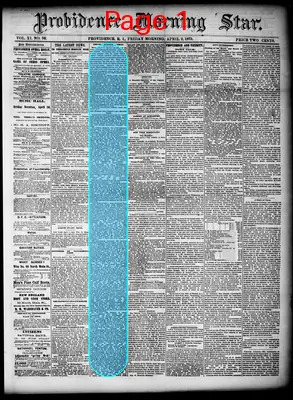
Providence Morning Star
Providence, Providence County, Rhode Island
What is this article about?
Detailed report of the Tilton-Beecher adultery trial session in Brooklyn on April 1, 1875, focusing on Henry Ward Beecher's arrival, swearing-in, and initial testimony about his life, career, marriage, and acquaintance with the Tiltons since 1850.
Clipping

OCR Quality
Full Text
BROOKLYN, N. Y., April 1.—As early as ten o'clock this morning the Brooklyn court room was crowded. The leading men of Plymouth Church occupied what are called "Beecher chairs." Deacon Caldwell acted as a kind of usher, and received a respectable portion of the audience as they arrived. Mrs. Field was in her usual place, and with her six lady friends; but neither Mrs. Tilton nor Bessie Turner were in the court room.
Beecher's sons and his sisters, Miss Catherine Beecher and Mrs. Perkins, were in the court room since ten o'clock. There were altogether nearly fifteen ladies in the court room, by far the largest number since the trial commenced.
At ten minutes to eleven a loud rap on the bench announced the Judge's arrival, and the roar of conversation and wrangling for chairs and stools was hushed. The Judge surveyed the court to ascertain whether his mandate forbidding standing room had been carried out by the officers.
Not only the court but the adjoining room, called the chambers and which connects with the court by a side door, were literally packed full, so full that Messrs. Evarts and Porter and some of the jurors, who arrived so unusually early as ten minutes before eleven, could with difficulty make their way to their places.
Precisely at 11 o'clock Mr. Beecher walked slowly in by the front door. After him walked Mrs. Beecher, Theo. O. C. Bullard, his brother in law, and then three lady friends. Mr. Beecher looked just as he does every day, no way excited. A rosy face and smile and nod to his acquaintances as he slowly made his way through the seated crowd.
A buzz of conversation instantly arose and lasted until [garbled: She Witness Colca the Witness Choir.]
Immediately behind Beecher and his friends came Tilton and his counsel, Mr. Beach. In the crush Beach and Beecher were brought face to face and they bowed and shook hands. The jury answered to their names at 12 minutes past 11. Mr. Fullerton then addressed the court and said he wished to recall James Redpath, and that witness accordingly resumed the chair.
The witness, Redpath, was cross-examined. His testimony concluded at 12 minutes to 12 o'clock. Then there was an earnest whispered consultation between defendant's counsel, and after a few moments, Mr. Evarts stood up and said, "Mr. Beecher, will you be sworn?"
The Clerk was in the act of administering the oath in the usual form, Mr. Beecher standing with uplifted hand instead of holding the Bible. Mr. Beach objected unless the witness stated that he had conscientious scruples against swearing on the Bible. Mr. Beecher said he had, and then he was sworn by the "everliving God," in New England fashion.
He testified in answer to Mr. Evarts:—I was born in Litchfield, Conn., in 1813; my father, Rev. Lyman Beecher, died in 1863, aged 86; my mother died when I was 3 years old; my family moved from Litchfield when I was thirteen years old and went to Boston; my father settled in Litchfield; I was licensed to preach in 1837: I was beneficiary under care of the American Home Mission Society; I had a congregation of nineteen; was next settled in Indianapolis; was supported by my congregation; I from there came to be Pastor of Plymouth Church; I was called to it by gentlemen that purchased the property; I told them they had no authority; then they formed the church and I was called again; there were not over twenty five members; I have remained with them ever since, except during several months of the first year, when was enfeebled by erysipelas, and with this exception have not lost five Sundays;
Here the clock struck 12, and the examination had to be suspended for a few minutes.
The witness continued: I was absent abroad twice, the first in consequence of my first sickness and was away two months, the second time I went to Europe which was in June, 1863. I had been worn out with preaching and incidents of war and writing and my friends advised me to take rest preparatory to greater labor; was in Manchester, Glasgow, London and the principal cities in England. and was led into a series of discussions about public affairs in America; the number of communicants in Plymouth Church is now 2,500, and it has been over two thousand for ten years and more.
For a series of years I have conducted Wednesday lectures, Friday night meetings and social circle in the parlor of the church, but I have remitted the social meeting to the young people; I have been connected with the New York Independent as contributor, having a column of my own, furnishing it for every issue; in 1860 I became connected with the Independent, and was a contributor all the time till 1866; after that a movement was set on foot, but was dropped, I declining to take any position that would seem to put me in antagonism with the Independent. The Christian Union was originally the Churchman, and it passed into the hands of a friend of mine, and circumstances forced me to take the editorship in 1870: it had only about 1,000 bona fide paying subscribers; the Christian Union had increased to over 30,000 circulation in the first year; I had other literary labors; I have been a very large lecturer from the second year of settling here. [Here an interruption took place, and Mr. Evarts said, "I have lost your answer, Mr. Beecher," The witness: "And I have lost your question." Laughter.]
The examination continued: My vacation extended from the first of August to the middle of September; I have had a summer residence in Peekskill about fourteen years, and usually spend my vacation there, but in the last four years have gone to the White Mountains; I have been let free by a vote in 1856 to go lecturing on politics; I have been a very voluminous author; about thirty-five volumes are in my name now; the "Life of Christ" was undertaken in December, 1867, and the first volume was issued in September, 1871: the preparation of this work occupied much of my time; my "Norwood" appeared in the Ledger in 1867, and in book form in 1868: I was married in 1837, and had been engaged seven years; was 23 when married, and my wife was 23 also; was engaged when sixteen or seventeen; I have four children living, and four waiting for me; I have eight grandchildren; of late years my wife has had occasion to visit the South; since 1870 or 1871; while I was in Indianapolis my wife went to her home in Massachusetts, through sickness. and that was the only break in our living together; from an early period I realized to her my secular affairs, so that until two years ago, never drew my own salary: she had poor health, but strength of purpose that gave her the strength of ten women, and this lasted until an accident happened her; she has opened my letters for many years; in my earlier years I attempted great deal of visiting: subsequently found it impossible to receive the multitudinous calls; in general, of late, I do not visit frequently: I was cautioned against having intimacy with the families of my parishioners, but I stood up for my rights, no matter who might be jealous; there were intimacies of my family with other families in my parish; have had large personal acquaintance with men engaged in politics, and correspondences within twenty years past; leaving out vacations from 1847 to 1873, I averaged six addresses a week, including two sermons on Sundays; became acquainted with Bowen in 1847; he was a leading man in the church, and connected with the Independent.
Mr. Beecher then testified in regard to his relations with Bowen and the Independent. his early acquaintance with Mr. Tilton: his affection for the latter: in 1865 I learned that Mr. Judson said that Tilton had accused me of immorality; I told Tilton, who saw Mr. Judson, and then told me that Mr. Judson said that it was all a mistake; from 1866 to December, 1870, I frequently met Tilton at his own home and elsewhere; my connection with the Christian Union made no difference in our relations and we co-operated on the subject of woman suffrage; in the fall of 1868 and spring of 1869 my portrait was painted by Mr. Page; Mr. Tilton wanted it done and I sat a great many times; I did not see the portrait in Tilton's house; Tilton joined Plymouth Church before he was married; his wife joined in 1851; he at first connected with the Sunday school and took part in Friday evening meetings; I thought him destined to be very useful; he useful for long time; he continued until his public duties called him away: I became acquainted with Frank Moulton while sitting for my picture; knew him a little before; I found him acute, fond of paintings, a worshiper of Lowell, in short, a man I liked to talk with; that was the extent of our acquaintance up to 1870; I had known Mrs. Moulton as I know thousands of people by seeing her at church; don't remember whether I knew Mrs. Morse before her second marriage: Mrs. Tilton went to school with my daughter: I only remember there was Libbie Richards Annie Howard, my daughter and other girls at school together; don't know how old my daughter is; she was born before we went to Indianapolis; I recall Mr. Tilton's wedding as a beautiful dream; I was interested in Mr. Tilton, but remember how they came in together and my thinking them one of the fairest couples had ever seen.
I called upon them once in Oxford street and quite often after they came back to Mrs. Morse's; Mr. Tilton invited me; this was in 1850; Tilton spoke admiringly of his wife; once said to me: "There is one little woman down at my house that loves you better than you know anything about" and he said again, "In Lib you have missed a friend such as a man needs;" my personal acquaintance with Mrs. Tilton began after 1850; after my return from Europe; I gave Mrs. Tilton a Brazilian topaz; remember it because she thought it was a gift; I visited there a good deal after "Norwood was written; Mrs. Tilton praised it highly and I gave her a picture; gave presents to thirty or forty people on my return from Europe; used to call upon the Tiltons in the forenoon on my way to the office; sometimes saw Mr. Tilton; sometimes did not; took Mrs. Tilton to ride in 1870; called for that purpose again and Mrs. Tilton declined; Mr. Tilton urged her to go and she went.
What sub-type of article is it?
What themes does it cover?
What keywords are associated?
What entities or persons were involved?
Where did it happen?
Story Details
Key Persons
Location
Brooklyn Court Room, N. Y.
Event Date
April 1
Story Details
Proceedings of the Tilton-Beecher trial where the courtroom fills early; Beecher enters calmly and is sworn in; he testifies about his birth in 1813, family, career from preaching in 1837, pastorate at Plymouth Church, travels, writings, marriage in 1837, relations with Tilton family starting 1850, and interactions including gifts and visits.