Thank you for visiting SNEWPapers!
Sign up free
The Brooksville Journal
Brooksville, Hernando County, Florida
What is this article about?
The Ruhr district in northwest Germany is highlighted for its vast coal resources and industrial prowess, producing nearly as much rolled steel as the rest of Europe (except Russia and England) in 1938, amid international discussions on the area.
Clipping
OCR Quality
Full Text
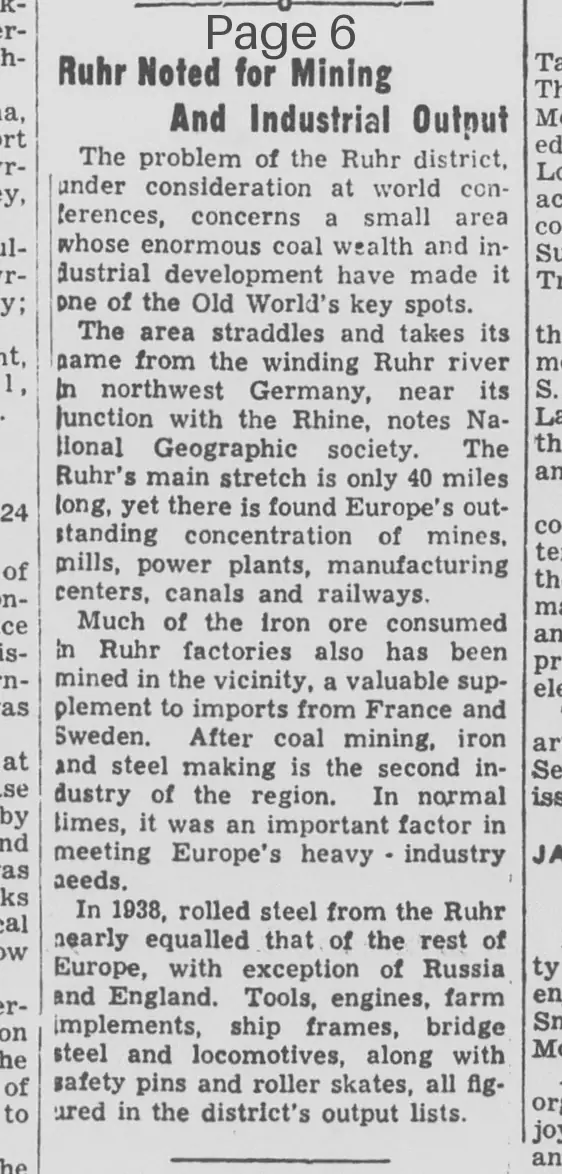
The problem of the Ruhr district, under consideration at world conferences, concerns a small area whose enormous coal wealth and industrial development have made it one of the Old World's key spots.
The area straddles and takes its name from the winding Ruhr river in northwest Germany, near its junction with the Rhine, notes National Geographic Society.
The Ruhr's main stretch is only 40 miles long, yet there is found Europe's outstanding concentration of mines, mills, power plants, manufacturing centers, canals and railways.
Much of the iron ore consumed in Ruhr factories also has been mined in the vicinity, a valuable supplement to imports from France and Sweden. After coal mining, iron and steel making is the second industry of the region. In normal times, it was an important factor in meeting Europe's heavy industry needs.
In 1938, rolled steel from the Ruhr nearly equalled that of the rest of Europe, with exception of Russia and England. Tools, engines, farm implements, ship frames, bridge steel and locomotives, along with safety pins and roller skates, all figured in the district's output lists.
What sub-type of article is it?
What keywords are associated?
Where did it happen?
Foreign News Details
Primary Location
Ruhr District, Northwest Germany
Event Date
1938
Event Details
The Ruhr district, under consideration at world conferences, is a small area with enormous coal wealth and industrial development, straddling the Ruhr river near the Rhine. Spanning 40 miles, it hosts Europe's top concentration of mines, mills, power plants, manufacturing centers, canals, and railways. Local iron ore supplements imports from France and Sweden; coal mining and iron/steel production are primary industries, meeting Europe's heavy needs. In 1938, its rolled steel output nearly matched the rest of Europe except Russia and England, including tools, engines, farm implements, ship frames, bridge steel, locomotives, safety pins, and roller skates.