Thank you for visiting SNEWPapers!
Sign up free
Story
September 1, 1903
The Salt Lake Herald
Salt Lake City, Salt Lake County, Utah
What is this article about?
Turkish diplomat Chekib Bey, envoy to the US, denies international fallout from a mistaken report of Vice Consul Magelssen's assassination, critiques missionary political interference in Turkey, and compares Turkish massacres to US lynchings as uncontrollable local outrages. (214 characters)
Clipping
OCR Quality
98%
Excellent
Full Text
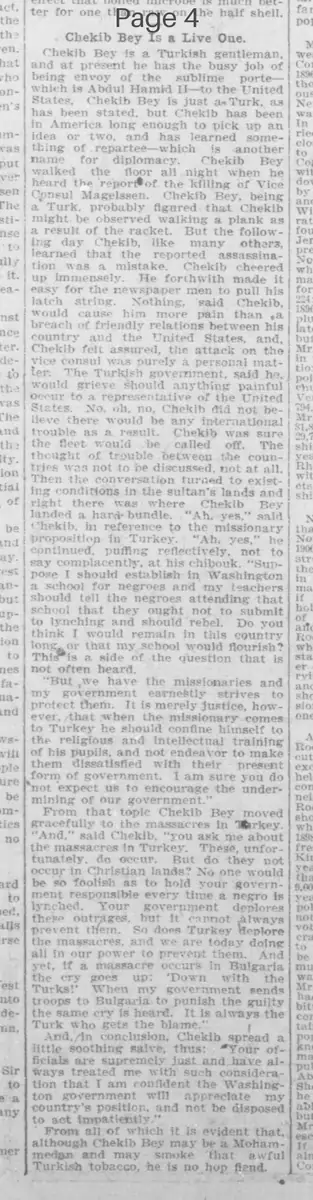
Chekib Bey Is a Live One.
Chekib Bey is a Turkish gentleman, and at present he has the busy job of being envoy of the sublime porte—which is Abdul Hamid II—to the United States. Chekib Bey is just a Turk, as has been stated, but Chekib has been in America long enough to pick up an idea or two, and has learned something of repartee which is another name for diplomacy.
Chekib Bey walked the floor all night when he heard the report of the killing of Vice Consul Magelssen. Chekib Bey, being a Turk, probably figured that Chekib might be observed walking a plank as a result of the racket. But the following day Chekib, like many others, learned that the reported assassination was a mistake. Chekib cheered up immensely. He forthwith made it easy for the newspaper men to pull his latch string. Nothing, said Chekib, would cause him more pain than a breach of friendly relations between his country and the United States, and, Chekib felt assured, the attack on the vice consul was purely a personal matter. The Turkish government, said he, would grieve should anything painful occur to a representative of the United States. No, oh, no. Chekib did not believe there would be any international trouble as a result. Chekib was sure the fleet would be called off. The thought of trouble between the countries was not to be discussed, not at all.
Then the conversation turned to existing conditions in the sultan's lands and right there was where Chekib Bey landed a hard bundle. "Ah, yes," said Chekib, in reference to the missionary proposition in Turkey. "Ah, yes," he continued, puffing reflectively, not to say complacently, at his chibouk. "Suppose I should establish in Washington a school for negroes and my teachers should tell the negroes attending that school that they ought not to submit to lynching and should rebel. Do you think I would remain in this country long, or that my school would flourish?
This is a side of the question that is not often heard. But we have the missionaries and my government earnestly strives to protect them. It is merely justice, however, that when the missionary comes to Turkey he should confine himself to the religious and intellectual training of his pupils, and not endeavor to make them dissatisfied with their present form of government. I am sure you do not expect us to encourage the undermining of our government."
From that topic Chekib Bey moved gracefully to the massacres in Turkey. "And," said Chekib, "you ask me about the massacres in Turkey. These, unfortunately, do occur. But do they not occur in Christian lands? No one would be so foolish as to hold your government responsible every time a negro is lynched. Your government deplores these outrages, but it cannot always prevent them. So does Turkey deplore the massacres, and we are today doing all in our power to prevent them. And yet, if a massacre occurs in Bulgaria the cry goes up: Down with the Turks!'
When my government sends troops to Bulgaria to punish the guilty the same cry is heard. It is always the Turk who gets the blame.
And, in conclusion, Chekib spread a little soothing salve, thus: Your officials are supremely just and have always treated me with such consideration that I am confident the Washington government will appreciate my country's position, and not be disposed to act impatiently."
From all of which it is evident that, although Chekib Bey may be a Mohammedan and may smoke that awful Turkish tobacco, he is no hop fiend.
Chekib Bey is a Turkish gentleman, and at present he has the busy job of being envoy of the sublime porte—which is Abdul Hamid II—to the United States. Chekib Bey is just a Turk, as has been stated, but Chekib has been in America long enough to pick up an idea or two, and has learned something of repartee which is another name for diplomacy.
Chekib Bey walked the floor all night when he heard the report of the killing of Vice Consul Magelssen. Chekib Bey, being a Turk, probably figured that Chekib might be observed walking a plank as a result of the racket. But the following day Chekib, like many others, learned that the reported assassination was a mistake. Chekib cheered up immensely. He forthwith made it easy for the newspaper men to pull his latch string. Nothing, said Chekib, would cause him more pain than a breach of friendly relations between his country and the United States, and, Chekib felt assured, the attack on the vice consul was purely a personal matter. The Turkish government, said he, would grieve should anything painful occur to a representative of the United States. No, oh, no. Chekib did not believe there would be any international trouble as a result. Chekib was sure the fleet would be called off. The thought of trouble between the countries was not to be discussed, not at all.
Then the conversation turned to existing conditions in the sultan's lands and right there was where Chekib Bey landed a hard bundle. "Ah, yes," said Chekib, in reference to the missionary proposition in Turkey. "Ah, yes," he continued, puffing reflectively, not to say complacently, at his chibouk. "Suppose I should establish in Washington a school for negroes and my teachers should tell the negroes attending that school that they ought not to submit to lynching and should rebel. Do you think I would remain in this country long, or that my school would flourish?
This is a side of the question that is not often heard. But we have the missionaries and my government earnestly strives to protect them. It is merely justice, however, that when the missionary comes to Turkey he should confine himself to the religious and intellectual training of his pupils, and not endeavor to make them dissatisfied with their present form of government. I am sure you do not expect us to encourage the undermining of our government."
From that topic Chekib Bey moved gracefully to the massacres in Turkey. "And," said Chekib, "you ask me about the massacres in Turkey. These, unfortunately, do occur. But do they not occur in Christian lands? No one would be so foolish as to hold your government responsible every time a negro is lynched. Your government deplores these outrages, but it cannot always prevent them. So does Turkey deplore the massacres, and we are today doing all in our power to prevent them. And yet, if a massacre occurs in Bulgaria the cry goes up: Down with the Turks!'
When my government sends troops to Bulgaria to punish the guilty the same cry is heard. It is always the Turk who gets the blame.
And, in conclusion, Chekib spread a little soothing salve, thus: Your officials are supremely just and have always treated me with such consideration that I am confident the Washington government will appreciate my country's position, and not be disposed to act impatiently."
From all of which it is evident that, although Chekib Bey may be a Mohammedan and may smoke that awful Turkish tobacco, he is no hop fiend.
What sub-type of article is it?
Biography
Historical Event
What themes does it cover?
Justice
Misfortune
Social Manners
What keywords are associated?
Turkish Envoy
Diplomatic Repartee
Missionaries Turkey
Massacres
Us Turkey Relations
Chekib Bey
What entities or persons were involved?
Chekib Bey
Abdul Hamid Ii
Vice Consul Magelssen
Where did it happen?
United States, Washington, Turkey, Bulgaria
Story Details
Key Persons
Chekib Bey
Abdul Hamid Ii
Vice Consul Magelssen
Location
United States, Washington, Turkey, Bulgaria
Story Details
Turkish envoy Chekib Bey reassures against international incident from false report of US vice consul's killing, defends limits on missionaries in Turkey, and equates Turkish massacres to lynchings in the US as regrettable local events not warranting blame on the government.