Thank you for visiting SNEWPapers!
Sign up free
Gazette Of The United States
Philadelphia, Philadelphia County, Pennsylvania
What is this article about?
Proceedings of the U.S. House of Representatives on February 22: reports read, petitions referred, resolution on publishing debates laid on table, motion to adjourn for half-hour to visit President negatived 50-38, committee of the whole debated bill authorizing loan for Washington city, reported progress, adjourned.
Clipping
OCR Quality
Full Text
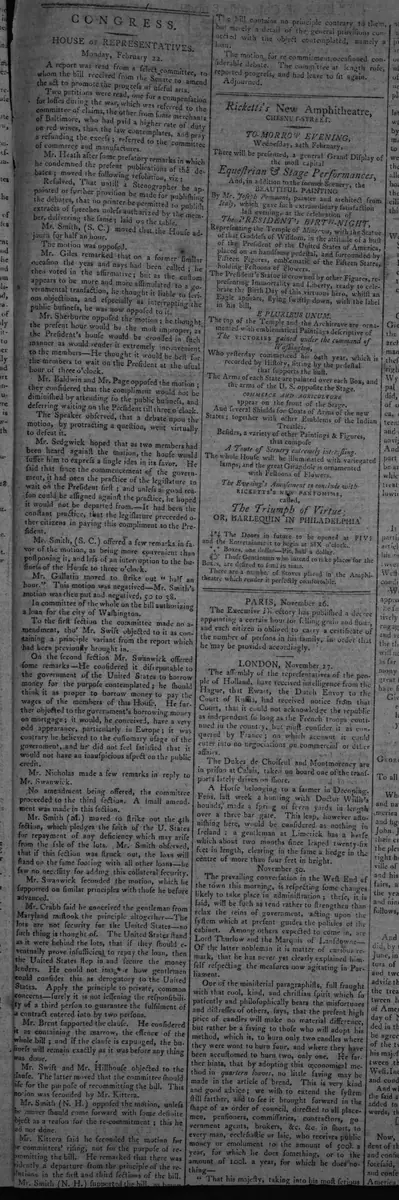
HOUSE OF REPRESENTATIVES.
Monday, February 22.
A report was read from a select committee, to whom the bill received from the Senate to amend the act to promote the progress of useful arts.
Two petitions were read, one for compensation for losses during the war, which was referred to the committee of claims, the other from some merchants of Baltimore, who had paid a higher rate of duty on red wines, than the law contemplates, and pray a refunding of the excess; referred to the committee of commerce and manufactures.
Mr. Heath after some prefatory remarks in which he condemned the present publications of the debates; moved the following resolution, viz:
Resolved, That until a Stenographer be appointed or further provision be made for publishing the debates, that no printer be permitted to publish extracts of speeches unless authorized by the member, delivering the same; laid on the table.
Mr. Smith, (S. C.) moved that the House adjourn for half an hour.
The motion was opposed.
Mr. Giles remarked that on a former similar occasion the yeas and nays had been called; he then voted in the affirmative; but as the custom appears to be more and more assimilated to a governmental transaction, he thought it liable to serious objections, and especially as interrupting the public business, he was now opposed to it.
Mr. Sherburne opposed the motion; he thought the present hour would be the most improper, as the President's house would be crowded in such manner as would render it extremely inconvenient to the members—He thought it would be best for the members to wait on the President at the usual hour of three o'clock.
Mr. Baldwin and Mr. Page opposed the motion; they considered that the compliment would not be diminished by attending to the public business, and deferring waiting on the President till three o'clock.
The Speaker observed, that a debate upon the motion, by protracting a question, went virtually to defeat it.
Mr. Sedgwick hoped that as two members had been heard against the motion, the house would suffer him to express a single idea in its favor. He said that since the commencement of the government, it had been the practice of the legislature to wait on the President first; and unless a good reason could be assigned against the practice, he hoped it would not be departed from.—It had been the constant practice, that the legislature preceded other citizens in paying this compliment to the President.
Mr. Smith, (S. C.) offered a few remarks in favor of the motion, as being more convenient than postponing it, and less of an interruption to the business of the House to three o'clock.
Mr. Gallatin moved to strike out "half an hour." This motion was negatived—Mr. Smith's motion was then put and negatived, 50 to 38.
In committee of the whole on the bill authorizing a loan for the city of Washington.
To the first section the committee made no amendment, tho' Mr. Swift objected to it as containing a principle variant from the report which had been previously brought in.
On the second section Mr. Swanwick offered some remarks—He considered it disreputable to the government of the United States to borrow money for the purpose contemplated; he should think it as proper to borrow money to pay the wages of the members of this House. He further objected to the government's borrowing money on mortgage; it would, he conceived, have a very odd appearance, particularly in Europe; it was contrary he believed to the customary usage of the government, and he did not feel satisfied that it would not have an inauspicious aspect on the public credit.
Mr. Nicholas made a few remarks in reply to Mr. Swanwick.
No amendment being offered, the committee proceeded to the third section. A small amendment was made in this section.
Mr. Smith (Md.) moved to strike out the 4th section, which pledges the faith of the U. States for repayment of any deficiency which may arise from the sale of the lots. Mr. Smith observed, that if this section was struck out, the loan will stand on the same footing with all other loans—he saw no necessity for adding this collateral security.
Mr. Swanwick seconded the motion, which he supported on similar principles with those he before advanced.
Mr. Crabb said he conceived the gentleman from Maryland mistook the principle altogether—The lots are not security for the United States—no such thing is thought of. The United States stand as it were behind the lots, that if they should eventually prove insufficient to repay the loan, then the United States step in and secure the money lenders. He could not imagine how gentlemen could consider this as derogatory to the United States. Apply the principle to private, common concerns—surely it is not lessening the responsibility of a third person to guarantee the fulfilment of a contract entered into by two persons.
Mr. Brent supported the clause. He considered it as containing the marrow, the essence of the whole bill: and if the clause is expunged, the business will remain exactly as it was before any thing was done.
Mr. Swift and Mr. Hillhouse objected to the clause. The latter moved that the committee should rise for the purpose of recommitting the bill. This motion was seconded by Mr. Kittera.
Mr. Smith (N. H.) opposed the motion, unless the mover should come forward with some definite object as a reason for the re-commitment; this he had not done.
Mr. Kittera said he seconded the motion for the committee's rising, not for the purpose of re-committing the bill. He remarked that there was evidently a departure from the principle of the report in the first and third sections of the bill.
Mr. Smith (N. H.) supported the bill, as he.
The bill contains no principle contrary to them, but merely a detail of the general provisions connected with the object contemplated, namely a loan.
The motion for re-commitment, occasioned considerable debate. The committee at length rose, reported progress, and had leave to sit again.
Adjourned.
What sub-type of article is it?
What keywords are associated?
What entities or persons were involved?
Where did it happen?
Domestic News Details
Primary Location
Washington
Event Date
Monday, February 22
Key Persons
Outcome
motion to adjourn negatived 50 to 38; committee reported progress on washington loan bill and had leave to sit again; house adjourned.
Event Details
House read report on bill to amend act for useful arts; referred petitions on war losses and wine duties; laid resolution on debate publications on table; debated and negatived motion to adjourn half-hour to visit President; in committee of whole, debated sections of bill authorizing loan for Washington city, including objections to borrowing on mortgage and pledging U.S. faith, small amendment to third section, motion to strike fourth section and to recommit debated.