Thank you for visiting SNEWPapers!
Sign up free
Story
January 26, 1871
Herald And Tribune
Jonesborough, Washington County, Tennessee
What is this article about?
The Germantown Telegraph reports farmers' growing opinion that sowing grass seeds like clover or timothy with fall wheat causes rust due to retained moisture affecting maturing stalks. It suggests sowing grass after wheat harvest yields similar results and seeks farmers' input on this important issue.
Clipping
OCR Quality
98%
Excellent
Full Text
The Cause of Rust in Wheat.
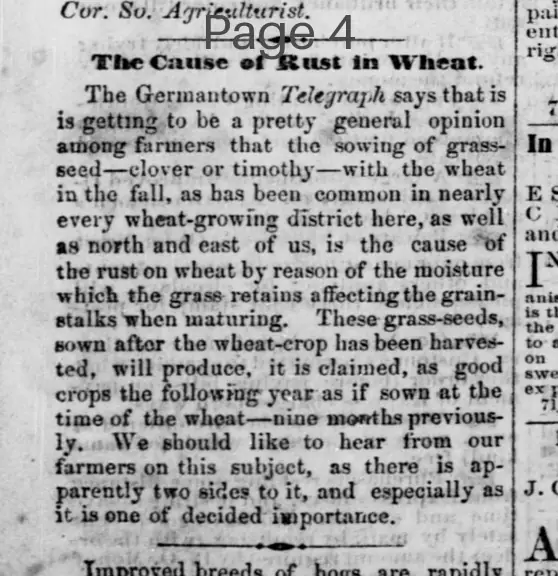
The Germantown Telegraph says that it is getting to be a pretty general opinion among farmers that the sowing of grass-seed—clover or timothy—with the wheat in the fall, as has been common in nearly every wheat-growing district here, as well as north and east of us, is the cause of the rust on wheat by reason of the moisture which the grass retains affecting the grain-stalks when maturing. These grass-seeds, sown after the wheat-crop has been harvested, will produce, it is claimed, as good crops the following year as if sown at the time of the wheat—nine months previously. We should like to hear from our farmers on this subject, as there is apparently two sides to it, and especially as it is one of decided importance.
The Germantown Telegraph says that it is getting to be a pretty general opinion among farmers that the sowing of grass-seed—clover or timothy—with the wheat in the fall, as has been common in nearly every wheat-growing district here, as well as north and east of us, is the cause of the rust on wheat by reason of the moisture which the grass retains affecting the grain-stalks when maturing. These grass-seeds, sown after the wheat-crop has been harvested, will produce, it is claimed, as good crops the following year as if sown at the time of the wheat—nine months previously. We should like to hear from our farmers on this subject, as there is apparently two sides to it, and especially as it is one of decided importance.
What sub-type of article is it?
Curiosity
What themes does it cover?
Misfortune
Nature
What keywords are associated?
Wheat Rust
Grass Seed Sowing
Farming Opinion
Agricultural Practice
Where did it happen?
Wheat Growing Districts
Story Details
Location
Wheat Growing Districts
Story Details
Farmers increasingly believe that sowing grass seeds with fall wheat causes rust by retaining moisture that affects maturing stalks; alternative sowing after harvest is claimed to produce equally good crops.