Thank you for visiting SNEWPapers!
Sign up free
Editorial
January 19, 1928
Clarke Courier
Berryville, Clarke County, Virginia
What is this article about?
Editorial urges residents to buy from local merchants instead of mail-order houses or peddlers to maintain community prosperity, likening the city to a powerhouse driven by individual economic contributions.
Clipping
OCR Quality
98%
Excellent
Full Text
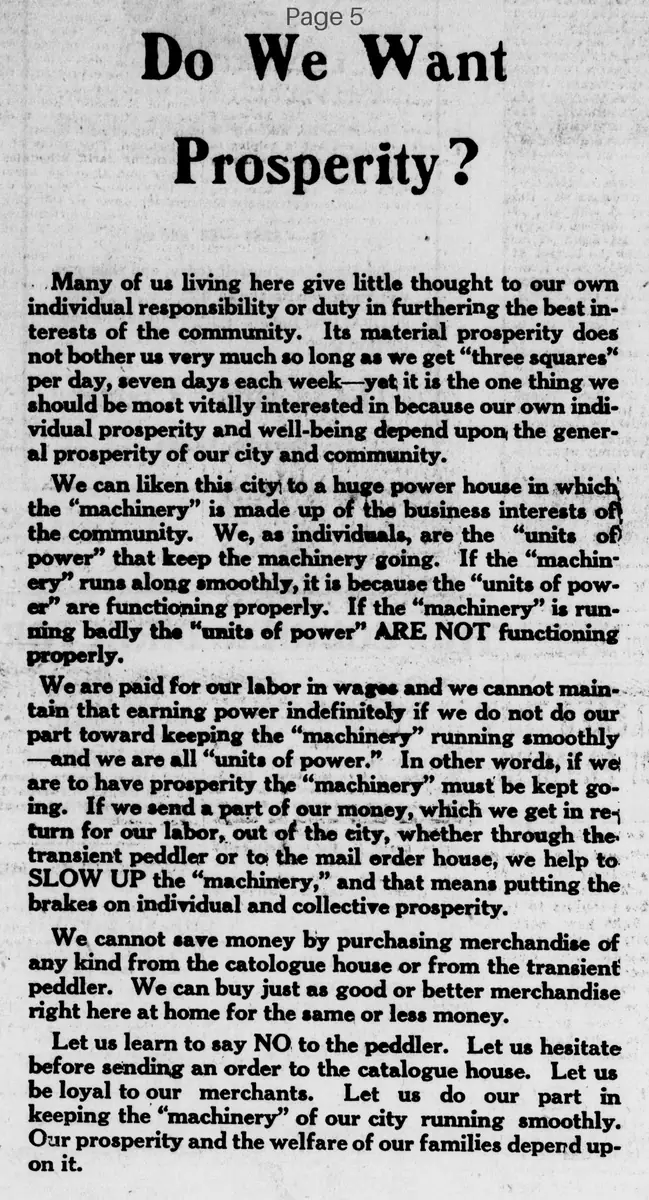
Do We Want Prosperity?
Many of us living here give little thought to our own individual responsibility or duty in furthering the best interests of the community. Its material prosperity does not bother us very much so long as we get "three squares" per day, seven days each week—yet it is the one thing we should be most vitally interested in because our own individual prosperity and well-being depend upon the general prosperity of our city and community.
We can liken this city to a huge power house in which the "machinery" is made up of the business interests of the community. We, as individuals, are the "units of power" that keep the machinery going. If the "machinery" runs along smoothly, it is because the "units of power" are functioning properly. If the "machinery" is running badly the "units of power" are not functioning properly.
We are paid for our labor in wages and we cannot maintain that earning power indefinitely if we do not do our part toward keeping the "machinery" running smoothly—and we are all "units of power." In other words, if we are to have prosperity the "machinery" must be kept going. If we send a part of our money, which we get in return for our labor, out of the city, whether through the transient peddler or to the mail order house, we help to slow up the "machinery," and that means putting the brakes on individual and collective prosperity.
We cannot save money by purchasing merchandise of any kind from the catalogue house or from the transient peddler. We can buy just as good or better merchandise right here at home for the same or less money.
Let us learn to say NO to the peddler. Let us hesitate before sending an order to the catalogue house. Let us be loyal to our merchants. Let us do our part in keeping the "machinery" of our city running smoothly.
Our prosperity and the welfare of our families depend upon it.
Many of us living here give little thought to our own individual responsibility or duty in furthering the best interests of the community. Its material prosperity does not bother us very much so long as we get "three squares" per day, seven days each week—yet it is the one thing we should be most vitally interested in because our own individual prosperity and well-being depend upon the general prosperity of our city and community.
We can liken this city to a huge power house in which the "machinery" is made up of the business interests of the community. We, as individuals, are the "units of power" that keep the machinery going. If the "machinery" runs along smoothly, it is because the "units of power" are functioning properly. If the "machinery" is running badly the "units of power" are not functioning properly.
We are paid for our labor in wages and we cannot maintain that earning power indefinitely if we do not do our part toward keeping the "machinery" running smoothly—and we are all "units of power." In other words, if we are to have prosperity the "machinery" must be kept going. If we send a part of our money, which we get in return for our labor, out of the city, whether through the transient peddler or to the mail order house, we help to slow up the "machinery," and that means putting the brakes on individual and collective prosperity.
We cannot save money by purchasing merchandise of any kind from the catalogue house or from the transient peddler. We can buy just as good or better merchandise right here at home for the same or less money.
Let us learn to say NO to the peddler. Let us hesitate before sending an order to the catalogue house. Let us be loyal to our merchants. Let us do our part in keeping the "machinery" of our city running smoothly.
Our prosperity and the welfare of our families depend upon it.
What sub-type of article is it?
Trade Or Commerce
Economic Policy
Social Reform
What keywords are associated?
Community Prosperity
Buy Local
Mail Order Opposition
Peddler Rejection
Economic Loyalty
What entities or persons were involved?
Local Merchants
Transient Peddler
Catalogue House
Editorial Details
Primary Topic
Promoting Local Buying For Community Prosperity
Stance / Tone
Exhortation To Support Local Merchants
Key Figures
Local Merchants
Transient Peddler
Catalogue House
Key Arguments
Individual Prosperity Depends On Community Prosperity
City Like A Powerhouse Where Individuals Are Units Of Power
Sending Money Out Of City Slows Economic Machinery
Better Merchandise Available Locally At Same Or Less Cost
Loyalty To Local Merchants Keeps Economy Running Smoothly