Thank you for visiting SNEWPapers!
Sign up free
Literary
July 27, 1914
The Milwaukee Leader
Milwaukee, Milwaukee County, Wisconsin
What is this article about?
In the village of Rawsonville, a plain and lame widow, Mrs. John Baker, struggles after her husband's death. The local editor fabricates a story of her inheriting $20,000 from a brother, attracting widowers. One farmer proposes after learning the truth, and they marry happily.
Clipping
OCR Quality
95%
Excellent
Full Text
A
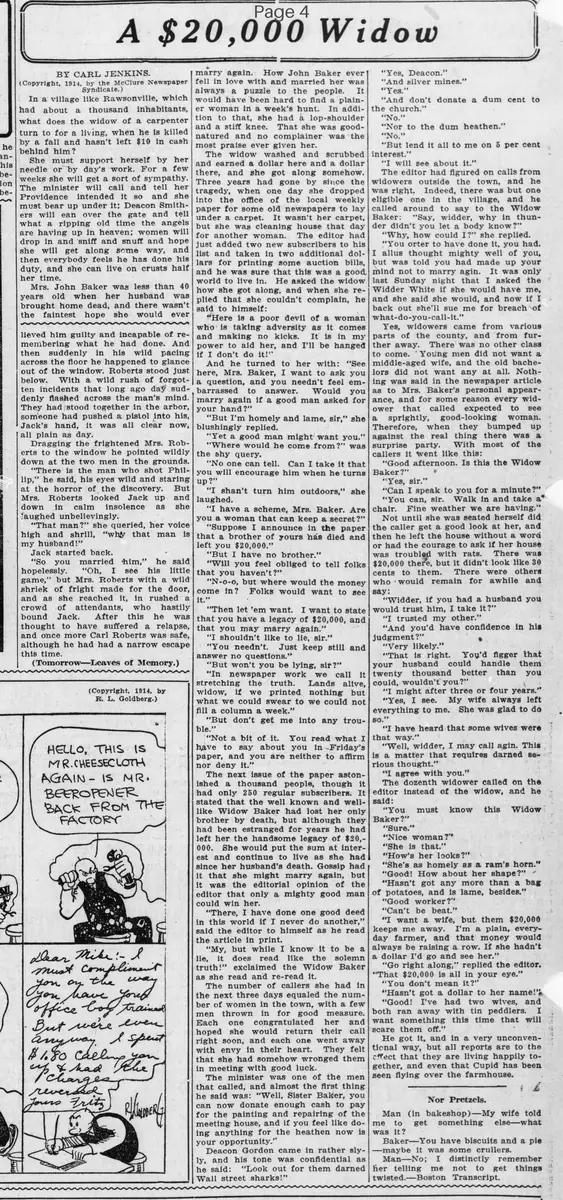
$20,000 Widow
BY CARL JENKINS.
(Copyright, 1914. by the McClure Newspaper
Syndicate.)
In a village like Rawsonville, which
had about a thousand inhabitants,
what does the widow of a carpenter
turn to for a living. when he is killed
by a fall and hasn't left $10 in cash
behind him?
She must support herself by her
needle or by day's work. For a few
weeks she will get a sort of sympathy.
The minister will call and tell her
Providence intended it so and she
must bear up under it: Deacon Smith-
ers will lean over the gate and tell
what a ripping old time the angels
are having up in heaven; women will
drop in and 'sniff and snuff and hope
she will get along some way, and
then everybody feels he has done his
duty, and she can live on crusts half
her time.
Mrs. John Baker was less than 40
years old when her husband
was
brought home dead, and there wasn't
the faintest hope she would ever
marry again. How John Baker ever
fell in love with and married her was
always a puzzle to the people.
It
would have been hard to find a plain-
er woman in a week's hunt. In addi-
tion to that, she had a lop-shoulder
and a stiff knee. That she was good-
natured and no complainer was the
most praise ever given her.
The widow washed and scrubbed
and earned a dollar here and a dollar
there, and she got along somehow.
Three years had gone by since the
tragedy. when one day she dropped
into the office of the local weekly
paper for some old newspapers to lay
under a carpet. It wasn't her carpet,
but she was cleaning house that day
for another woman. The editor had
just added two new subscribers to his
list and taken in two additional dol-
lars for printing some auction bills,
and he was sure that this was a good
world to live in. He asked the widow
how she got along, and when she re-
plied that she couldn't complain, he
said to himself:
"Here is a poor devil of a woman
who is taking adversity as it comes
and making no kicks. It is in my
power to aid her, and I'll be hanged
if I don't do it!"
And he turned to her with: "See
here, Mrs. Baker, I want to ask you
a question, and you needn't feel em-
barrassed to
answer. Would you
marry again if a good man asked for
your hand?"
"But I'm homely and lame, sir," she
blushingly replied.
"Yet a good man might want you."
"Where would he come from?"
was
the shy query.
"No one can tell. Can I take it that
you will encourage him when he turns
up?"
"I shan't turn him outdoors,"
she
laughed.
"I have a scheme, Mrs. Baker. Are
you a woman that can keep a secret?"
"Suppose I announce in the paper
that a brother of yours has died and
left you $20,000."
"But I have no brother."
"Will you feel obliged to tell folks
that you haven't?"
"N-o-o, but where would the money
come in? Folks would want to see
it."
"Then let 'em want. I want to state
that you have a legacy of $20,000, and
that you may marry again."
"I shouldn't like to lie. sir."
"You needn't. Just keep still and
answer no questions."
"But won't you be lying, sir?"
"In newspaper work we call it
stretching the truth.
Lands alive,
widow, if
we printed nothing but
what we could swear to we could not
fill a column a week."
"But don't get me into any trou-
ble."
"Not a bit of it. You read what I
have to say about you in Friday's
paper, and you are neither to affirm
nor deny it."
The next issue of the paper aston-
ished a thousand people, though it
had only 250 regular subscribers. It
stated that the well known and well-
like Widow Baker had lost her only
brother by death, but although they
had been estranged for years he had
left her the handsome legacy of $20,-
000. She would put the sum at inter-
est and continue to live as she had
since her husband's death. Gossip had
it that she might marry again, but
it was the editorial opinion of the
editor that only a mighty good man
could win her.
"There, I have done one good deed
in this world if I never do another."
said the editor to himself as he read
the article in print.
"My. but while I know it to be a
lie, it does read like the solemn
truth!" exclaimed the Widow Baker
as she read and re-read it.
The number of callers she had in
the next three days equaled the num-
ber of women in the town, with a few
men thrown in for good measure.
Each one congratulated her and
hoped she would return their call
right soon, and each one went away
with envy in their heart. They felt
that she had somehow wronged them
in meeting with good luck.
The minister was one of the men
that called, and almost the first thing
he said was: "Well, Sister Baker, you
can now donate enough cash to pay
for the painting and repairing of the
meeting house, and if you feel like do-
ing anything for the heathen now is
your opportunity."
Deacon Gordon came in rather sly-
ly, and his tone was confidential as
he said: "Look out for them darned
Wall street sharks!"
"Yes, Deacon.
"And silver mines."
"Yes."
"And don't donate a dum cent to
the church."
"No."
"Nor to the dum heathen."
"No."
"But lend it all to me on 5 per cent
interest."
"I will see about it."
The editor had figured on calls from
widowers outside the town, and he
was right. Indeed, there was but one
eligible one in the village, and he
called around to say to the Widow
Baker: "Say, widder, why in thun-
der didn't you let a body know?"
"Why. how could I?" she replied.
"You orter to have done it, you had.
I allus thought mighty well of you,
but was told you had made up your
mind not to marry agin. It was only
last Sunday night that I asked the
Widder White if she would have me,
and she said she would, and now if I
back out she'll sue me for breach of
what-do-you-call-it."
Yes, widowers came from various
parts of the county, and from fur-
ther away. There was no other class
to come. Young men did not want a
middle-aged wife, and the old bache-
lors did not want any at all. Noth-
ing was said in the newspaper article
as to Mrs. Baker's personal appear-
ance, and for some reason every wid-
ower that called expected to see
a sprightly, good-looking woman.
Therefore, when they bumped up
against the real thing there was a
surprise party.
With most of the
callers it went like this:
"Good afternoon. Is this the Widow
Baker?"
"Yes, sir."
"Can I speak to you for a minute?"
"You can, sir. Walk in and take a
chair. Fine weather we are having."
Not until she was seated herself did
the caller get a good look at her, and
then he left the house without a word
or had the courage to ask if her house
was troubled with rats. There was
$20,000 there, but it didn't look like 30
cents to them. There were others
who 'would remain for awhile and
say:
"Widder, if you had a husband you
would trust him, I take it?"
"I trusted my other."
"And you'd have confidence in his
judgment?"
"Very likely."
"That is right.
You'd figger that
your
husband
could handle them
twenty
thousand
better than you
could, wouldn't you?"
"I might after three or four years."
"Yes. I see.
My wife always left
everything to me. She was glad to do
so."
"I have heard that some wives were
that way."
"Well, widder, I may call agin. This
is a matter that requires darned se-
rious thought."
"I agree with you."
The dozenth widower called on the
editor instead of the widow, and he
said:
"You
must
know
this
Widow
Baker?"
"Sure."
"Nice woman?"
"She is that."
"How's her looks?"
"She's as homely as a ram's horn."
"Good! How about her shape?"
"Hasn't got any more than a bag
of potatoes, and is lame, besides."
"Good worker?"
"Can't be beat."
"I want a wife. but them $20.000
keeps me away. I'm a plain, every-
day farmer, and that money would
always be raising a row. If she hadn't
a dollar I'd go and see her."
"Go right along." replied the editor.
"That $20,000 is all in your eye."
"You don't mean it?"
"Hasn't got a dollar to her name!"
"Good! I've had two wives, and
both ran away with tin peddlers. I
want something this time that will
scare them off."
He got it, and in a very unconven-
tional way, but all reports are to the
effect that they are living happily to-
gether, and even that Cupid has been
seen flying over the farmhouse.
$20,000 Widow
BY CARL JENKINS.
(Copyright, 1914. by the McClure Newspaper
Syndicate.)
In a village like Rawsonville, which
had about a thousand inhabitants,
what does the widow of a carpenter
turn to for a living. when he is killed
by a fall and hasn't left $10 in cash
behind him?
She must support herself by her
needle or by day's work. For a few
weeks she will get a sort of sympathy.
The minister will call and tell her
Providence intended it so and she
must bear up under it: Deacon Smith-
ers will lean over the gate and tell
what a ripping old time the angels
are having up in heaven; women will
drop in and 'sniff and snuff and hope
she will get along some way, and
then everybody feels he has done his
duty, and she can live on crusts half
her time.
Mrs. John Baker was less than 40
years old when her husband
was
brought home dead, and there wasn't
the faintest hope she would ever
marry again. How John Baker ever
fell in love with and married her was
always a puzzle to the people.
It
would have been hard to find a plain-
er woman in a week's hunt. In addi-
tion to that, she had a lop-shoulder
and a stiff knee. That she was good-
natured and no complainer was the
most praise ever given her.
The widow washed and scrubbed
and earned a dollar here and a dollar
there, and she got along somehow.
Three years had gone by since the
tragedy. when one day she dropped
into the office of the local weekly
paper for some old newspapers to lay
under a carpet. It wasn't her carpet,
but she was cleaning house that day
for another woman. The editor had
just added two new subscribers to his
list and taken in two additional dol-
lars for printing some auction bills,
and he was sure that this was a good
world to live in. He asked the widow
how she got along, and when she re-
plied that she couldn't complain, he
said to himself:
"Here is a poor devil of a woman
who is taking adversity as it comes
and making no kicks. It is in my
power to aid her, and I'll be hanged
if I don't do it!"
And he turned to her with: "See
here, Mrs. Baker, I want to ask you
a question, and you needn't feel em-
barrassed to
answer. Would you
marry again if a good man asked for
your hand?"
"But I'm homely and lame, sir," she
blushingly replied.
"Yet a good man might want you."
"Where would he come from?"
was
the shy query.
"No one can tell. Can I take it that
you will encourage him when he turns
up?"
"I shan't turn him outdoors,"
she
laughed.
"I have a scheme, Mrs. Baker. Are
you a woman that can keep a secret?"
"Suppose I announce in the paper
that a brother of yours has died and
left you $20,000."
"But I have no brother."
"Will you feel obliged to tell folks
that you haven't?"
"N-o-o, but where would the money
come in? Folks would want to see
it."
"Then let 'em want. I want to state
that you have a legacy of $20,000, and
that you may marry again."
"I shouldn't like to lie. sir."
"You needn't. Just keep still and
answer no questions."
"But won't you be lying, sir?"
"In newspaper work we call it
stretching the truth.
Lands alive,
widow, if
we printed nothing but
what we could swear to we could not
fill a column a week."
"But don't get me into any trou-
ble."
"Not a bit of it. You read what I
have to say about you in Friday's
paper, and you are neither to affirm
nor deny it."
The next issue of the paper aston-
ished a thousand people, though it
had only 250 regular subscribers. It
stated that the well known and well-
like Widow Baker had lost her only
brother by death, but although they
had been estranged for years he had
left her the handsome legacy of $20,-
000. She would put the sum at inter-
est and continue to live as she had
since her husband's death. Gossip had
it that she might marry again, but
it was the editorial opinion of the
editor that only a mighty good man
could win her.
"There, I have done one good deed
in this world if I never do another."
said the editor to himself as he read
the article in print.
"My. but while I know it to be a
lie, it does read like the solemn
truth!" exclaimed the Widow Baker
as she read and re-read it.
The number of callers she had in
the next three days equaled the num-
ber of women in the town, with a few
men thrown in for good measure.
Each one congratulated her and
hoped she would return their call
right soon, and each one went away
with envy in their heart. They felt
that she had somehow wronged them
in meeting with good luck.
The minister was one of the men
that called, and almost the first thing
he said was: "Well, Sister Baker, you
can now donate enough cash to pay
for the painting and repairing of the
meeting house, and if you feel like do-
ing anything for the heathen now is
your opportunity."
Deacon Gordon came in rather sly-
ly, and his tone was confidential as
he said: "Look out for them darned
Wall street sharks!"
"Yes, Deacon.
"And silver mines."
"Yes."
"And don't donate a dum cent to
the church."
"No."
"Nor to the dum heathen."
"No."
"But lend it all to me on 5 per cent
interest."
"I will see about it."
The editor had figured on calls from
widowers outside the town, and he
was right. Indeed, there was but one
eligible one in the village, and he
called around to say to the Widow
Baker: "Say, widder, why in thun-
der didn't you let a body know?"
"Why. how could I?" she replied.
"You orter to have done it, you had.
I allus thought mighty well of you,
but was told you had made up your
mind not to marry agin. It was only
last Sunday night that I asked the
Widder White if she would have me,
and she said she would, and now if I
back out she'll sue me for breach of
what-do-you-call-it."
Yes, widowers came from various
parts of the county, and from fur-
ther away. There was no other class
to come. Young men did not want a
middle-aged wife, and the old bache-
lors did not want any at all. Noth-
ing was said in the newspaper article
as to Mrs. Baker's personal appear-
ance, and for some reason every wid-
ower that called expected to see
a sprightly, good-looking woman.
Therefore, when they bumped up
against the real thing there was a
surprise party.
With most of the
callers it went like this:
"Good afternoon. Is this the Widow
Baker?"
"Yes, sir."
"Can I speak to you for a minute?"
"You can, sir. Walk in and take a
chair. Fine weather we are having."
Not until she was seated herself did
the caller get a good look at her, and
then he left the house without a word
or had the courage to ask if her house
was troubled with rats. There was
$20,000 there, but it didn't look like 30
cents to them. There were others
who 'would remain for awhile and
say:
"Widder, if you had a husband you
would trust him, I take it?"
"I trusted my other."
"And you'd have confidence in his
judgment?"
"Very likely."
"That is right.
You'd figger that
your
husband
could handle them
twenty
thousand
better than you
could, wouldn't you?"
"I might after three or four years."
"Yes. I see.
My wife always left
everything to me. She was glad to do
so."
"I have heard that some wives were
that way."
"Well, widder, I may call agin. This
is a matter that requires darned se-
rious thought."
"I agree with you."
The dozenth widower called on the
editor instead of the widow, and he
said:
"You
must
know
this
Widow
Baker?"
"Sure."
"Nice woman?"
"She is that."
"How's her looks?"
"She's as homely as a ram's horn."
"Good! How about her shape?"
"Hasn't got any more than a bag
of potatoes, and is lame, besides."
"Good worker?"
"Can't be beat."
"I want a wife. but them $20.000
keeps me away. I'm a plain, every-
day farmer, and that money would
always be raising a row. If she hadn't
a dollar I'd go and see her."
"Go right along." replied the editor.
"That $20,000 is all in your eye."
"You don't mean it?"
"Hasn't got a dollar to her name!"
"Good! I've had two wives, and
both ran away with tin peddlers. I
want something this time that will
scare them off."
He got it, and in a very unconven-
tional way, but all reports are to the
effect that they are living happily to-
gether, and even that Cupid has been
seen flying over the farmhouse.
What sub-type of article is it?
Prose Fiction
Satire
What themes does it cover?
Social Manners
Love Romance
Moral Virtue
What keywords are associated?
Widow
Inheritance Hoax
Small Town
Marriage Proposals
Editor Scheme
Widowers
Deception For Good
What entities or persons were involved?
By Carl Jenkins.
Literary Details
Title
A $20,000 Widow
Author
By Carl Jenkins.
Key Lines
"Here Is A Poor Devil Of A Woman Who Is Taking Adversity As It Comes And Making No Kicks. It Is In My Power To Aid Her, And I'll Be Hanged If I Don't Do It!"
"In Newspaper Work We Call It Stretching The Truth. Lands Alive, Widow, If We Printed Nothing But What We Could Swear To We Could Not Fill A Column A Week."
"That $20,000 Is All In Your Eye." "You Don't Mean It?" "Hasn't Got A Dollar To Her Name!"
"Good! I've Had Two Wives, And Both Ran Away With Tin Peddlers. I Want Something This Time That Will Scare Them Off."