Thank you for visiting SNEWPapers!
Sign up free
Story
October 30, 1911
The Evening Times
Grand Forks, Grand Forks County, North Dakota
What is this article about?
Article on the racing judge's pivotal, impartial role at New York-area tracks, deciding ownership of huge sums instantly without appeal, surpassing court importance; details duties, safeguards, and modest pay amid high tension.
Clipping
OCR Quality
75%
Good
Full Text
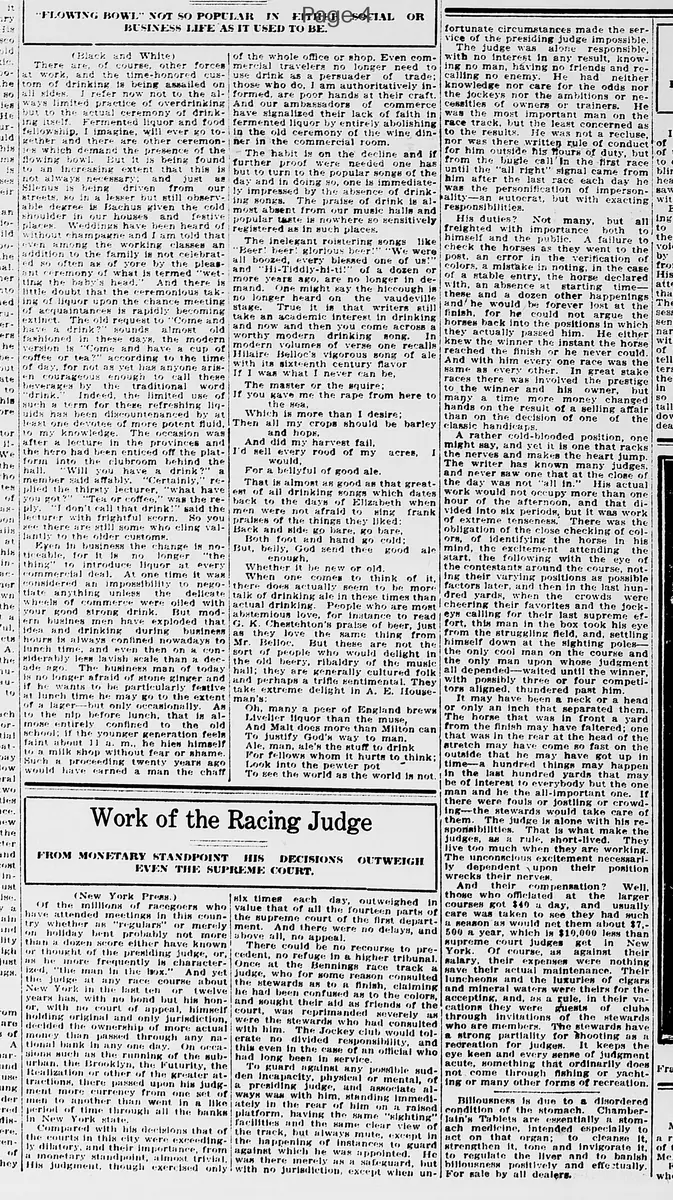
Work of the Racing Judge
FROM MONETARY STANDPOINT
HIS
DECISIONS
OUTWEIGH
EVEN THE SUPREME COURT.
By Ydrx Traax.
Of the millions of racegoers who have attended meetings in this country whether as "regulars" or merely on holiday bent probably not more than a dozen score either have known or thought of the presiding judge, or, as he more frequently is characterized, "the man in the box." And yet the judge at any race course about New York in the last ten or twelve years has, with no bond but his honor, with no court of appeal, himself holding original and only jurisdiction, decided the ownership of more actual money than passed through any national bank in any one day. On occasions such as the running of the Suburban, the Brooklyn, the Futurity, the Realization or other of the greater attractions, there passed upon his judgment more currency from one set of men to another than went in a like period of time through all the banks in New York state.
Compared with his decisions that of the courts in this city were exceedingly dilatory, and their importance, from a monetary standpoint, almost trivial. His judgment, though exercised only six times each day, outweighed in value that of all the fourteen parts of the supreme court of the first department. And there were no delays, and above all, no appeal.
There could be no recourse to precedent, no refuge in a higher tribunal. Once at the Bennings race track a judge, who for some reason consulted the stewards as to a finish, claiming he had been confused as to the colors, and sought their aid as friends of the court, was reprimanded severely as were the stewards who had consulted with him. The Jockey club would tolerate no divided responsibility, and this even in the case of an official who had long been in service.
To guard against any possible sudden incapacity, physical or mental, of a presiding judge, an associate always was with him, standing immediately in the rear of him on a raised platform, having the same sighting facilities and the same clear view of the track, but always mute, except in the happening of instances to guard against which he was appointed. He was there merely as a safeguard, but with no jurisdiction, except when unfortunate circumstances made the service of the presiding judge impossible.
The judge was alone responsible, with no interest in any result, knowing no man, having no friends and recalling no enemy. He had neither knowledge nor care for the odds nor the jockeys nor the ambitions or necessities of owners or trainers. He was the most important man on the race track, but the least concerned as to the results. He was not a recluse, nor was there written rule of conduct for him outside his hours of duty, but from the bugle call in the first race until the "all right" signal came from him after the last race each day he was the personification of impersonality - an autocrat, but with exacting responsibilities.
His duties? Not many, but all freighted with importance both to himself and the public. A failure to check the horses as they went to the post, an error in the verification of colors, a mistake in noting, in the case of a stable entry, the horse declared with, an absence at starting time - these and a dozen other happenings and he would be forever lost at the finish, for he could not argue the horses back into the positions in which they actually passed him. He either knew the winner the instant the horse reached the finish or he never could. And with him every one race was the same as every other. In great stake races there was involved the prestige to the winner and his owner, but many a time more money changed hands on the result of a selling affair than on the decision of one of the classic handicaps.
A rather cold-blooded position, one might say, and yet it is one that racks the nerves and makes the heart jump. The writer has known many judges, and never saw one that at the close of the day was not "all in." His actual work would not occupy more than one hour of the afternoon, and that divided into six periods, but it was work of extreme tenseness.
There was the obligation of the close checking of colors, of identifying the horse in his mind, the excitement attending the start, the following with the eye of the contestants around the course, noting their varying positions as possible factors later, and then in the last hundred yards, when the crowds were cheering their favorites and the jockeys calling for their last supreme effort, this man in the box took his eye from the struggling field, and, settling himself down at the sighting poles the only cool man on the course and the only man upon whose judgment all depended - waited until the winner, with possibly three or four competitors aligned, thundered past him.
It may have been a neck or a head or only an inch that separated them. The horse that was in front a yard from the finish may have faltered; one that was in the rear at the head of the stretch may have come so fast on the outside that he may have got up in time - a hundred things may happen in the last hundred yards that may be of interest to everybody but the one man and he the all-important one. If there were fouls or jostling or crowding - the stewards would take care of them. The judge is alone with his responsibilities.
That is what makes the judges, as a rule, short-lived. They live too much when they are working. The unconscious excitement necessarily dependent upon their position wrecks their nerves.
And their compensation? Well, those who officiated at the larger courses got $40 a day and usually care was taken to see they had much of a season as would net them about $7,500 a year, which is $19,000 less than supreme court judges get in New York.
Of course, as against their salary, expenses were nothing save their actual maintenance. Their luncheons and the luxuries of cigars and mineral waters were theirs for the accepting, and, as a rule, in their vacations they were guests of clubs through invitations of the stewards who are members. The stewards have a strong partiality for shooting as a recreation for judges. It keeps the eye keen and every sense of judgment acute, something that ordinarily does not come through fishing or yachting or many other forms of recreation.
FROM MONETARY STANDPOINT
HIS
DECISIONS
OUTWEIGH
EVEN THE SUPREME COURT.
By Ydrx Traax.
Of the millions of racegoers who have attended meetings in this country whether as "regulars" or merely on holiday bent probably not more than a dozen score either have known or thought of the presiding judge, or, as he more frequently is characterized, "the man in the box." And yet the judge at any race course about New York in the last ten or twelve years has, with no bond but his honor, with no court of appeal, himself holding original and only jurisdiction, decided the ownership of more actual money than passed through any national bank in any one day. On occasions such as the running of the Suburban, the Brooklyn, the Futurity, the Realization or other of the greater attractions, there passed upon his judgment more currency from one set of men to another than went in a like period of time through all the banks in New York state.
Compared with his decisions that of the courts in this city were exceedingly dilatory, and their importance, from a monetary standpoint, almost trivial. His judgment, though exercised only six times each day, outweighed in value that of all the fourteen parts of the supreme court of the first department. And there were no delays, and above all, no appeal.
There could be no recourse to precedent, no refuge in a higher tribunal. Once at the Bennings race track a judge, who for some reason consulted the stewards as to a finish, claiming he had been confused as to the colors, and sought their aid as friends of the court, was reprimanded severely as were the stewards who had consulted with him. The Jockey club would tolerate no divided responsibility, and this even in the case of an official who had long been in service.
To guard against any possible sudden incapacity, physical or mental, of a presiding judge, an associate always was with him, standing immediately in the rear of him on a raised platform, having the same sighting facilities and the same clear view of the track, but always mute, except in the happening of instances to guard against which he was appointed. He was there merely as a safeguard, but with no jurisdiction, except when unfortunate circumstances made the service of the presiding judge impossible.
The judge was alone responsible, with no interest in any result, knowing no man, having no friends and recalling no enemy. He had neither knowledge nor care for the odds nor the jockeys nor the ambitions or necessities of owners or trainers. He was the most important man on the race track, but the least concerned as to the results. He was not a recluse, nor was there written rule of conduct for him outside his hours of duty, but from the bugle call in the first race until the "all right" signal came from him after the last race each day he was the personification of impersonality - an autocrat, but with exacting responsibilities.
His duties? Not many, but all freighted with importance both to himself and the public. A failure to check the horses as they went to the post, an error in the verification of colors, a mistake in noting, in the case of a stable entry, the horse declared with, an absence at starting time - these and a dozen other happenings and he would be forever lost at the finish, for he could not argue the horses back into the positions in which they actually passed him. He either knew the winner the instant the horse reached the finish or he never could. And with him every one race was the same as every other. In great stake races there was involved the prestige to the winner and his owner, but many a time more money changed hands on the result of a selling affair than on the decision of one of the classic handicaps.
A rather cold-blooded position, one might say, and yet it is one that racks the nerves and makes the heart jump. The writer has known many judges, and never saw one that at the close of the day was not "all in." His actual work would not occupy more than one hour of the afternoon, and that divided into six periods, but it was work of extreme tenseness.
There was the obligation of the close checking of colors, of identifying the horse in his mind, the excitement attending the start, the following with the eye of the contestants around the course, noting their varying positions as possible factors later, and then in the last hundred yards, when the crowds were cheering their favorites and the jockeys calling for their last supreme effort, this man in the box took his eye from the struggling field, and, settling himself down at the sighting poles the only cool man on the course and the only man upon whose judgment all depended - waited until the winner, with possibly three or four competitors aligned, thundered past him.
It may have been a neck or a head or only an inch that separated them. The horse that was in front a yard from the finish may have faltered; one that was in the rear at the head of the stretch may have come so fast on the outside that he may have got up in time - a hundred things may happen in the last hundred yards that may be of interest to everybody but the one man and he the all-important one. If there were fouls or jostling or crowding - the stewards would take care of them. The judge is alone with his responsibilities.
That is what makes the judges, as a rule, short-lived. They live too much when they are working. The unconscious excitement necessarily dependent upon their position wrecks their nerves.
And their compensation? Well, those who officiated at the larger courses got $40 a day and usually care was taken to see they had much of a season as would net them about $7,500 a year, which is $19,000 less than supreme court judges get in New York.
Of course, as against their salary, expenses were nothing save their actual maintenance. Their luncheons and the luxuries of cigars and mineral waters were theirs for the accepting, and, as a rule, in their vacations they were guests of clubs through invitations of the stewards who are members. The stewards have a strong partiality for shooting as a recreation for judges. It keeps the eye keen and every sense of judgment acute, something that ordinarily does not come through fishing or yachting or many other forms of recreation.
What sub-type of article is it?
Curiosity
What themes does it cover?
Justice
Moral Virtue
What keywords are associated?
Racing Judge
Horse Racing
Impartial Decisions
Monetary Stakes
Official Responsibilities
Where did it happen?
Race Tracks About New York, Bennings Race Track
Story Details
Location
Race Tracks About New York, Bennings Race Track
Event Date
Last Ten Or Twelve Years
Story Details
The presiding judge at horse races holds sole authority over decisions involving vast sums of money, more than major courts, with no appeals; duties include verifying horses, colors, and determining winners under intense pressure; compensated modestly at $40 per day.