Thank you for visiting SNEWPapers!
Sign up free
Story
January 16, 1887
The Memphis Appeal
Memphis, Shelby County, Tennessee
What is this article about?
A correspondent describes the surprising economic boom in Decatur, Alabama, on January 15, highlighting the formation of the Decatur Land Improvement and Furnace Company led by E. C. Gordon, rapid real estate growth, and new industrial enterprises like iron furnaces and a tannery.
Clipping
OCR Quality
95%
Excellent
Full Text
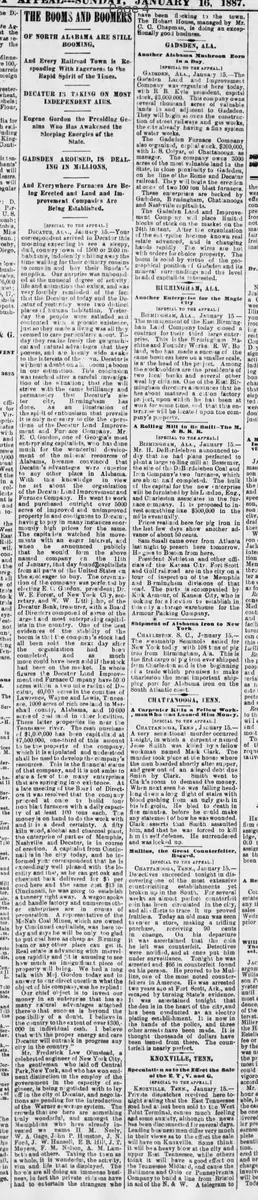
Decatur, Ala., January 15.-Your correspondent arrived in Decatur this morning expecting to see a sleepy, dull, country town of 1500 or 2000 inhabitants, indolently whiling away the time waiting for their country cousins to come in and buy their Sunday supplies. Our surprise was unbounded at the unusual degree of activity, life and animation that exists, and was very forcibly reminded of the fact that the Decatur of today and the Decatur of yesterday were two distinct places of human habitation.
Yesterday the people were satisfied and contented with a prosaic existence just so they made a living was all they seemed to care particularly about. Today they realize freshly the geographical and natural advantages that they possess, and are keenly wide awake to the interests of the town. Decatur is without doubt in a boom; a boom in our estimation. This conclusion was reached after a careful investigation of the situation; that she will strive with the same brilliancy and permanency that Decatur's sister city, Birmingham, has done.
As an illustration of the spirit of enthusiasm that prevails it is only necessary to cite the operations of the Decatur Land Improvement and Furnace Company. Mr. E. C. Gordon, one of Georgia's most enterprising capitalists, who has done much for the wonderful development of the mineral resources of Alabama, became convinced that Decatur's advantages were superior to any other place in Alabama. With this knowledge in view he set about the organization of the Decatur Land Improvement and Furnaces Company. He went to work and purchased outright over 5000 acres of improved and unimproved property in and contiguous to Decatur, having to pay in many instances enormously high prices for the same.
The capitalists watched his movements with an eager interest, and when he announced publicly that he would form the above named company on the 11th of January, that day found capitalists from all parts of the United States on the spot eager to buy. The organization of the company was perfected by electing E. C. Gordon, president; Dr. W. E. Forest, of New York City, secretary, and W. W. Littlejohn, of the Decatur Bank, treasurer, with a Board of Directors composed of some of the largest and most enterprising capitalists in the country.
One of the best evidences of the stability of the boom is that the company's stock had all been sold the next day after the organization had been completed, and $8 much more could have been sold if the stock had been on the market. In whole figures the Decatur Land Improvement and Furnace Company have 500 acres within a two mile radius of Decatur, 40,000 acres in the counties of Lawrence, Wayne and Lewis, Tenn., 1000 acres of rich ore land in Marshall county, Alabama, and 10,000 acres of coal land in other localities. These latter properties lie near the Tennessee river. The cash purchase of $1,000,000 has been capitalized at $7,500,000, one-third of this amount to be the property of the company, which it is stipulated and understood shall be used to develop the company's resources.
This is the financial status of that company, and it is not amiss to state a few of the many enterprises that are springing into existence. At a late meeting of the Board of Directors it was resolved that the company proceed at once to build four iron blast furnaces with a daily capacity of at least 100 tons each. The money is on hand to do the work with and it is a dead certainty.
A fifty kiln wood, alcohol and charcoal plant, the enterprise of parties of Memphis, Nashville and Decatur, is in course of erection. A capitalist from Cincinnati is in the city today, and he informed your correspondent that he is exceedingly well pleased with the locality and that, as he can get oak and chestnut bark delivered for $5 per cord here and the same cost $13 in Cincinnati, he was going to establish a tannery right away. A wagon spoke and handle factory and numerous other enterprises are in course of preparation.
A representative of the McNab Coal Mines, which are owned by Cincinnati capitalists, was here today and says he will be only too glad to put coal here as cheap as Birmingham or any other place can get it. Real estate is advancing with marvelous rapidity and it is amusing to see how much an insignificant piece of property will bring.
We had a long talk with Maj. Gordon today and in answer to our direct question what the object of his company was he replied: "Our chief object is to invest our money in an enterprise that has so many natural advantages attached thereto that success is beyond the possibility of a doubt. I believe in the country to this extent of over $300,000 in individual cash. I believe that with the proper energy and care Decatur will outrank in progress any city in the country."
Mr. Frederick Law Olmstead, a celebrated engineer of New York City, the gentleman who laid off Central Park, New York, and who has won eminent distinction in the employ of the government in the capacity of engineer, is being negotiated with to lay off the city of Decatur, and negotiations are pending for the introduction of the Warner sewerage system.
The crowds that are here are something truly wonderful, and amongst the Memphians who have already invested we name H. M. Neely, W. A. Gage, John P. Houston, J. N. Ford, J. W. Hansell, E. B. Hill, J. T. Myers, F. M. Nelson, A. M. Lambeth and others. Taking the town as a whole, it is wonderful, the activity, vim and life that is displayed. The hotels are all doing an immense business, in fact the private citizens have had to entertain the strangers who have been flocking to the town.
The Hobart House, managed by Mr. C. C. Chapman, is doing an exceptionally good business.
Yesterday the people were satisfied and contented with a prosaic existence just so they made a living was all they seemed to care particularly about. Today they realize freshly the geographical and natural advantages that they possess, and are keenly wide awake to the interests of the town. Decatur is without doubt in a boom; a boom in our estimation. This conclusion was reached after a careful investigation of the situation; that she will strive with the same brilliancy and permanency that Decatur's sister city, Birmingham, has done.
As an illustration of the spirit of enthusiasm that prevails it is only necessary to cite the operations of the Decatur Land Improvement and Furnace Company. Mr. E. C. Gordon, one of Georgia's most enterprising capitalists, who has done much for the wonderful development of the mineral resources of Alabama, became convinced that Decatur's advantages were superior to any other place in Alabama. With this knowledge in view he set about the organization of the Decatur Land Improvement and Furnaces Company. He went to work and purchased outright over 5000 acres of improved and unimproved property in and contiguous to Decatur, having to pay in many instances enormously high prices for the same.
The capitalists watched his movements with an eager interest, and when he announced publicly that he would form the above named company on the 11th of January, that day found capitalists from all parts of the United States on the spot eager to buy. The organization of the company was perfected by electing E. C. Gordon, president; Dr. W. E. Forest, of New York City, secretary, and W. W. Littlejohn, of the Decatur Bank, treasurer, with a Board of Directors composed of some of the largest and most enterprising capitalists in the country.
One of the best evidences of the stability of the boom is that the company's stock had all been sold the next day after the organization had been completed, and $8 much more could have been sold if the stock had been on the market. In whole figures the Decatur Land Improvement and Furnace Company have 500 acres within a two mile radius of Decatur, 40,000 acres in the counties of Lawrence, Wayne and Lewis, Tenn., 1000 acres of rich ore land in Marshall county, Alabama, and 10,000 acres of coal land in other localities. These latter properties lie near the Tennessee river. The cash purchase of $1,000,000 has been capitalized at $7,500,000, one-third of this amount to be the property of the company, which it is stipulated and understood shall be used to develop the company's resources.
This is the financial status of that company, and it is not amiss to state a few of the many enterprises that are springing into existence. At a late meeting of the Board of Directors it was resolved that the company proceed at once to build four iron blast furnaces with a daily capacity of at least 100 tons each. The money is on hand to do the work with and it is a dead certainty.
A fifty kiln wood, alcohol and charcoal plant, the enterprise of parties of Memphis, Nashville and Decatur, is in course of erection. A capitalist from Cincinnati is in the city today, and he informed your correspondent that he is exceedingly well pleased with the locality and that, as he can get oak and chestnut bark delivered for $5 per cord here and the same cost $13 in Cincinnati, he was going to establish a tannery right away. A wagon spoke and handle factory and numerous other enterprises are in course of preparation.
A representative of the McNab Coal Mines, which are owned by Cincinnati capitalists, was here today and says he will be only too glad to put coal here as cheap as Birmingham or any other place can get it. Real estate is advancing with marvelous rapidity and it is amusing to see how much an insignificant piece of property will bring.
We had a long talk with Maj. Gordon today and in answer to our direct question what the object of his company was he replied: "Our chief object is to invest our money in an enterprise that has so many natural advantages attached thereto that success is beyond the possibility of a doubt. I believe in the country to this extent of over $300,000 in individual cash. I believe that with the proper energy and care Decatur will outrank in progress any city in the country."
Mr. Frederick Law Olmstead, a celebrated engineer of New York City, the gentleman who laid off Central Park, New York, and who has won eminent distinction in the employ of the government in the capacity of engineer, is being negotiated with to lay off the city of Decatur, and negotiations are pending for the introduction of the Warner sewerage system.
The crowds that are here are something truly wonderful, and amongst the Memphians who have already invested we name H. M. Neely, W. A. Gage, John P. Houston, J. N. Ford, J. W. Hansell, E. B. Hill, J. T. Myers, F. M. Nelson, A. M. Lambeth and others. Taking the town as a whole, it is wonderful, the activity, vim and life that is displayed. The hotels are all doing an immense business, in fact the private citizens have had to entertain the strangers who have been flocking to the town.
The Hobart House, managed by Mr. C. C. Chapman, is doing an exceptionally good business.
What sub-type of article is it?
Historical Event
What themes does it cover?
Fortune Reversal
Triumph
What keywords are associated?
Decatur Boom
Land Improvement Company
Iron Furnaces
Real Estate Growth
Economic Development
Capital Investment
What entities or persons were involved?
E. C. Gordon
Dr. W. E. Forest
W. W. Littlejohn
Frederick Law Olmstead
Where did it happen?
Decatur, Ala.
Story Details
Key Persons
E. C. Gordon
Dr. W. E. Forest
W. W. Littlejohn
Frederick Law Olmstead
Location
Decatur, Ala.
Event Date
January 15
Story Details
Correspondent reports on Decatur's sudden economic boom, driven by the Decatur Land Improvement and Furnace Company's formation under E. C. Gordon, acquiring vast lands and capitalizing at $7,500,000; plans for iron furnaces, tannery, and other industries; rapid real estate growth and influx of investors.