Thank you for visiting SNEWPapers!
Sign up free
Story
February 5, 1863
Memphis Daily Appeal
Memphis, Shelby County, Tennessee
What is this article about?
Confederate editorial decrying Northern officers' betrayal of anti-abolition principles, now supporting Lincoln's emancipation agenda in the Civil War, shifting from Union preservation to racial equality fights.
Clipping
OCR Quality
95%
Excellent
Full Text
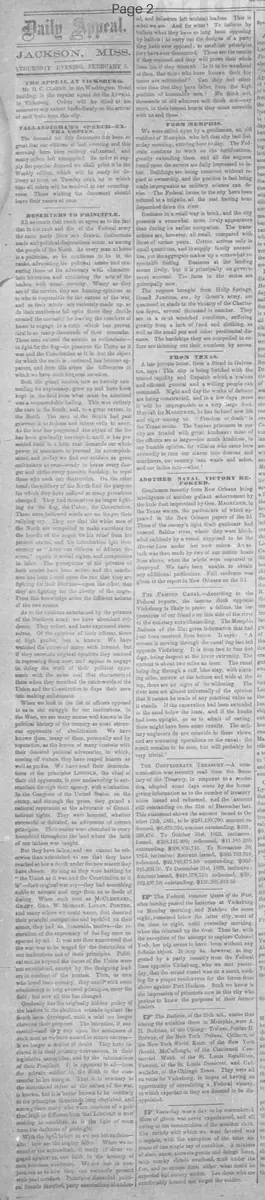
DESERTERS TO PRINCIPLE.
All accounts that reach us agree as to the fact that in the rank and file of the Federal army the same party lines are drawn, distinctions made and political disputations occur, as among the people of the North. As every man at home is a politician, so he continues to be in the ranks, advocating his political tenets and censuring those of his adversary with characteristic bitterness, and criticising the acts of the leaders with usual severity. Weary as they are of the service, they are forming opinions as to who is responsible for the causes of the war and as their minds are variously made up, so do their anathemas fall upon those they decide created the necessity for leaving the comforts of home to engage in a strife which has proven fatal to so many thousands of their comrades. These men entered the service as enthusiasts- to fight for the flag-to preserve the Union as it was and the Constitution as it is; but the object for which the strife is continued has become apparent, and from this arises the differences of which we have such frequent mention.
Both the great armies, now so fiercely contending for supremacy, grew up and have been kept in the field from what must be admitted was a commendable motive. This was entirely the case in the South, and, to a great extent, in the North. The men of the South had past grievances to redress and future evils to avert. As the war has progressed the object of the foe has been gradually developed, until it has presented itself in a form that demands our whole power of resistance to prevent its accomplishment, and to-day we find our soldiers as enthusiastic as ever—ready to brave every danger and suffer every possible hardship, to repel those who seek our destruction. On the other hand, the soldiery of the North find the purpose for which they have suffered so many privations changed. They find themselves no longer fighting for the flag, the Union, the Constitution. These once hallowed words are no longer their rallying cry. They see that the white men of the North are compelled to take sacrifices for the benefit of the black race, for his relief from his present stains, and his introduction into their country as "American citizens of African descent," equal in social rights, and competitors in labor. The perceptions of the privates of both armies have been active, and the conclusion has been forced upon the one that they are fighting for their liberties—upon the other, that they are fighting for the liberty of the negro. From this knowledge arises the different animus of the two armies.
As to the opinions entertained by the privates of the Northern army, we have abundant evidence. They reflect, and have expressed themselves. Of the opinions of their officers, those of high grades, less is known. We have watched the course of many with interest, but if they entertain original opinions they succeed in repressing them now, and appear to engage in doing the work of their political opponents with the same zeal that characterized them when they mouthed the catch-words of the Union and the Constitution to dupe their men into making enlistments.
When we look in the list of officers opposed to us in our struggle for our institutions, in the West, we see many names well known in the political history of the country as most strenuous opponents of abolitionism. We have known them, many of them, personally and by reputation, as the heroes of many contests with their detested political adversaries, in which, coming off victors, they have reaped honors as well as profits. We have read their denunciations of the principles Lincoln, the chief of their old opponents, is now endeavoring to substantiate through their agency, with admiration. In the Congress of the United States, on the stump, and through the press, they gained a national reputation as the advocates of Constitutional rights. They were honored, whether successful or defeated, as advocates of correct principles. Their names were cherished in every household throughout the land where the faith of our fathers was taught.
But they have fallen, and we cannot be otherwise than astonished to see that they have reached so low a depth under the new master they have chosen. So long as they were battling for "the Union as it was and the Constitution as it is"-their original war cry-they had something noble to actuate and urge them on to deeds of daring. When such men as McCLERNAND, GRANT, GEO. W. MORGAN, LOGAN, PORTER, and many others we could name, first deserted their peaceful occupations and donned their armor, they had an honorable motive-the restoration of the supremacy of the flag once respected by all. It was not then announced that the war was to be waged for the destruction of our institutions and of their principles. Political hostilities beyond the cause of the Union were not entertained, except by the designing leaders in conduct of the contest. Then, as men who loved their country, they could with some consistency to long avowed principles, enter the field; but now all this has changed.
Gradually has the originally hidden policy of the leaders in the abolition crusade against the South been developed until a mist no longer obscures their purposes. The intention, if successful-and they rely upon the assistance of such men as we have named to secure success- is no longer a matter of doubt. They have declared it in their primary conventions, in their legislative assemblies, and by the fulminations of their President. It is apparent to all-from the private soldier in the ditch to the commander in his marquee. That it is contrary to the announced object at the outset of the war, is known, but it is better known to be contrary to the principles thousands long cherished, and among them many who were teachers of a political faith as different from that Lincoln is now seeking to establish, as is the light of noon from the darkness of midnight.
With the light before us we can but exclaim— alas how are the mighty fallen! When we remember the antecedents of many of those engaged against us, our faith in the honesty of men becomes weakened. We are lost in conjectures as to how they can reconcile present with past conduct. Principles discarded, political associations abandoned
ed, and followers left without leaders. This is what we see. And for what? To enforce by bullets what they have so long been opposing by ballots; to carry out the designs of a party they have ever opposed: to establish principles they have ever denounced. These are the results if they succeed, and they will prove their whole lives lies if they triumph. Is it to be wondered at then, that those who have known their history are astonished? Can they feel otherwise than that they have fallen from the high position of honorable men? We think not. Thousands of old admirers will think not-nay more, in their inmost hearts they must coincide with us and these!
All accounts that reach us agree as to the fact that in the rank and file of the Federal army the same party lines are drawn, distinctions made and political disputations occur, as among the people of the North. As every man at home is a politician, so he continues to be in the ranks, advocating his political tenets and censuring those of his adversary with characteristic bitterness, and criticising the acts of the leaders with usual severity. Weary as they are of the service, they are forming opinions as to who is responsible for the causes of the war and as their minds are variously made up, so do their anathemas fall upon those they decide created the necessity for leaving the comforts of home to engage in a strife which has proven fatal to so many thousands of their comrades. These men entered the service as enthusiasts- to fight for the flag-to preserve the Union as it was and the Constitution as it is; but the object for which the strife is continued has become apparent, and from this arises the differences of which we have such frequent mention.
Both the great armies, now so fiercely contending for supremacy, grew up and have been kept in the field from what must be admitted was a commendable motive. This was entirely the case in the South, and, to a great extent, in the North. The men of the South had past grievances to redress and future evils to avert. As the war has progressed the object of the foe has been gradually developed, until it has presented itself in a form that demands our whole power of resistance to prevent its accomplishment, and to-day we find our soldiers as enthusiastic as ever—ready to brave every danger and suffer every possible hardship, to repel those who seek our destruction. On the other hand, the soldiery of the North find the purpose for which they have suffered so many privations changed. They find themselves no longer fighting for the flag, the Union, the Constitution. These once hallowed words are no longer their rallying cry. They see that the white men of the North are compelled to take sacrifices for the benefit of the black race, for his relief from his present stains, and his introduction into their country as "American citizens of African descent," equal in social rights, and competitors in labor. The perceptions of the privates of both armies have been active, and the conclusion has been forced upon the one that they are fighting for their liberties—upon the other, that they are fighting for the liberty of the negro. From this knowledge arises the different animus of the two armies.
As to the opinions entertained by the privates of the Northern army, we have abundant evidence. They reflect, and have expressed themselves. Of the opinions of their officers, those of high grades, less is known. We have watched the course of many with interest, but if they entertain original opinions they succeed in repressing them now, and appear to engage in doing the work of their political opponents with the same zeal that characterized them when they mouthed the catch-words of the Union and the Constitution to dupe their men into making enlistments.
When we look in the list of officers opposed to us in our struggle for our institutions, in the West, we see many names well known in the political history of the country as most strenuous opponents of abolitionism. We have known them, many of them, personally and by reputation, as the heroes of many contests with their detested political adversaries, in which, coming off victors, they have reaped honors as well as profits. We have read their denunciations of the principles Lincoln, the chief of their old opponents, is now endeavoring to substantiate through their agency, with admiration. In the Congress of the United States, on the stump, and through the press, they gained a national reputation as the advocates of Constitutional rights. They were honored, whether successful or defeated, as advocates of correct principles. Their names were cherished in every household throughout the land where the faith of our fathers was taught.
But they have fallen, and we cannot be otherwise than astonished to see that they have reached so low a depth under the new master they have chosen. So long as they were battling for "the Union as it was and the Constitution as it is"-their original war cry-they had something noble to actuate and urge them on to deeds of daring. When such men as McCLERNAND, GRANT, GEO. W. MORGAN, LOGAN, PORTER, and many others we could name, first deserted their peaceful occupations and donned their armor, they had an honorable motive-the restoration of the supremacy of the flag once respected by all. It was not then announced that the war was to be waged for the destruction of our institutions and of their principles. Political hostilities beyond the cause of the Union were not entertained, except by the designing leaders in conduct of the contest. Then, as men who loved their country, they could with some consistency to long avowed principles, enter the field; but now all this has changed.
Gradually has the originally hidden policy of the leaders in the abolition crusade against the South been developed until a mist no longer obscures their purposes. The intention, if successful-and they rely upon the assistance of such men as we have named to secure success- is no longer a matter of doubt. They have declared it in their primary conventions, in their legislative assemblies, and by the fulminations of their President. It is apparent to all-from the private soldier in the ditch to the commander in his marquee. That it is contrary to the announced object at the outset of the war, is known, but it is better known to be contrary to the principles thousands long cherished, and among them many who were teachers of a political faith as different from that Lincoln is now seeking to establish, as is the light of noon from the darkness of midnight.
With the light before us we can but exclaim— alas how are the mighty fallen! When we remember the antecedents of many of those engaged against us, our faith in the honesty of men becomes weakened. We are lost in conjectures as to how they can reconcile present with past conduct. Principles discarded, political associations abandoned
ed, and followers left without leaders. This is what we see. And for what? To enforce by bullets what they have so long been opposing by ballots; to carry out the designs of a party they have ever opposed: to establish principles they have ever denounced. These are the results if they succeed, and they will prove their whole lives lies if they triumph. Is it to be wondered at then, that those who have known their history are astonished? Can they feel otherwise than that they have fallen from the high position of honorable men? We think not. Thousands of old admirers will think not-nay more, in their inmost hearts they must coincide with us and these!
What sub-type of article is it?
Historical Event
Tragedy
What themes does it cover?
Betrayal
Fortune Reversal
Tragedy
What keywords are associated?
Civil War
Northern Officers
Betrayal Principles
Abolition Crusade
Union Army
Emancipation
Political Shift
What entities or persons were involved?
Mcclernand
Grant
Geo. W. Morgan
Logan
Porter
Lincoln
Where did it happen?
In The West
Story Details
Key Persons
Mcclernand
Grant
Geo. W. Morgan
Logan
Porter
Lincoln
Location
In The West
Story Details
Confederate commentary on Northern officers' shift from opposing abolition to supporting emancipation, betraying prior principles amid evolving Civil War objectives from Union restoration to racial liberation.