Thank you for visiting SNEWPapers!
Sign up free
Editorial
June 7, 1833
Phenix Gazette
Alexandria, Virginia
What is this article about?
This editorial defends the American Colonization Society against Arthur Tappan's letter condemning it as Satanic and unworthy of Christian support. It critiques Tappan's reasons for opposition—trade in spirits, tobacco, and arms in the colony, and influence from Garrison's anti-colonization arguments—affirming the society's transparency, public esteem, and role in abolishing slavery.
Clipping
OCR Quality
95%
Excellent
Full Text
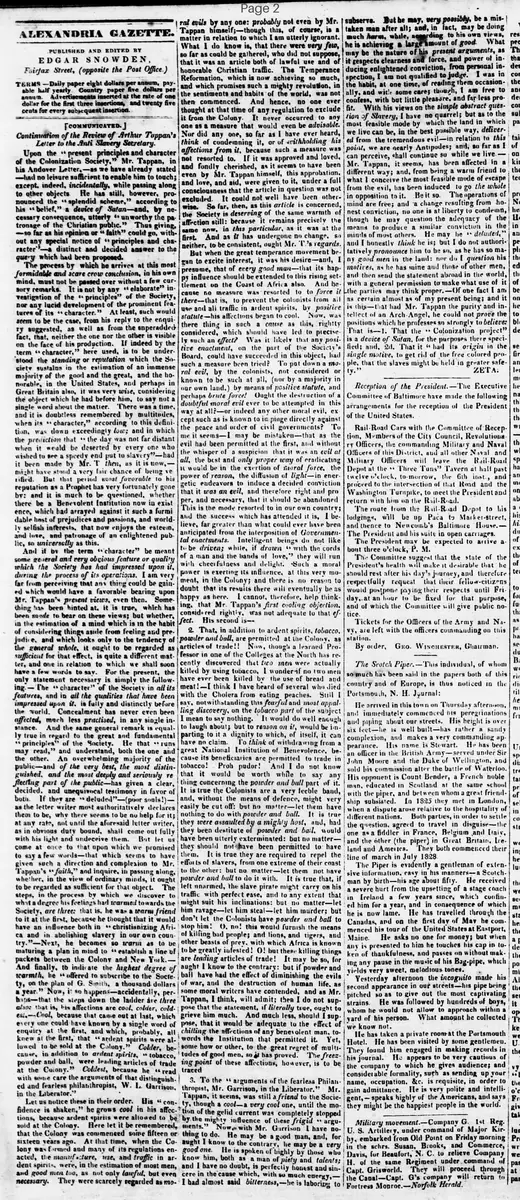
[Communicated.]
Continuation of the Review of Arthur Tappan's Letter to the Anti-Slavery Secretary.
Upon the "present principles and character of the Colonization Society." Mr. Tappan, in his Andover Letter,—as we have already stated—had no leisure sufficient to enable him to touch; except, indeed, incidentally, while passing along to other objects. He has still, however, pronounced the "splendid scheme," according to his "belief," a device of Satan—and, by necessary consequence, utterly "unworthy the patronage of the Christian public." Thus giving,—so far as his opinion or "faith" could go,—without any special notice of "principles and character"—a distinct and decided answer to the query which had been proposed.
The process by which he arrives at this most formidable and scare-crow conclusion, in his own mind, must not be passed over without a few cursory remarks. It is not by any "elaborate" investigation of the "principles" of the Society, nor any lucid development of the prominent features of its "character." At least, such would seem to be the case, from his reply to the enquiry suggested, as well as from the superadded fact, that, neither the one nor the other is visible on the face of his production. If indeed by the term "character," here used, is to be understood the standing or reputation which the Society sustains in the estimation of an immense majority of the good and the great, and the honorable, in the United States, and perhaps in Great Britain also, it was very wise, considering the object which he had before him, to say not a single word about the matter. There was a time, and it is doubtless remembered by multitudes, when its "character," according to this definition, was down exceedingly low; and in which the prediction that the day was not far distant when it would be deserted by every one who wished to see a speedy end put to slavery—had it been made by Mr. T. then, as it is now,—might have stood a very fair chance of being verified. But that period most favorable to his reputation as a Prophet has very fortunately gone by; and it is much to be questioned, whether there be a Benevolent Institution now in existence, which had arrayed against it such a formidable host of prejudices and passions, and worldly selfish interests, that now enjoys the esteem, and love, and patronage of an enlightened public, so universally as this.
And if by the term "character" be meant some general and very obvious feature or quality which the Society has had impressed upon it, during the process of its operations, I am very far from perceiving that anything could be gained which would have a favorable bearing upon Mr. Tappan's present views, even then. Something has been hinted at, it is true, which has been made to bear on these views; but whether, in the estimation of a mind which is in the habit of considering things aside from feeling and prejudice, and which looks only to the tendency of the general whole, it ought to be regarded as sufficient for that effect, is quite a different matter, and one in relation to which we shall soon have a few words to say. For the present, the only statement necessary is simply the following.—The "character" of the Society in all its features, and in all the qualities that have been impressed upon it, is fully and distinctly before the world. Concealment has never even been affected, much less practised, in any single instance. And the same general remark is equally true in regard to the great and fundamental "principles" of the Society. He that runs may read," and understand, both the one and the other. An overwhelming majority of the public—and of the very best, the most distinguished, and the most deeply and seriously reflecting part of the public—has given a clear, decided, and unequivocal testimony in favor of both. If they are "deluded"—(poor souls!)—as the letter writer most authoritatively declares them to be, why there seems to be no help for it; at any rate, not until the aforesaid letter writer, as in obvious duty bound, shall come out fully with his light and undeceive them. But let us come at once to that upon which we promised to say a few words—that which seems to have given such a direction and complexion to Mr. Tappan's "faith," and inquire, in passing along, whether, in the view of ordinary minds, it ought to be regarded as sufficient for that object. The steps, in the process by which we discover to what a degree his feelings had warmed towards the Society, are three: that is, he was a warm friend to it at the first, because he thought that it would have an influence both in "christianizing Africa and in abolishing slavery in our own country."—Next, he becomes so warm as to be maturing a plan in mind to "establish a line of packets between the Colony and New York.—And finally, to indicate the highest degree of warmth, he "offered to subscribe to the Society, on the plan of G. Smith, a thousand dollars a year." Now, it so happens—accidentally, perhaps—that the steps down the ladder are three also: that is, his affections are cool, colder, coldest.—Cool, because that came out at last, which every one could have known by a single word of enquiry at the first, and which, probably, all knew at the first, that "ardent spirits were allowed to be sold at the Colony."" Colder, because, in addition to ardent spirits, "tobacco, powder and ball, were leading articles of trade at the Colony." Coldest, because he "read with some care the arguments of that distinguished and fearless philanthropist, W. L. Garrison, in the Liberator."
Let us notice these in their order. His "confidence is shaken," he grows cool in his affections, because ardent spirits were allowed to be sold at the Colony. Here let it be remembered, that the Colony was commenced some fifteen or sixteen years ago. At that time, when the Colony was formed and many of its regulations enacted, the manufacture, use, and traffic in ardent spirits, were, in the estimation of most men, and good men too, as not only lawful, but even necessary. They were scarcely regarded as moral evils by any one: probably not even by Mr. Tappan himself;—though this, of course, is a matter in relation to which I am utterly ignorant. What I do know is, that there were very few, so far as could be gathered, who did not suppose, that it was an article both of lawful use and of honorable Christian traffic. The Temperance Reformation, which is now achieving so much, and which promises such a mighty revolution, in the sentiments and habits of the world, was not then commenced. And hence, no one ever thought at that time of any regulation to exclude it from the Colony. It never occurred to any one as a measure that would even be advisable. Nor did any one, so far as I have ever heard, think of condemning it, or of withholding his affections from it, because such a measure was not resorted to. If it was approved and loved, and fondly cherished, as it seems to have been even by Mr. Tappan himself, this approbation, and love, and aid, were given to it, under a full consciousness that the article in question was not excluded. It could not well have been otherwise. So far, then, as this article is concerned, the Society is deserving of the same warmth of affection still: because it remains precisely the same now, in this particular, as it was at the first. And as it has undergone no change, so neither, to be consistent, ought Mr. T.'s regards. But when the great temperance movement began to excite interest, it was his desire—and, I presume, that of every good man—that its happy influence should be extended to this rising settlement on the Coast of Africa also. And because no measure was resorted to to force it there—that is, to prevent the colonists from all use and all traffic in ardent spirits, by positive statute—his affections began to cool. Now, was there anything in such a cause as this, rightly considered, which should have led to precisely such an effect? Was it likely that any positive enactment, on the part of the Society's Board, could have succeeded in this object, had such a measure been tried? To put down a moral evil, by the colonists, not considered or known to be such at all, (nor by a majority in our own land,) by means of positive statute, and perhaps brute force! Ought the destruction of a doubtful moral evil ever to be attempted in this way at all?—or indeed any other moral evil, except such as is known to impinge directly against the peace and order of civil governments? To me it seems—I may be mistaken—that as the evil had been permitted at the first, and without the whisper of a suspicion that it was an evil at all, the best and only proper way of eradicating it would be in the exertion of moral force, the power of reason, the diffusion of light—in energetic endeavors to induce a decided conviction that it was an evil, and therefore right and proper, and necessary, that it should be abandoned. This is the mode resorted to in our own country; and the success which has attended it is, I believe, far greater than what could ever have been anticipated from the interposition of Governmental enactments. Intelligent beings do not like to be driven; while, if drawn "with the cords of a man and the bands of love," they will run with cheerfulness and delight. Such a moral power is exerting its influence, at this very moment, in the Colony; and there is no reason to doubt that its results there will eventually be as happy as here. I cannot, therefore, help thinking, that Mr. Tappan's first cooling objection, considered rightly, was not adequate to that effect. His second is—
2. That, in addition to ardent spirits, tobacco, powder and ball, are permitted at the Colony, as articles of trade!! Now, though a learned Professor in one of the Colleges at the North has recently discovered that two men were actually killed by using tobacco, I wonder if no two men have ever been killed by the use of bread and meat!—I think I have heard of several who died with the Cholera from eating peaches. Still I say, notwithstanding this fearful and most appalling discovery, on the tobacco part of the subject—I mean to say nothing. 'It would do well enough to laugh about; but to reason on it, would be imparting to it a dignity to which, of itself, it can have no claim. To think of withdrawing from a great National Institution of Benevolence, because its beneficiaries are permitted to trade in tobacco! Proh pudor! And I do not know that it would be worth while to say anything concerning the powder and ball part of it. It is true the Colonists are a very feeble band, and, without the means of defence, might very easily be cut off: but no matter—let them have nothing to do with powder and ball. It is true they were assailed by a mighty host, and, had they been destitute of powder and ball, would have been utterly exterminated: but no matter—they should not have been permitted to have them. It is true they are required to repel the efforts of slavers, from one extreme of their coast to the other: but no matter—let them not have powder and ball to do it with. It is true that, if left unarmed, the slave pirate might carry on his traffic with perfect ease, and to any extent that might suit his inclinations: but no matter—let him ravage—let him steal—let him murder: but don't let the Colonists have powder and ball to stop him! O, no! this would furnish the means of killing bad people; and lions, and tigers, and other beasts of prey, with which Africa is known to be greatly infested! O! but these killing things are leading articles of trade! It may be so, for aught I know to the contrary: but if powder and ball have had the effect of diminishing the evils of war, and the destruction of human life, as some moral writers have contended, and as Mr. Tappan, I think, will admit; then I do not suppose that the statement, if literally true, ought to grieve him much. And much less, should I suppose, that it would be adequate to the effect of chilling the affections of any benevolent man, towards the Institution that permitted it. Yet, somehow or other, to the great regret of multitudes of good men, so it has proved. The freezing point of these affections, however, is to be traced
3. To the "arguments of the fearless Philanthropist, Mr. Garrison, in the Liberator." Mr. Tappan, it seems, was still a friend to the Society, though a cool—a very cool one, until the motion of the gelid current was completely stopped by the mighty influence of these frigid arguments." Now, with Mr. Garrison I have nothing to do. He may be a good man, and, for aught I know to the contrary, he may be a very good one. He is spoken of highly by those who know him, both as a man of piety and talents; and I have no doubt, is perfectly honest and sincere in the cause which, with so much energy,—I had almost said bitterness,—he is laboring to subserve. But he may, very possibly, be a mistaken man after all; and, in fact, may be doing much harm, while, according to his own views, he is achieving a large amount of good. What may be the nature of his present arguments, as it respects clearness and force, and power of inducing enlightened conviction, from personal inspection, I am not qualified to judge. I was in the habit, at one time, of reading them occasionally, and with some care; though, I am free to confess, with but little pleasure, and far less profit. With his views on the simple abstract question of Slavery, I have no quarrel; but as to the most feasible mode by which the land in which we live can be, in the best possible way, delivered from the tremendous evil—in relation to this point, we are nearly Antipodes; and, so far as I can perceive, shall continue so while we live.—Mr. Tappan, it seems, has been affected in a different way; and, from being a warm friend to what I conceive the most feasible mode of escape from the evil, has been induced to go the whole in opposition to it. Be it so. The operations of mind are free: and a change resulting from honest conviction, no one is at liberty to condemn, though he may question the adequacy of the means to produce a similar conviction in the minds of most others. He may be "deluded," and I honestly think he is; but I do not authoritatively pronounce him to be so, as he has so many good men in the land: nor do I question his motives, as he has mine and those of other men, and then send the statement abroad in the world, with a general permission to make what use of it the parties may think proper.—Of one fact I am as certain almost as of my present being; and it is this—that had Mr. Tappan the purity and intellect of an Arch-Angel, he could not prove the positions which he professes so strongly to believe: That is—1. That the "Colonization project" is a device of Satan, for the purposes there specified; and, 2d. That it "had its origin in the single motive, to get rid of the free colored people, that the slaves might be held in greater safety."
ZETA.
Continuation of the Review of Arthur Tappan's Letter to the Anti-Slavery Secretary.
Upon the "present principles and character of the Colonization Society." Mr. Tappan, in his Andover Letter,—as we have already stated—had no leisure sufficient to enable him to touch; except, indeed, incidentally, while passing along to other objects. He has still, however, pronounced the "splendid scheme," according to his "belief," a device of Satan—and, by necessary consequence, utterly "unworthy the patronage of the Christian public." Thus giving,—so far as his opinion or "faith" could go,—without any special notice of "principles and character"—a distinct and decided answer to the query which had been proposed.
The process by which he arrives at this most formidable and scare-crow conclusion, in his own mind, must not be passed over without a few cursory remarks. It is not by any "elaborate" investigation of the "principles" of the Society, nor any lucid development of the prominent features of its "character." At least, such would seem to be the case, from his reply to the enquiry suggested, as well as from the superadded fact, that, neither the one nor the other is visible on the face of his production. If indeed by the term "character," here used, is to be understood the standing or reputation which the Society sustains in the estimation of an immense majority of the good and the great, and the honorable, in the United States, and perhaps in Great Britain also, it was very wise, considering the object which he had before him, to say not a single word about the matter. There was a time, and it is doubtless remembered by multitudes, when its "character," according to this definition, was down exceedingly low; and in which the prediction that the day was not far distant when it would be deserted by every one who wished to see a speedy end put to slavery—had it been made by Mr. T. then, as it is now,—might have stood a very fair chance of being verified. But that period most favorable to his reputation as a Prophet has very fortunately gone by; and it is much to be questioned, whether there be a Benevolent Institution now in existence, which had arrayed against it such a formidable host of prejudices and passions, and worldly selfish interests, that now enjoys the esteem, and love, and patronage of an enlightened public, so universally as this.
And if by the term "character" be meant some general and very obvious feature or quality which the Society has had impressed upon it, during the process of its operations, I am very far from perceiving that anything could be gained which would have a favorable bearing upon Mr. Tappan's present views, even then. Something has been hinted at, it is true, which has been made to bear on these views; but whether, in the estimation of a mind which is in the habit of considering things aside from feeling and prejudice, and which looks only to the tendency of the general whole, it ought to be regarded as sufficient for that effect, is quite a different matter, and one in relation to which we shall soon have a few words to say. For the present, the only statement necessary is simply the following.—The "character" of the Society in all its features, and in all the qualities that have been impressed upon it, is fully and distinctly before the world. Concealment has never even been affected, much less practised, in any single instance. And the same general remark is equally true in regard to the great and fundamental "principles" of the Society. He that runs may read," and understand, both the one and the other. An overwhelming majority of the public—and of the very best, the most distinguished, and the most deeply and seriously reflecting part of the public—has given a clear, decided, and unequivocal testimony in favor of both. If they are "deluded"—(poor souls!)—as the letter writer most authoritatively declares them to be, why there seems to be no help for it; at any rate, not until the aforesaid letter writer, as in obvious duty bound, shall come out fully with his light and undeceive them. But let us come at once to that upon which we promised to say a few words—that which seems to have given such a direction and complexion to Mr. Tappan's "faith," and inquire, in passing along, whether, in the view of ordinary minds, it ought to be regarded as sufficient for that object. The steps, in the process by which we discover to what a degree his feelings had warmed towards the Society, are three: that is, he was a warm friend to it at the first, because he thought that it would have an influence both in "christianizing Africa and in abolishing slavery in our own country."—Next, he becomes so warm as to be maturing a plan in mind to "establish a line of packets between the Colony and New York.—And finally, to indicate the highest degree of warmth, he "offered to subscribe to the Society, on the plan of G. Smith, a thousand dollars a year." Now, it so happens—accidentally, perhaps—that the steps down the ladder are three also: that is, his affections are cool, colder, coldest.—Cool, because that came out at last, which every one could have known by a single word of enquiry at the first, and which, probably, all knew at the first, that "ardent spirits were allowed to be sold at the Colony."" Colder, because, in addition to ardent spirits, "tobacco, powder and ball, were leading articles of trade at the Colony." Coldest, because he "read with some care the arguments of that distinguished and fearless philanthropist, W. L. Garrison, in the Liberator."
Let us notice these in their order. His "confidence is shaken," he grows cool in his affections, because ardent spirits were allowed to be sold at the Colony. Here let it be remembered, that the Colony was commenced some fifteen or sixteen years ago. At that time, when the Colony was formed and many of its regulations enacted, the manufacture, use, and traffic in ardent spirits, were, in the estimation of most men, and good men too, as not only lawful, but even necessary. They were scarcely regarded as moral evils by any one: probably not even by Mr. Tappan himself;—though this, of course, is a matter in relation to which I am utterly ignorant. What I do know is, that there were very few, so far as could be gathered, who did not suppose, that it was an article both of lawful use and of honorable Christian traffic. The Temperance Reformation, which is now achieving so much, and which promises such a mighty revolution, in the sentiments and habits of the world, was not then commenced. And hence, no one ever thought at that time of any regulation to exclude it from the Colony. It never occurred to any one as a measure that would even be advisable. Nor did any one, so far as I have ever heard, think of condemning it, or of withholding his affections from it, because such a measure was not resorted to. If it was approved and loved, and fondly cherished, as it seems to have been even by Mr. Tappan himself, this approbation, and love, and aid, were given to it, under a full consciousness that the article in question was not excluded. It could not well have been otherwise. So far, then, as this article is concerned, the Society is deserving of the same warmth of affection still: because it remains precisely the same now, in this particular, as it was at the first. And as it has undergone no change, so neither, to be consistent, ought Mr. T.'s regards. But when the great temperance movement began to excite interest, it was his desire—and, I presume, that of every good man—that its happy influence should be extended to this rising settlement on the Coast of Africa also. And because no measure was resorted to to force it there—that is, to prevent the colonists from all use and all traffic in ardent spirits, by positive statute—his affections began to cool. Now, was there anything in such a cause as this, rightly considered, which should have led to precisely such an effect? Was it likely that any positive enactment, on the part of the Society's Board, could have succeeded in this object, had such a measure been tried? To put down a moral evil, by the colonists, not considered or known to be such at all, (nor by a majority in our own land,) by means of positive statute, and perhaps brute force! Ought the destruction of a doubtful moral evil ever to be attempted in this way at all?—or indeed any other moral evil, except such as is known to impinge directly against the peace and order of civil governments? To me it seems—I may be mistaken—that as the evil had been permitted at the first, and without the whisper of a suspicion that it was an evil at all, the best and only proper way of eradicating it would be in the exertion of moral force, the power of reason, the diffusion of light—in energetic endeavors to induce a decided conviction that it was an evil, and therefore right and proper, and necessary, that it should be abandoned. This is the mode resorted to in our own country; and the success which has attended it is, I believe, far greater than what could ever have been anticipated from the interposition of Governmental enactments. Intelligent beings do not like to be driven; while, if drawn "with the cords of a man and the bands of love," they will run with cheerfulness and delight. Such a moral power is exerting its influence, at this very moment, in the Colony; and there is no reason to doubt that its results there will eventually be as happy as here. I cannot, therefore, help thinking, that Mr. Tappan's first cooling objection, considered rightly, was not adequate to that effect. His second is—
2. That, in addition to ardent spirits, tobacco, powder and ball, are permitted at the Colony, as articles of trade!! Now, though a learned Professor in one of the Colleges at the North has recently discovered that two men were actually killed by using tobacco, I wonder if no two men have ever been killed by the use of bread and meat!—I think I have heard of several who died with the Cholera from eating peaches. Still I say, notwithstanding this fearful and most appalling discovery, on the tobacco part of the subject—I mean to say nothing. 'It would do well enough to laugh about; but to reason on it, would be imparting to it a dignity to which, of itself, it can have no claim. To think of withdrawing from a great National Institution of Benevolence, because its beneficiaries are permitted to trade in tobacco! Proh pudor! And I do not know that it would be worth while to say anything concerning the powder and ball part of it. It is true the Colonists are a very feeble band, and, without the means of defence, might very easily be cut off: but no matter—let them have nothing to do with powder and ball. It is true they were assailed by a mighty host, and, had they been destitute of powder and ball, would have been utterly exterminated: but no matter—they should not have been permitted to have them. It is true they are required to repel the efforts of slavers, from one extreme of their coast to the other: but no matter—let them not have powder and ball to do it with. It is true that, if left unarmed, the slave pirate might carry on his traffic with perfect ease, and to any extent that might suit his inclinations: but no matter—let him ravage—let him steal—let him murder: but don't let the Colonists have powder and ball to stop him! O, no! this would furnish the means of killing bad people; and lions, and tigers, and other beasts of prey, with which Africa is known to be greatly infested! O! but these killing things are leading articles of trade! It may be so, for aught I know to the contrary: but if powder and ball have had the effect of diminishing the evils of war, and the destruction of human life, as some moral writers have contended, and as Mr. Tappan, I think, will admit; then I do not suppose that the statement, if literally true, ought to grieve him much. And much less, should I suppose, that it would be adequate to the effect of chilling the affections of any benevolent man, towards the Institution that permitted it. Yet, somehow or other, to the great regret of multitudes of good men, so it has proved. The freezing point of these affections, however, is to be traced
3. To the "arguments of the fearless Philanthropist, Mr. Garrison, in the Liberator." Mr. Tappan, it seems, was still a friend to the Society, though a cool—a very cool one, until the motion of the gelid current was completely stopped by the mighty influence of these frigid arguments." Now, with Mr. Garrison I have nothing to do. He may be a good man, and, for aught I know to the contrary, he may be a very good one. He is spoken of highly by those who know him, both as a man of piety and talents; and I have no doubt, is perfectly honest and sincere in the cause which, with so much energy,—I had almost said bitterness,—he is laboring to subserve. But he may, very possibly, be a mistaken man after all; and, in fact, may be doing much harm, while, according to his own views, he is achieving a large amount of good. What may be the nature of his present arguments, as it respects clearness and force, and power of inducing enlightened conviction, from personal inspection, I am not qualified to judge. I was in the habit, at one time, of reading them occasionally, and with some care; though, I am free to confess, with but little pleasure, and far less profit. With his views on the simple abstract question of Slavery, I have no quarrel; but as to the most feasible mode by which the land in which we live can be, in the best possible way, delivered from the tremendous evil—in relation to this point, we are nearly Antipodes; and, so far as I can perceive, shall continue so while we live.—Mr. Tappan, it seems, has been affected in a different way; and, from being a warm friend to what I conceive the most feasible mode of escape from the evil, has been induced to go the whole in opposition to it. Be it so. The operations of mind are free: and a change resulting from honest conviction, no one is at liberty to condemn, though he may question the adequacy of the means to produce a similar conviction in the minds of most others. He may be "deluded," and I honestly think he is; but I do not authoritatively pronounce him to be so, as he has so many good men in the land: nor do I question his motives, as he has mine and those of other men, and then send the statement abroad in the world, with a general permission to make what use of it the parties may think proper.—Of one fact I am as certain almost as of my present being; and it is this—that had Mr. Tappan the purity and intellect of an Arch-Angel, he could not prove the positions which he professes so strongly to believe: That is—1. That the "Colonization project" is a device of Satan, for the purposes there specified; and, 2d. That it "had its origin in the single motive, to get rid of the free colored people, that the slaves might be held in greater safety."
ZETA.
What sub-type of article is it?
Slavery Abolition
What keywords are associated?
Colonization Society
Arthur Tappan
William Lloyd Garrison
Slavery Abolition
African Colony
Temperance Reform
Benevolent Institution
What entities or persons were involved?
Arthur Tappan
Colonization Society
W. L. Garrison
Anti Slavery Secretary
G. Smith
Editorial Details
Primary Topic
Defense Of The Colonization Society Against Arthur Tappan's Criticisms
Stance / Tone
Supportive Of Colonization Society, Critical Of Tappan And Garrison
Key Figures
Arthur Tappan
Colonization Society
W. L. Garrison
Anti Slavery Secretary
G. Smith
Key Arguments
Tappan's View Of The Colonization Society As A Satanic Device Is Unfounded And Lacks Investigation Of Its Principles
The Society's Character And Principles Are Transparent, Publicly Supported, And Have Overcome Initial Prejudices
Tappan's Initial Support Cooled Over Allowance Of Ardent Spirits In The Colony, But This Was Standard At Founding And Best Addressed Morally, Not By Force
Permitting Trade In Tobacco, Powder, And Ball Is Practical For Colonists' Defense And Not A Moral Failing Warranting Withdrawal Of Support
Tappan's Opposition Was Influenced By Garrison's Arguments In The Liberator, Which The Author Disputes As Mistaken Despite Garrison's Sincerity
Tappan Cannot Prove The Colonization Project Originated Solely To Remove Free Blacks For Slaveholders' Benefit