Thank you for visiting SNEWPapers!
Sign up free
The Labor Journal
Everett, Snohomish County, Washington
What is this article about?
Argument by Hamilton Higday in favor of Initiative Measure No. 9, the 'First Aid' bill, amending Washington's Workmen's Compensation Act to provide employer-funded medical care for injured workers in extra-hazardous trades, promote safety, and end coercive hospital fees. Highlights legislative failure, injustices to workers, and alignment with national standards.
Merged-components note: Merged multi-column and cross-page continuation of the editorial on Initiative Measure No. 9 'First Aid' bill. Relabeled the page 4 part from domestic_news to editorial.
Clippings
1 of 2
OCR Quality
Full Text
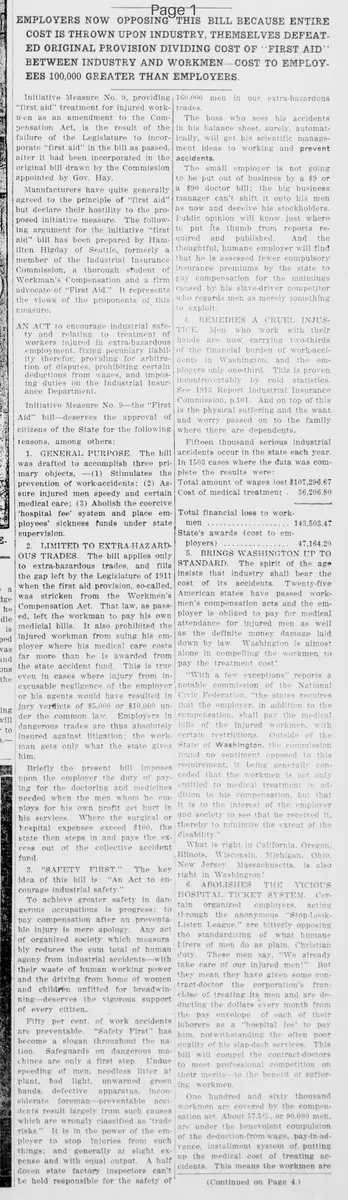
Manufacturers have quite generally agreed to the principle of "first aid" but declare their hostility to the proposed initiative measure. The following argument for the initiative "first aid" bill has been prepared by Hamilton Higday of Seattle, formerly a member of the Industrial Insurance Commission, a thorough student of Workman's Compensation and a firm advocate of "First Aid." It represents the views of the proponents of this measure.
AN ACT to encourage industrial safety and relating to treatment of workers injured in extra-hazardous employment, fixing pecuniary liability therefor, providing for arbitration of disputes, prohibiting certain deductions from wages, and imposing duties on the Industrial Insurance Department.
Initiative Measure No. 9-the "First Aid" bill-deserves the approval of citizens of the State for the following reasons, among others:
1. GENERAL PURPOSE. The bill was drafted to accomplish three primary objects: (1) Stimulates the prevention of work-accidents; (2) Assure injured men speedy and certain medical care; (3) Abolish the coercive 'hospital fee' system and place employees' sickness funds under state supervision.
2. LIMITED TO EXTRA-HAZARDOUS TRADES. The bill applies only to extra-hazardous trades, and fills the gap left by the Legislature of 1911 when the first aid provision, so-called, was stricken from the Workmen's Compensation Act. That law, as passed, left the workman to pay his own medical bills. It also prohibited the injured workman from suing his employer where his medical care costs far more than he is awarded from the state accident fund. This is true even in cases where injury from inexcusable negligence of the employer or his agents would have resulted in jury verdicts of $5,000 or $10,000 under the common law. Employers in dangerous trades are thus absolutely insured against litigation; the workman gets only what the state gives him.
Briefly the present bill imposes upon the employer the duty of paying for the doctoring and medicines needed when the men whom he employs for his own profit get hurt in his services. Where the surgical or hospital expenses exceed $100, the state then steps in and pays the excess out of the collective accident fund.
3. "SAFETY FIRST" The key idea of this bill is: "An Act to encourage industrial safety."
To achieve greater safety in dangerous occupations is progress; to pay compensation after a preventable injury is mere apology. Any act of organized society which measurably reduces the sum total of human agony from industrial accidents-with their waste of human working power and the driving from home of women and children unfitted for breadwinning-deserves the vigorous support of every citizen.
Fifty per cent of work accidents are preventable. "Safety First" has become a slogan throughout the nation. Safeguards on dangerous machines are only a first step. Undue speeding of men, needless litter at plant, bad light, unwarned green hands, defective apparatus, inconsiderate foreman-preventable accidents result largely from such causes which are wrongly classified as 'trade risks.' It is in the power of the employer to stop injuries from such things; and generally at slight expense and with equal output. A half dozen state factory inspectors can't be held responsible for the safety of 160,000 men in our extra-hazardous trades.
EMPLOYERS NOW OPPOSING THIS BILL BECAUSE ENTIRE COST IS THROWN UPON INDUSTRY. THEMSELVES DEFEATED ORIGINAL PROVISION DIVIDING COST OF 'FIRST AID' BETWEEN INDUSTRY AND WORKMEN-COST TO EMPLOYEES 100,000 GREATER THAN EMPLOYERS.
The boss who sees his accidents in his balance sheet, surely, automatically, will get his scientific management ideas to working and prevent accidents.
The small employer is not going to be put out of business by a $9 or a $90 doctor bill; the big business manager can't shift it onto his men as now and deceive his stockholders.
Public opinion will know just where to put its thumb from reports required and published. And the thoughtful, humane employer will find that he is assessed fewer compulsory Insurance premiums by the state to pay compensation for the maimings caused by his slave-driver competitor who regards men as merely something to exploit.
4. REMEDIES A CRUEL INJUSTICE. Men who work with their hands are now carrying two-thirds of the financial burden of work-accidents in Washington, and the employers only one-third. This is proven incontrovertibly by cold statistics. See 1913 Report Industrial Insurance Commission, p.101. And on top of this is the physical suffering and the want and worry passed on to the family where there are dependents.
Fifteen thousand serious industrial accidents occur in the state each year. In 1503 cases where the data was complete the results were:
Total amount of wages lost $107,296.67
Cost of medical treatment . 36,206.80
Total financial loss to workmen 143,503.47
State's awards (cost to employers) 47,164.20
5. BRINGS WASHINGTON UP TO STANDARD. The spirit of the age insists that industry shall bear the cost of its accidents. Twenty-five American states have passed workmen's compensation acts and the employer is obliged to pay for medical attendance for injured men as well as the definite money damage laid down by law. Washington is almost alone in compelling the workmen to pay the treatment cost.
"With a few exceptions" reports a notable commission of the National Civic Federation, "the states requires that the employer, in addition to the compensation, shall pay the medical bills of the injured workmen, with certain restrictions. Outside of the State of Washington, the commission found no sentiment opposed to this requirement. It being generally conceded that the workmen is not only entitled to medical treatment in addition to his compensation, but that it is to the interest of the employer and society to see that he received it, thereby to minimize the extent of the disability."
What is right in California, Oregon, Illinois, Wisconsin, Michigan, Ohio, New Jersey, Massachusetts, is also right in Washington.
6. ABOLISHES THE VICIOUS HOSPITAL TICKET SYSTEM Certain organized employers, acting through the anonymous "Stop-Look-Listen League," are bitterly opposing the standardizing of what humane hirers of men do as plain, Christian duty. These men say, "We already take care of our injured men!" But they mean they have given some contract-doctor the corporation's franchise of treating its men and are deducting the dollars every month from the pay envelope of each of their laborers as a "hospital fee" to pay him, notwithstanding the often poor quality of his slap-dash services. This bill will compel the contract-doctors to meet professional competition on their merits-to the benefit of suffering workmen.
One hundred and sixty thousand workmen are covered by the compensation act. About 57.5%, or 90,000 men, are under the benevolent compulsion of the deduction-from-wage, pay-in-advance, installment system of putting up the medical cost of treating accidents. This means the workmen are
(Continued on Page 4.)
No. 2982.
ORDER APPOINTING DAY FOR SETTLEMENT OF ACCOUNT AND TO SHOW CAUSE WHY DISTRIBUTION SHOULD NOT BE MADE.
IN THE SUPERIOR COURT OF THE STATE OF WASHINGTON, IN AND FOR SNOHOMISH COUNTY.
In the Matter of the Estate of Henry Mangis, Deceased.
Christian Christenson, the administrator of the estate of Henry Mangis, deceased, having this day rendered and presented for settlement and filed in this court, his final account of his administration of the estate of the said deceased, and now the court being duly advised in the premises, does order that Saturday, the 31st day of October, 1914, at 10 a. m. sharp, be and the same hereby is appointed the time for the settlement of the said account, and that the clerk give notice thereof by posting.
And it also appearing that the said Christian Christenson, the administrator of the above entitled estate, has also filed a verified petition praying for an order of distribution of the residue of the said estate among the persons entitled thereto, and it further appearing that the heirs at law of the said Henry Mangis, deceased, have filed a verified petition also in which they ask that at the time of the distribution there be a partition of said estate, and that the court appoint commissioners to make said partition of the said estate: and it appearing that in all respects the proceedings heretofore had in this said matter are regular and sufficient, and the court being duly advised in the premises does now order that all persons interested in the above entitled estate be and appear before the above entitled court in Everett, Washington, in Department No. 2 thereof, on Saturday, the 31st day of October, 1914, at the hour of 10:30 a. m. sharp, and after the said final account has been settled, passed and approved, and then and there show cause why an order of distribution should not be made on the report of the commissioners as to the partition of the said estate among the heirs at law of the said deceased, or otherwise, if deemed proper by the said court.
It is further ordered that a copy of this order be published once a week for four successive weeks before the said 31st day of October, 1914, in the Labor Journal, a newspaper printed and published in Snohomish county, Washington, and of general circulation therein.
Dated at Everett, Washington, Oct 1, 1914.
GUY C. ALSTON,
Judge.
Wm. Sheller, attorney for administrator, Everett, Washington.
Date of first publication, October 2, 1914.
What sub-type of article is it?
What keywords are associated?
What entities or persons were involved?
Editorial Details
Primary Topic
Support For Initiative Measure No. 9 First Aid Bill
Stance / Tone
Strongly Supportive Advocacy
Key Figures
Key Arguments