Thank you for visiting SNEWPapers!
Sign up free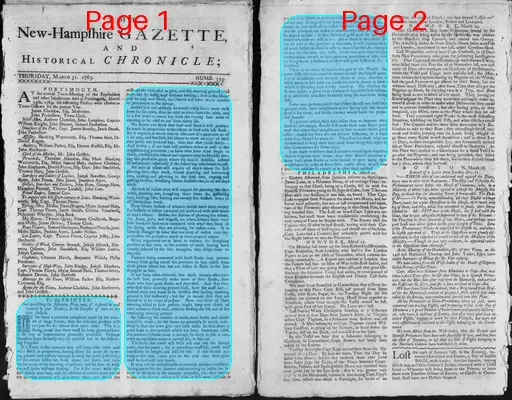
The New Hampshire Gazette And Historical Chronicle
Portsmouth, Greenland, Rockingham County, New Hampshire
What is this article about?
A letter to the printer proposes farming reforms for large farms: reduce livestock by one-third, convert some mowing land to pasture without overfeeding, and plant wheat instead of Indian corn to cut labor costs while boosting yields. This addresses complaints of low returns, recent droughts, and upcoming money scarcity in the province.
Merged-components note: This is a continuation of the letter to the printer from page 1 (reading order 2) to page 2 (reading order 3), discussing farming improvements and economic arguments; the original label of 'editorial' for the second part is incorrect as it is part of the same reader-submitted letter.
Clippings
1 of 2
OCR Quality
Full Text
Your publishing the following Piece, may, if it should be well received by your Readers, be the Occasion of more on the same Subject.
It has been a common complaint made by the owners of large Farms, that the ordinary produce will not pay for the labour done upon land. This is a strong proof that there must be some grand mistake in the way of improvement generally practised. Perhaps therefore some Remedy may be pointed out in the following Proposal.
If a Farm in the common way will keep nine cows and other stock in proportion, having thirty six acres of mowing ground and pasture enough to keep the cattle just alive ; let the owner lessen his stock about one third, and turn twelve acres of his mowing to pasture, and be sure to keep the rest entire without feeding. For if six cows with the feed which nine had, and the addition of twelve acres out of the mowing ground, will give more than two thirds the milk all the nine used to give, and the mowing ground yield more hay by being kept without feeding ; then as the labour will be only two thirds, the Owner will have more income in proportion to the labour.
Indeed it is not unlikely he would really have more milk from his six cows, than he used to have from the nine, and in a few years as much hay from the twenty four acres of mowing as he used to cut from thirty six.
No farmer can think that land over stock'd will produce so much in proportion to the labour as land with less stock : for it requires as much time to take care of a poor cow as of a fat one, and but little less labour to mow an acre of land that yields ten cocks of hay, than one that yields thirty.
And farther ; if our land will produce wheat as well as the neighbouring provinces ; as some who have tried begin to think, considerable labour and expence may be saved by sowing this profitable grain where the land is suitable, instead of indian corn : especially if the following calculation be just.
An acre of wheat will require of men's labour for first plowing two days, work, second plowing and harrowing two, sowing and plowing in the seed two, reaping and getting in two, threshing fifteen Bushels two, in all ten days work
An acre of indian corn will require for plowing two days work, planting one, houghing three times six, gathering two, husking two, beating out twenty five bushels two ; in all fifteen days work.
Now fifteen bushels of wheat is worth more than twenty five bushels of indian corn, and yet produced with two thirds of men's labour. Besides the seasons of plowing for wheat; viz. June, July, and August, are when farmers have very little work for their oxen compared with what they have in the spring while they are plowing for indian corn. It is likewise thought by some that one crop of indian corn impoverishes the ground as much as three crops of wheat.
Many arguments are at hand to enforce the foregoing practice at this time, as the number of cattle having been already reduced by the late droughts, may oblige some to the trial.
Farmers being contented with small stocks may prevent money from going out of the province to buy cattle from those places where hay has not fallen so short in the late droughts as here.
It has been often observed, that those farmers who have the best feed, generally make more of their stocks, than those who have great stocks and poor feed: And that they who feed their mowing ground least; have the most hay.
Indeed every one seems to be sensible that feeding mowing ground is bad husbandry ; but say in excuse that they are forced to it for want of pasture. Now one third of their mowing added to their pasture might keep two thirds of their common stock well, without feeding the life out of the remaining mowing ground.
By lessening the number of cattle, more butter and cheese would be made ; for the farms are generally so much over-stock'd, that the cows give very little milk. So that there is good sense in that proverb which has been sometimes used, that when an Irishman wants to increase his dairy, he sells a cow, when an Englishman wants to increase his, he buys one.
Tis likely that cattle will fetch less and less for several years after the peace ; for as provisions must fall, cattle will necessarily be bought and sold for less : if this should not happen this year ; next year or the year after their price must be lowered very much.
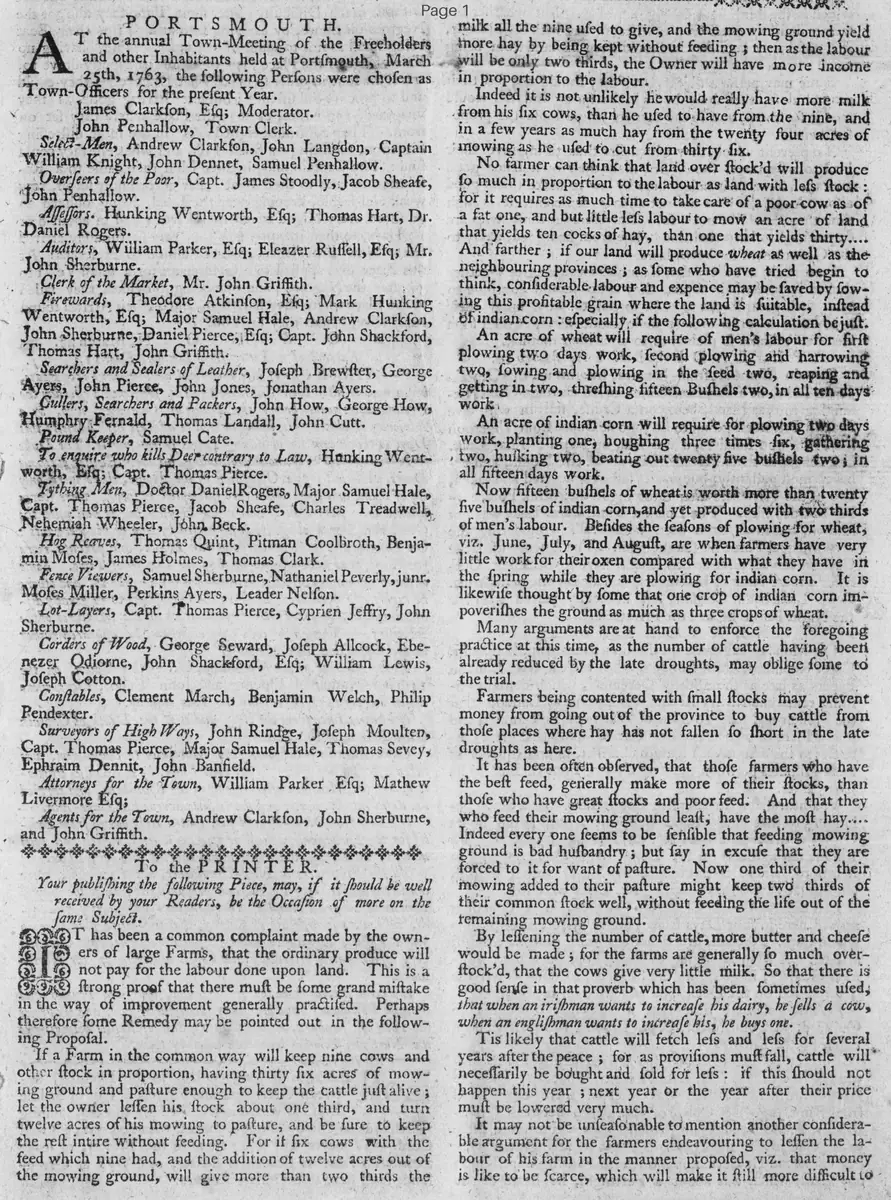
It may not be unseasonable to mention another considerable argument for the farmers endeavouring to lessen the labour of his farm in the manner proposed, viz. that money is like to be scarce, which will make it still more difficult to
pay for such labour as turns to little profit. The scarcity of
money may be argued from hence, that the bills that are a
tender in law must all be called in about three years hence,
and the province can make no more money that any one can
be forced to take; so that silver and gold must be our cur-
rency whether we will or no: and as there is very little sil-
ver or gold in the province at this time, it will require seve-
ral years before we shall be able to export lumber, &c, enough
to pay for the rum, tea, coffee, bread corn and other foreign
commodities we use in such amazing quantities of late; and
to bring home a ballance of silver and gold sufficient for a
currency.
There is no want of land in this part of the World: the
great difficulty is to contrive means to raise the largest quan-
tity of necessaries with the least labour of men, whether it
takes more or less land; as hands are not so plenty as land;
which is the thing here chiefly aimed at. But whether the
farmer desires a good crop of wheat or hay with little labour.
it is absolutely necessary he should keep his land from being
overfed.
Some may perhaps object that if they should not feed their
ground close, their neighbours in the spring and fall would
be feed it for them, and so the owners would loose the propo-
sed benefit.
To prevent which, they who desire thus to improve their
land to advantage, should first make their own fence good
and then force their neighbours by law to make theirs good
also: And if the laws are not already sufficient, it is high
time they should be made so.. Therefore let those who are
determined to keep their land close from being fed, apply to
the Government for better laws.
I am ready to believe that if numbers would agree together
thus to improve their farms, they who should continue to
keep such great stocks as to be forced to prey upon their
neighbours in order to keep their cattle alive, would soon
feel their mistake so plainly as to alter their method.
What sub-type of article is it?
What themes does it cover?
What keywords are associated?
What entities or persons were involved?
Letter to Editor Details
Recipient
The Printer
Main Argument
farmers should reduce livestock by one-third, convert some mowing land to pasture without overfeeding, and plant wheat instead of indian corn to decrease labor while increasing or maintaining produce, addressing low farm profitability amid droughts and money scarcity.
Notable Details