Thank you for visiting SNEWPapers!
Sign up free
Story
July 17, 1961
The Nome Nugget
Nome, Nome County, Alaska
What is this article about?
Wernher von Braun, director of Marshall Space Center, tells reporters in Seattle that Russia leads the US in large rocket boosters and scientist education, but the US surpasses in satellite launches, space data utilization, and communication/weather satellites.
Clipping
OCR Quality
100%
Excellent
Full Text
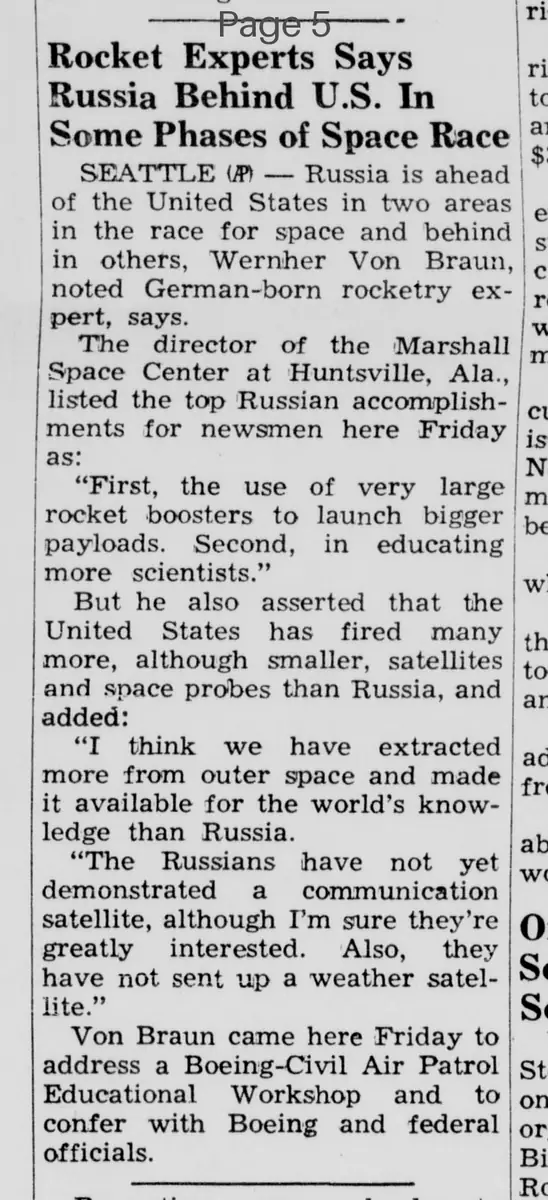
Rocket Experts Says Russia Behind U.S. In Some Phases of Space Race
SEATTLE (AP) — Russia is ahead of the United States in two areas in the race for space and behind in others, Wernher Von Braun, noted German-born rocketry expert, says.
The director of the Marshall Space Center at Huntsville, Ala., listed the top Russian accomplishments for newsmen here Friday as:
"First, the use of very large rocket boosters to launch bigger payloads. Second, in educating more scientists."
But he also asserted that the United States has fired many more, although smaller, satellites and space probes than Russia, and added:
"I think we have extracted more from outer space and made it available for the world's knowledge than Russia.
"The Russians have not yet demonstrated a communication satellite, although I'm sure they're greatly interested. Also, they have not sent up a weather satellite."
Von Braun came here Friday to address a Boeing-Civil Air Patrol Educational Workshop and to confer with Boeing and federal officials.
SEATTLE (AP) — Russia is ahead of the United States in two areas in the race for space and behind in others, Wernher Von Braun, noted German-born rocketry expert, says.
The director of the Marshall Space Center at Huntsville, Ala., listed the top Russian accomplishments for newsmen here Friday as:
"First, the use of very large rocket boosters to launch bigger payloads. Second, in educating more scientists."
But he also asserted that the United States has fired many more, although smaller, satellites and space probes than Russia, and added:
"I think we have extracted more from outer space and made it available for the world's knowledge than Russia.
"The Russians have not yet demonstrated a communication satellite, although I'm sure they're greatly interested. Also, they have not sent up a weather satellite."
Von Braun came here Friday to address a Boeing-Civil Air Patrol Educational Workshop and to confer with Boeing and federal officials.
What sub-type of article is it?
Historical Event
What themes does it cover?
Exploration
What keywords are associated?
Space Race
Russia Us
Rocketry Expert
Satellites
Space Probes
Wernher Von Braun
What entities or persons were involved?
Wernher Von Braun
Where did it happen?
Seattle
Story Details
Key Persons
Wernher Von Braun
Location
Seattle
Story Details
Wernher Von Braun compares US and Russian space achievements, noting Russian leads in large boosters and scientist education, while US leads in satellite numbers, space data extraction, and lacks in communication and weather satellites by Russia.