Thank you for visiting SNEWPapers!
Sign up free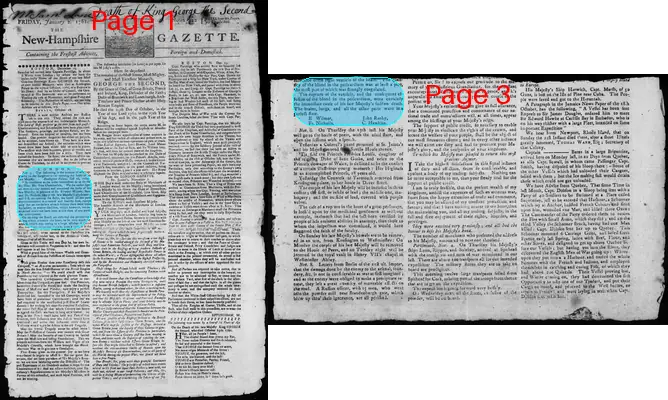
The New Hampshire Gazette
Portsmouth, Rockingham County, New Hampshire
What is this article about?
Autopsy report on the death of King George II, conducted at Kensington Palace on October 26, 1760, revealing a rupture in the right ventricle of the heart causing fatal blood effusion into the pericardium. Reported in London on November 4, 1760.
Merged-components note: Continuation of the autopsy report on King George II's death across pages; original label for second component was obituary, changed to foreign_news as it is part of the news reporting.
Clippings
1 of 2
OCR Quality
Full Text
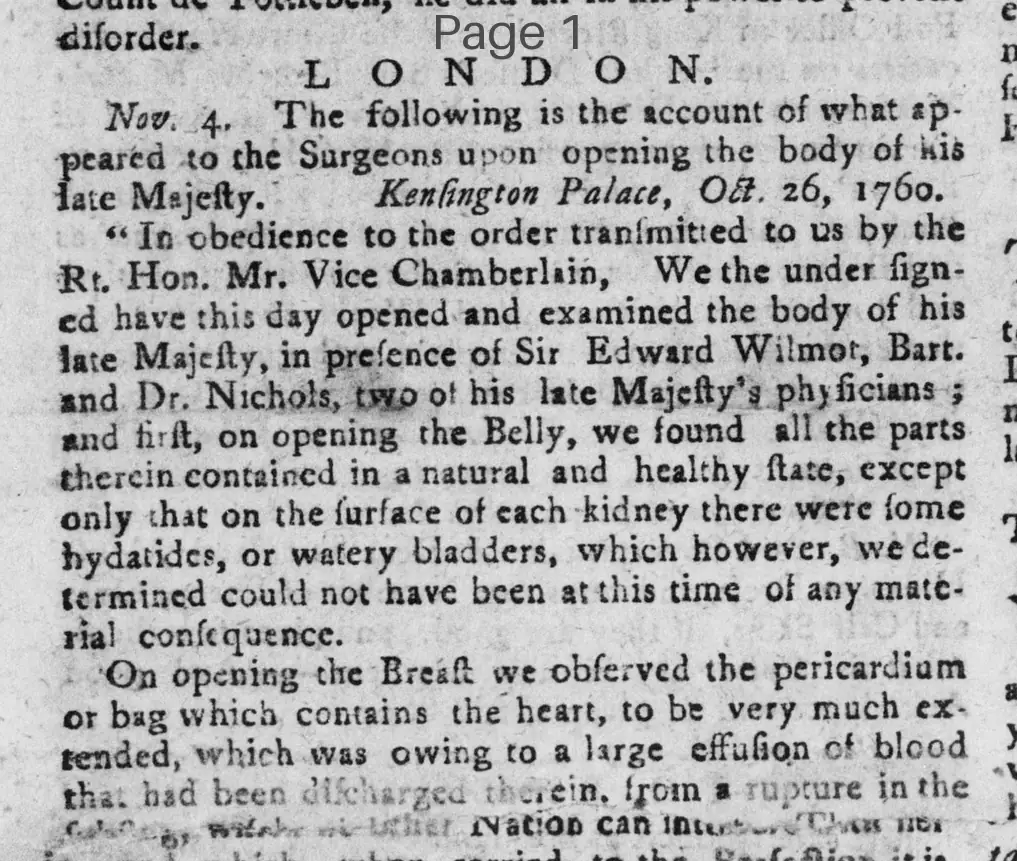
Nov. 4. The following is the account of what appeared to the surgeons upon opening the body of his late majesty.
Kensington Palace, Oct. 26, 1760.
In obedience to the order transmitted to us by the Rt. Hon. Mr. Vice Chamberlain, we the undersigned have this day opened and examined the body of his late majesty, in presence of Sir Edward Wilmot, Bart., and Dr. Nichols, two of his late majesty's physicians; and first, on opening the belly, we found all the parts therein contained in a natural and healthy state, except only that on the surface of each kidney there were some hydatides, or watery bladders, which however we determined could not have been at this time of any material consequence.
On opening the breast we observed the pericardium or bag which contains the heart, to be very much extended, which was owing to a large effusion of blood that had been discharged therein from a rupture in the considerable opening in the right ventricle of the heart. In a new quantity of the blood in the pericardium was at least a pint, the most part of which was strongly coagulated. The rupture of the ventricle, and the consequent effusion of the blood in the pericardium, were certainly the immediate cause of his late Majesty's sudden death. The brains, lungs, and all the other parts were in a perfect state.
E. Wilmot,
John Ranby,
Fr. Nicholls,
C. Hawkins.
What sub-type of article is it?
What keywords are associated?
What entities or persons were involved?
Where did it happen?
Foreign News Details
Primary Location
Kensington Palace
Event Date
Oct. 26, 1760
Key Persons
Outcome
rupture of the right ventricle of the heart leading to effusion of at least a pint of blood into the pericardium, the immediate cause of his late majesty's sudden death.
Event Details
Surgeons opened and examined the body of his late majesty, finding healthy internal parts except hydatides on kidneys (not material) and a large blood effusion in the pericardium from a rupture in the right ventricle of the heart. Brains, lungs, and other parts perfect.