Thank you for visiting SNEWPapers!
Sign up free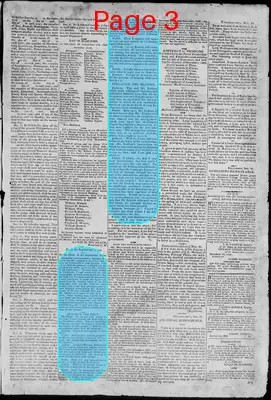
Letter to Editor
January 5, 1810
Virginia Argus
Richmond, Virginia
What is this article about?
A correspondent condenses the prolix diplomatic correspondence between U.S. Secretary Robert Smith and British Minister Richard Jackson into two dialogues, covering the disavowal of the Erskine arrangement, the Chesapeake incident, and the Orders in Council. The writer criticizes British insolence and injustice. Dated around 1809, signed 'C.'
Clipping
OCR Quality
98%
Excellent
Full Text
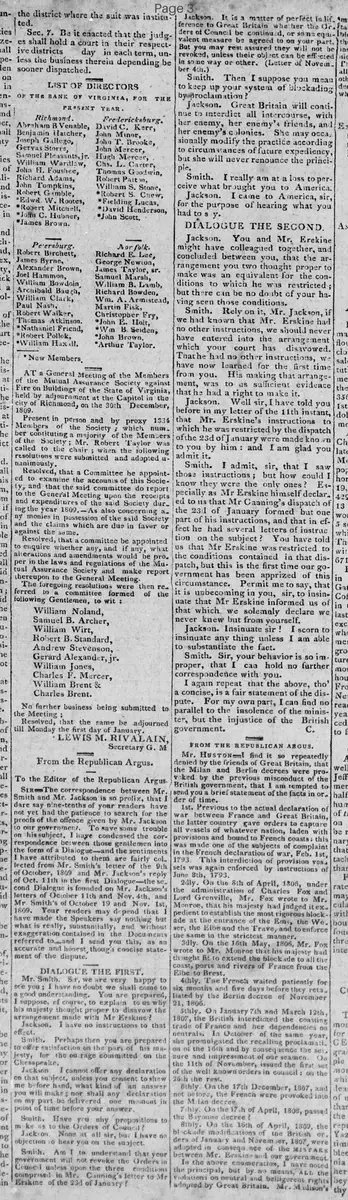
From the Republican Argus.
To the Editor of the Republican Argus.
Sir--The correspondence between Mr. Smith and Mr. Jackson is so prolix, that I dare say nine-tenths of your readers have not yet had the patience to search for the proofs of the offence given by Mr. Jackson to our government. To save some trouble on this subject, I have condensed the correspondence between those gentlemen into the form of a Dialogue--and the sentiments I have attributed to them are fairly collected from Mr. Smith's letter of the 9th of October, 1809 and Mr. Jackson's reply of Oct. 11th in the first Dialogue--the second Dialogue is founded on Mr. Jackson's letters of October 11th and Nov. 4th, and Mr. Smith's of October 19 and Nov. 1st, 1809. Your readers may depend that I have made the Speakers say nothing but what is really, substantially, and without exaggeration contained in the Documents referred to and I send you this, as an accurate and honest though concise statement of the dispute.
DIALOGUE THE FIRST.
Mr. Smith. Sir, we are very happy to see you; I have no doubt we shall come to a good understanding. You are prepared, I suppose, of course, to explain to us why his majesty thought proper to disavow the arrangement made with Mr Erskine?
Jackson. I have no instructions to that effect.
Smith. Perhaps then you are prepared to offer satisfaction on the part of his majesty, for the outrage committed on the Chesapeake,
Jackson I cannot offer any declaration on that subject, unless you consent to shew me before hand, what kind of an answer you will make; nor shall any declaration on my part be delivered one moment in point of time before your answer.
Smith. Have you any propositions to make as to the Orders of Council?
Jackson. None at all sir, but I have no objection to hear you on the subject.
Smith. Am I to understand that your government will not revoke the Orders in Council unless upon the three conditions comprised in Mr. Canning's letter to Mr Erskine of the 23d of January?
Jackson. It is a matter of perfect indifference to Great Britain whether the Orders in Council be continued, or some equivalent measure be agreed to on your part. But you may rest assured they will not be revoked, unless their object can be effected in some way or other. (Letter of November 4th.)
Smith. Then I suppose you mean to keep up your system of blockading by proclamation?
Jackson. Great Britain will continue to interdict all intercourse, with her enemy, her enemy's friends, and her enemy's colonies. She may occasionally modify the practice according to circumstances of future expediency, but she will never renounce the principle.
Smith. I really am at a loss to perceive what brought you to America.
Jackson. I came to America, sir, for the purpose of hearing what you had to say.
DIALOGUE THE SECOND.
Jackson. You and Mr. Erskine might have colleagued together, and concluded between you, that the arrangement you two thought proper to make was an equivalent for the conditions to which he was restricted; but there can be no doubt of your having seen those conditions.
Smith. Rely on it, Mr. Jackson, if we had known that Mr. Erskine had no other instructions, we should never have entered into the arrangement which your court has disavowed. That he had no other instructions, we have now learned for the first time from you. His making that arrangement, was to us sufficient evidence that he had a right to make it.
Jackson. Well sir, I have told you before in my letter of the 11th instant, that Mr. Erskine's instructions to which he was restricted by the dispatch of the 23d of January were made known to you by him: and I am glad you admit it.
Smith. I admit, sir, that I saw those instructions; but how could I know they were the only ones? Especially as Mr Erskine himself declared to us that Mr Canning's dispatch of the 23d of January formed but one part of his instructions, and that in effect he had several letters of instruction on the subject? You have told us that Mr Erskine was restricted to the conditions contained in that dispatch, but this is the first time our government has been apprized of this circumstance. Permit me to say, that it is unbecoming in you, sir, to insinuate that Mr Erskine informed us of that which we solemnly declare we never knew but from yourself.
Jackson. Insinuate sir! I scorn to insinuate anything unless I am able to substantiate the fact.
Smith. Sir, your behavior is so improper, that I can hold no further correspondence with you.
I again repeat that the above, tho a concise, is a fair statement of the dispute. For my own part, I can find no parallel to the insolence of the minister, but the injustice of the British government.
C.
To the Editor of the Republican Argus.
Sir--The correspondence between Mr. Smith and Mr. Jackson is so prolix, that I dare say nine-tenths of your readers have not yet had the patience to search for the proofs of the offence given by Mr. Jackson to our government. To save some trouble on this subject, I have condensed the correspondence between those gentlemen into the form of a Dialogue--and the sentiments I have attributed to them are fairly collected from Mr. Smith's letter of the 9th of October, 1809 and Mr. Jackson's reply of Oct. 11th in the first Dialogue--the second Dialogue is founded on Mr. Jackson's letters of October 11th and Nov. 4th, and Mr. Smith's of October 19 and Nov. 1st, 1809. Your readers may depend that I have made the Speakers say nothing but what is really, substantially, and without exaggeration contained in the Documents referred to and I send you this, as an accurate and honest though concise statement of the dispute.
DIALOGUE THE FIRST.
Mr. Smith. Sir, we are very happy to see you; I have no doubt we shall come to a good understanding. You are prepared, I suppose, of course, to explain to us why his majesty thought proper to disavow the arrangement made with Mr Erskine?
Jackson. I have no instructions to that effect.
Smith. Perhaps then you are prepared to offer satisfaction on the part of his majesty, for the outrage committed on the Chesapeake,
Jackson I cannot offer any declaration on that subject, unless you consent to shew me before hand, what kind of an answer you will make; nor shall any declaration on my part be delivered one moment in point of time before your answer.
Smith. Have you any propositions to make as to the Orders of Council?
Jackson. None at all sir, but I have no objection to hear you on the subject.
Smith. Am I to understand that your government will not revoke the Orders in Council unless upon the three conditions comprised in Mr. Canning's letter to Mr Erskine of the 23d of January?
Jackson. It is a matter of perfect indifference to Great Britain whether the Orders in Council be continued, or some equivalent measure be agreed to on your part. But you may rest assured they will not be revoked, unless their object can be effected in some way or other. (Letter of November 4th.)
Smith. Then I suppose you mean to keep up your system of blockading by proclamation?
Jackson. Great Britain will continue to interdict all intercourse, with her enemy, her enemy's friends, and her enemy's colonies. She may occasionally modify the practice according to circumstances of future expediency, but she will never renounce the principle.
Smith. I really am at a loss to perceive what brought you to America.
Jackson. I came to America, sir, for the purpose of hearing what you had to say.
DIALOGUE THE SECOND.
Jackson. You and Mr. Erskine might have colleagued together, and concluded between you, that the arrangement you two thought proper to make was an equivalent for the conditions to which he was restricted; but there can be no doubt of your having seen those conditions.
Smith. Rely on it, Mr. Jackson, if we had known that Mr. Erskine had no other instructions, we should never have entered into the arrangement which your court has disavowed. That he had no other instructions, we have now learned for the first time from you. His making that arrangement, was to us sufficient evidence that he had a right to make it.
Jackson. Well sir, I have told you before in my letter of the 11th instant, that Mr. Erskine's instructions to which he was restricted by the dispatch of the 23d of January were made known to you by him: and I am glad you admit it.
Smith. I admit, sir, that I saw those instructions; but how could I know they were the only ones? Especially as Mr Erskine himself declared to us that Mr Canning's dispatch of the 23d of January formed but one part of his instructions, and that in effect he had several letters of instruction on the subject? You have told us that Mr Erskine was restricted to the conditions contained in that dispatch, but this is the first time our government has been apprized of this circumstance. Permit me to say, that it is unbecoming in you, sir, to insinuate that Mr Erskine informed us of that which we solemnly declare we never knew but from yourself.
Jackson. Insinuate sir! I scorn to insinuate anything unless I am able to substantiate the fact.
Smith. Sir, your behavior is so improper, that I can hold no further correspondence with you.
I again repeat that the above, tho a concise, is a fair statement of the dispute. For my own part, I can find no parallel to the insolence of the minister, but the injustice of the British government.
C.
What sub-type of article is it?
Informative
Persuasive
Political
What themes does it cover?
Politics
Commerce Trade
What keywords are associated?
Jackson Smith Correspondence
Erskine Arrangement
Chesapeake Outrage
Orders In Council
British Diplomacy
Diplomatic Dispute
What entities or persons were involved?
C.
The Editor Of The Republican Argus
Letter to Editor Details
Author
C.
Recipient
The Editor Of The Republican Argus
Main Argument
the condensed dialogues fairly represent the diplomatic dispute between smith and jackson over the erskine arrangement, chesapeake outrage, and orders in council, revealing british insolence and injustice.
Notable Details
Based On Letters Dated October 9, 11, 19, November 1, 4, 1809
References Canning's Letter Of January 23
Criticizes Jackson's Behavior As Improper And Insolent