Thank you for visiting SNEWPapers!
Sign up free
Story
March 7, 1866
The Daily Dispatch
Richmond, Virginia
What is this article about?
Commentary on Americans' enthusiasm for military heroes like Grant, leading to presidencies for Washington, Jackson, Harrison, and Taylor, but not Scott, attributing it to soldiers' proven patriotism and peace advocacy.
Clipping
OCR Quality
98%
Excellent
Full Text
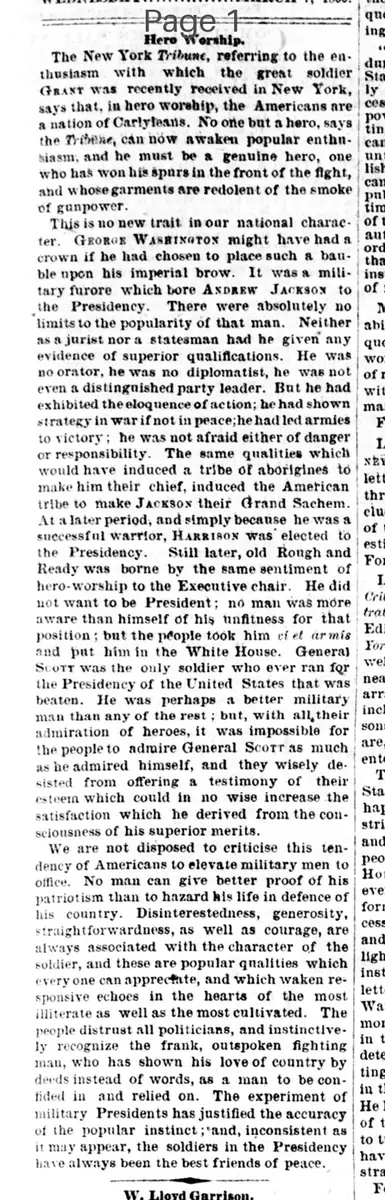
Hero Worship.
The New York Tribune, referring to the enthusiasm with which the great soldier Grant was recently received in New York, says that, in hero worship, the Americans are a nation of Carlyleans. No one but a hero, says the Tribune, can now awaken popular enthusiasm, and he must be a genuine hero, one who has won his spurs in the front of the fight, and whose garments are redolent of the smoke of gunpowder.
This is no new trait in our national character. George Washington might have had a crown if he had chosen to place such a bauble upon his imperial brow. It was a military furore which bore Andrew Jackson to the Presidency. There were absolutely no limits to the popularity of that man. Neither as a jurist nor a statesman had he given any evidence of superior qualifications. He was no orator. He was no diplomatist. He was not even a distinguished party leader. But he had exhibited the eloquence of action; he had shown strategy in war if not in peace; he had led armies to victory; he was not afraid either of danger or responsibility. The same qualities which would have induced a tribe of aborigines to make him their chief, induced the American tribe to make Jackson their Grand Sachem.
At a later period, and simply because he was a successful warrior, Harrison was elected to the Presidency. Still later, old Rough and Ready was borne by the same sentiment of hero-worship to the Executive chair. He did not want to be President: no man was more aware than himself of his unfitness for that position; but the people took him vi et armis and put him in the White House. General Scott was the only soldier who ever ran for the Presidency of the United States that was beaten. He was perhaps a better military man than any of the rest; but, with all their admiration of heroes, it was impossible for the people to admire General Scott as much as he admired himself, and they wisely desisted from offering a testimony of their esteem which could in no wise increase the satisfaction which he derived from the consciousness of his superior merits.
We are not disposed to criticise this tendency of Americans to elevate military men to office. No man can give better proof of his patriotism than to hazard his life in defence of his country. Disinterestedness, generosity, straightforwardness, as well as courage, are always associated with the character of the soldier, and these are popular qualities which every one can appreciate, and which waken responsive echoes in the hearts of the most illiterate as well as the most cultivated. The people distrust all politicians, and instinctively recognize the frank, outspoken fighting man, who has shown his love of country by deeds instead of words, as a man to be confided in and relied on. The experiment of military Presidents has justified the accuracy of the popular instinct; and, inconsistent as it may appear, the soldiers in the Presidency have always been the best friends of peace.
The New York Tribune, referring to the enthusiasm with which the great soldier Grant was recently received in New York, says that, in hero worship, the Americans are a nation of Carlyleans. No one but a hero, says the Tribune, can now awaken popular enthusiasm, and he must be a genuine hero, one who has won his spurs in the front of the fight, and whose garments are redolent of the smoke of gunpowder.
This is no new trait in our national character. George Washington might have had a crown if he had chosen to place such a bauble upon his imperial brow. It was a military furore which bore Andrew Jackson to the Presidency. There were absolutely no limits to the popularity of that man. Neither as a jurist nor a statesman had he given any evidence of superior qualifications. He was no orator. He was no diplomatist. He was not even a distinguished party leader. But he had exhibited the eloquence of action; he had shown strategy in war if not in peace; he had led armies to victory; he was not afraid either of danger or responsibility. The same qualities which would have induced a tribe of aborigines to make him their chief, induced the American tribe to make Jackson their Grand Sachem.
At a later period, and simply because he was a successful warrior, Harrison was elected to the Presidency. Still later, old Rough and Ready was borne by the same sentiment of hero-worship to the Executive chair. He did not want to be President: no man was more aware than himself of his unfitness for that position; but the people took him vi et armis and put him in the White House. General Scott was the only soldier who ever ran for the Presidency of the United States that was beaten. He was perhaps a better military man than any of the rest; but, with all their admiration of heroes, it was impossible for the people to admire General Scott as much as he admired himself, and they wisely desisted from offering a testimony of their esteem which could in no wise increase the satisfaction which he derived from the consciousness of his superior merits.
We are not disposed to criticise this tendency of Americans to elevate military men to office. No man can give better proof of his patriotism than to hazard his life in defence of his country. Disinterestedness, generosity, straightforwardness, as well as courage, are always associated with the character of the soldier, and these are popular qualities which every one can appreciate, and which waken responsive echoes in the hearts of the most illiterate as well as the most cultivated. The people distrust all politicians, and instinctively recognize the frank, outspoken fighting man, who has shown his love of country by deeds instead of words, as a man to be confided in and relied on. The experiment of military Presidents has justified the accuracy of the popular instinct; and, inconsistent as it may appear, the soldiers in the Presidency have always been the best friends of peace.
What sub-type of article is it?
Historical Event
What themes does it cover?
Bravery Heroism
Social Manners
What keywords are associated?
Hero Worship
Military Presidents
American Patriotism
Soldier Leaders
Presidential Elections
What entities or persons were involved?
Grant
George Washington
Andrew Jackson
Harrison
Old Rough And Ready
General Scott
Where did it happen?
United States
Story Details
Key Persons
Grant
George Washington
Andrew Jackson
Harrison
Old Rough And Ready
General Scott
Location
United States
Story Details
The article examines the American national trait of hero worship, particularly for military leaders, leading to their election as presidents, with examples of Washington, Jackson, Harrison, Taylor, and the failure of Scott, praising soldiers' qualities and their success in promoting peace.