Thank you for visiting SNEWPapers!
Sign up free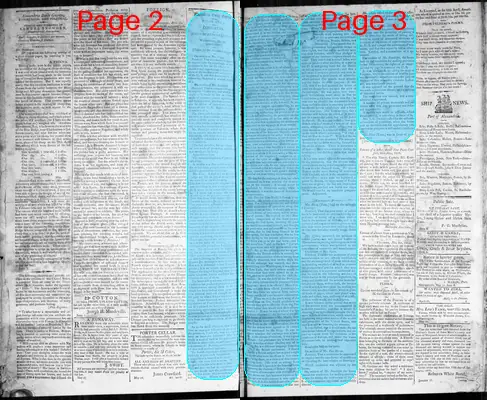
Alexandria Daily Gazette, Commercial & Political
Alexandria, Virginia
What is this article about?
Report on U.S. House of Representatives sessions on May 31 and June 1, covering resolutions for veteran relief, marshal processes, merchant vessel crews, treasury inquiry, land distribution, manufacturing duties, drawbacks, census, engineers, elections evidence, jury trials, and debate on approbatory resolution praising President's foreign policy amid embargo discussions.
Merged-components note: These components form a continuous report on congressional proceedings, with text flowing directly from one to the next across pages. All original labels are domestic_news, so no label change.
Clippings

1 of 2
OCR Quality
Full Text
FRIDAY, JUNE 2.
CONGRESS.
HOUSE OF REPRESENTATIVES
Wednesday, May 31.
[Concluded.]
[Taken for the Alexandria Gazette.]
On motion of Mr. Nelson,
Resolved, That a committee be appointed to enquire into the expediency of making provision by law for the relief of the infirm disabled and superannuated officers and soldiers of the revolutionary and present army of the U. S. and that they report by bill or otherwise. Referred to a select committee of 5.
On motion of Mr. Randolph,
Resolved, That a committee be appointed to enquire whether any, and what provision ought to be made by law in relation to the mode of summary process against marshals and their deputies, who have recovered money by virtue of executions issued in courts of the U. S. Referred to a select committee of 5.
Mr. Dana called up the resolution laid on the table by him yesterday, relative to a regulation of the crews of merchant vessels as to citizenship, and moved it to be referred to a select committee of 5--carried.
Mr. Randolph called up his resolution for an enquiry into the state of the treasury laid on the table some days ago, and moved that it be referred to a select committee of 7--carried.
[The last member, for an enquiry into the best mode of promoting economy, was struck out by him.]
Approbatory vote.
The unfinished business of yesterday called for.
A motion was then under consideration for an indefinite postponement of Mr. Randolph's approbatory resolution.
Mr. Ross. I shall not on this occasion pledge my life or appeal to my God, the veracity of my declarations.
The first objection to the adoption of the present resolution is, that every person in U. S. agree to the sentiments expressed in it. I know not whether this objection should be the parent resolution, I know that those who oppose this resolution now because it is an abstract self evident proposition, advocated last session the resolution reported by the committee on foreign relations, because it was self evident but this is a question on which a difference of opinion does exist, & requires that house make a declaration.[Mr. R. read extracts from the Aurora dissenting from measures of the executive.]If it is not a reason to reject a resolution because it is self evident, it is a double reason why we shall pass this resolution, that there is a difference of opinion ; but of this no more. I have been in the habit of thinking for myself and have even paused ere I could adopt my own. My opinions may be called heretical, but so they must remain till I have other convictions--for instance, I cannot see that delivering the Presidential communication by message is more democratic than was it delivered before Congress in person ; it is no reason against that mode because the king of England does so-because kings use knives and forks must we abandon the use of them.
The resolution has produced precedents in every administration, among them in the instance which has been looked upon as one of the longest. I have instanced the conduct of the party to which I have the honor to belong in the best political truth--I thought so, as one nation. If it pleased the last pres't to have the legislatures of Pennsylvania and N. Carolina resolutions approbatory of his measures sion from the representatives of the whole government, can it be less agreeable to the people.
As to the third objection, that it might have an improper influence on the mind of the president, I will ask, may not a refusal imply a want of faith in his government sit here in silent chillness, and pass over his acts unnoticed? Nothing can be more gratifying than well merited applause.
The fourth objection- Congress have no authority to pass such resolutions. When a proposition is wanted to be got rid of, it ingenuity can soon find reasons. We have salary, and have we law to sanction the publicly elected a chaplain who must be paid his pay it ? Yet we are told we must now sneaking our hands into the public treasury and act by law. Where is the law autho r
Rising each member to be supplied with three papers. Yet here is no nice sensibility for acting without constitutional provision.— Men have two motives—one they give to the world, the other they keep to themselves—and it is the hidden one which is the motive of action—in this case the object of the opposition, much. The fifth—That it will be council of censors to revise the conduct of the President—Can gentlemen make it a disapprobation of his measures by the people's representatives, would ever be an injury to the nation. Sixth and last—that it is calculated to reflect on the proceedings of the last administration—if that be the object of the mover, I think he has missed his aim—for this, with the amendment, founded on the expressions of the president in his message, the last has done. While it has been stated that there were three parties in this house, those who worshipped the rising sun, those who worshipped the setting sun, and those who did not worship at all, it would be necessary to a proper understanding, to see how they resist on this question: Here is a resolution applauding the president of the U.S. Is not applauding the president on this subject, applauding all he has said on this subject, which is applauding the sentiments expressed in his message in these words: 'Whilst I take pleasure in doing justice to the councils of his Britannic Majesty, which no longer adhering to the policy which made an abandonment by France, of her decrees, a pre-requisite to a revocation of the British orders, have substituted the amicable course which has issued thus happily; I cannot do less than refer to the proposal heretofore made on the part of the U.S. embracing a like restoration of the suspended commerce, as a proof of the spirit of accommodation which has at no time been intermitted, and to the result which now calls for our congratulations.' as corroborating the principles, by which the public councils have been guided during a period of the most trying embarrassments." He was for the embargo at first, but when persevered in, it was proving the destruction of the country; it should never be mentioned by democrats again; when it was enacted, it was the dawn of federalism in this country. Mr. Fisk (of New-York) followed in opposition. He rebutted the evidence of precedent, that it was not relevant, and doubted the application of precedent altogether to such a case as this; it should only be applied to forms of procedure, not to principles of action. He replied to Mr. Randolph's comparison of the horse-jockey praising the bad horse, knowing the good one would recommend himself, and thought the gentleman was unfortunate in his comparison, that he had hung himself in his own garter, for this resolution was no less than saving to the present administration, "I know you to be the bad horse, and I will praise you," and to the last "you are the good horse and will recommend yourself." As to the embargo not being produced by the British orders in council, no official communication of them having been made, he observed, that twelve days before the embargo was enacted, and three would bring it to Washington, it was known at New-York, that such orders would be issued—that they were agreed to on the 11th, and to be published on the 14th November. It was the duty of the President to lay every information he possesses before Congress: must it be official? Must Congress act only from official knowledge?— Must they form no opinion from correct, though unofficial corroborative circumstances? Were we told the north wing of the capitol was on fire, would gentlemen sit here till they got it officially from the President before they would seek their personal safety? It may be asked where was this evidence obtained? At the bar of the British house of commons—Mr. Martin there stated that he wrote to his correspondent at New-York on the 12th November, the day after the orders were agreed to in council and sanctioned by the king. It was no matter whether the embargo was a lucky hit, or the dictate of wisdom, it was a good measure: but gentlemen say it was the ruin of America without effecting any of its ends this is a different language from that of the British parliament. I should suppose a British subject has as good a right to know what were its effects in that country, living there, as a citizen of this country residing here. [He read an extract from Mr. Grenville's speech in the house of lords respecting the distress of Britain through a suspension of commerce with this country.] This shews one fact however injurious the embargo was to this country it was oppressive to G.B. this fulfilled one of its primary objects: it was retaliatory: it was one
of a system of measures, which the hon. mover has unceasingly opposed, began in 1806, resorted to from the peculiarity of the situation of the United States at that time. When the non-intercourse was enacted what were the complaints of the memorials were pouring into this all the seaports on the continent of Britain, Britain, and protection. They stated that the British government had made an inroad on their rights, and that too so suddenly as to risk their fortunes, which they pledged in support of any measure congress should decree. They stated that a vessel laden with colonial produce after touching at a port in the U. S. and giving bond for the duties, on sailing again was captured; and that a still more destructive principle was soon after supported in their courts of admiralty, which decreed that vessels must actually pay the duties on their cargoes. It was said, that if we had accepted the treaty of 1806 we should have escaped the evils of the embargo. He was sorry, very sorry, such declarations were made as that we could never get a better treaty than that: he was sure we should: the documents before them authorized him in asserting positively we should have a satisfactory and a better treaty than that. Mr. Erskine says, that a minister will be sent to conclude a treaty, not on a particular point, but on all points in dispute. He was astonished to hear gentlemen who had opposed a system of measures, arrogating the credit arising out of these measures; it reminded him of the fly on the coach wheel exclaiming, "O what a dust we flies do make!" Who had the responsibility of the measures? The minority? No—yet we see them stepping forward for the credit of them. There is minorities in all bodies: there was a minority during the revolution; but did they claim that undertaking. It has been urged against the amendment, to the resolution, that the present happy prospects are owing to a change of measures. It was we who changed them. We placed France on the same footing of restriction with England. which is the ostensible cause of her offers: at the time we legislated against G. Britain, the aggressions of France were not so great; she had not imprisoned our citizens, she had not burnt our ships. He would vote for an indefinite postponement. Adjourned. THURSDAY, June 1 Mr. Rhea, (Tenn.) laid on the table the following: Resolved, That the committee of public lands be instructed to enquire into the expediency of laying off a certain tract of land in the territory of Orleans, and it be surveyed and a quarter section given to each free male white person now resident there, or who may hereafter actually reside thereon. Mr. Quincy presented the petitions of certain journeymen and master hatters in Massachusetts, praying encouragement from government; which was referred to the committee of commerce and manufactures. On motion of Mr. Lyon Resolved, That for the protection of such manufactories as are already established, and the encouragement of those which may be hereafter established as well as promote the production of articles which they may manufacture, it is expedient additional duties be laid on the following articles: of which leather is the principal ingredient, on hemp and cotton and the articles manufactured from them, woollen cloth, the invoice price of which is more than 6s. sterling per square yard, woollen hosiery, window glass, all kinds of paper, silver and plated ware, nails and spikes, hats, millinery of all kinds, clothes ready made, and malt liquors. It was opposed on the ground that many of the articles were not manufactured in sufficient quantities, and that it would be drawing from agricultural pursuits the farmers and their connexions, which would be destroying the greatest source of the wealth and prosperity of the United States, and that it would be lessening the revenue. It was replied, that it would make the nation independent of foreign nations, and secure us impost from the collisions of the continent of Europe, and make our wants of revenue less, by making our expences less. Resolution laid on the table. On motion of Mr. Van Horne, Resolved, That a committee be appointed to enquire into the expediency of modifying or repealing the laws relative to drawback. Which resolution was rejected by the house. On motion of Mr. Randolph the house passed the resolution for making provision by law for taking the next census of the U. S. and a committee appointed conformably thereto.
Mr. Lewis called up the resolution offered for the purpose of removing the corps of engineers, &c. which was refused by the house. On motion of Mr. Southard, Resolved, That a committee be appointed to enquire into the propriety of passing a law to prescribe the mode of taking evidence in cases of contested elections of members of the house of representatives of the U.S. and compel the attendance of witnesses, and that they report by bill or otherwise. Carried, and a committee of 5 appointed. On motion of Mr. Randolph, the house took up the resolution for making provision by law for securing the rights of an impartial trial by jury in courts of the U. S. - It was advocated, by citing the state of Virginia, where the system of trial by jury was abominably imperfect—that the jury on the case of that miserable creature Callender, was notoriously packed. It was opposed on the ground that the law made a provision already on the subject of impartial juries. The resolution was carried, and a committee of 5 appointed. A number of private memorials and petitions were this day presented and referred respectively. A motion was made to adjourn, -which was negatived, 2 only rising in favor of it. Mr. N. G. Jackson called for the unfinished business of yesterday, when the house took up the resolution for approbatory vote (motion to postpone it still under consideration.) Mr. Rhea (Tenn.) was in favor of postponement. [This days proceedings to be continued.]
What sub-type of article is it?
What keywords are associated?
What entities or persons were involved?
Domestic News Details
Event Date
Wednesday, May 31. And Thursday, June 1
Key Persons
Outcome
various resolutions referred to committees; some rejected; debate on approbatory resolution continued without resolution.
Event Details
Proceedings in the House of Representatives included motions and resolutions on relief for revolutionary and current army veterans, summary processes against marshals, regulation of merchant vessel crews, inquiry into the treasury state, land distribution in Orleans Territory, petitions from hatters, additional duties on imported goods to protect manufactures, modification of drawback laws, census provisions, removal of engineers, evidence in contested elections, and securing impartial jury trials. Debate continued on an approbatory resolution praising the President's foreign policy, with speeches by Ross and Fisk opposing postponement and discussing embargo effects, precedents, and international relations.