Thank you for visiting SNEWPapers!
Sign up free
Editorial
February 23, 1814
Daily National Intelligencer
Washington, District Of Columbia
What is this article about?
The editorial argues that Congress and the nation should properly reward military and naval heroes for their valor, despite some misconduct in the army, citing Gen. Jackson's despatch and poetic reference to Leonidas. It expresses confidence in future recognition.
Clipping
OCR Quality
95%
Excellent
Full Text
REWARDS DUE TO NAVAL HEROES
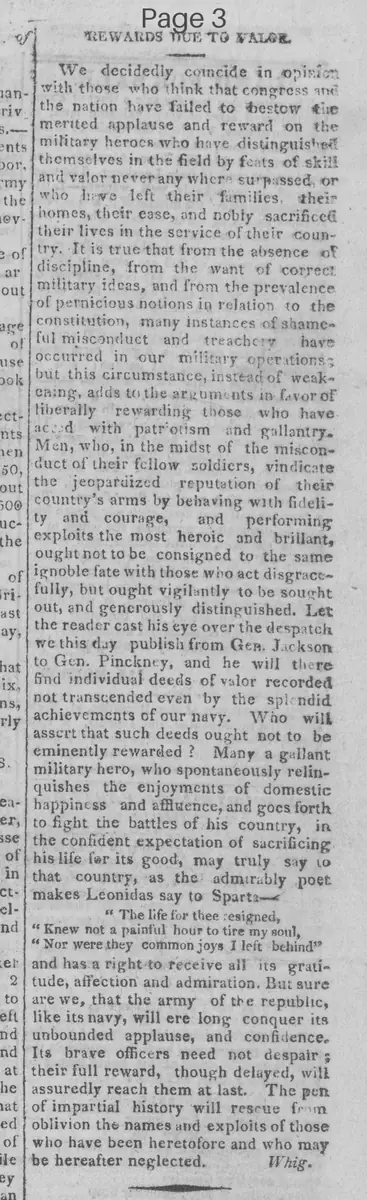
We decidedly coincide in opinion with those who think that congress and the nation have failed to bestow the merited applause and reward on the military heroes who have distinguished themselves in the field by feats of skill and valor never anywhere surpassed, or who have left their families, their homes, their ease, and nobly sacrificed their lives in the service of their country. It is true that from the absence of discipline, from the want of correct military ideas, and from the prevalence of pernicious notions in relation to the constitution, many instances of shameful misconduct and treachery have occurred in our military operations; but this circumstance, instead of weakening, adds to the arguments in favor of liberally rewarding those who have acted with patriotism and gallantry.
Men, who, in the midst of the misconduct of their fellow soldiers, vindicate the jeopardized reputation of their country's arms by behaving with fidelity and courage, and performing exploits the most heroic and brilliant, ought not to be consigned to the same ignoble fate with those who act disgracefully, but ought vigilantly to be sought out, and generously distinguished. Let the reader cast his eye over the despatch we this day publish from Gen. Jackson to Gen. Pinckney, and he will there find individual deeds of valor recorded not transcended even by the splendid achievements of our navy. Who will assert that such deeds ought not to be eminently rewarded? Many a gallant military hero, who spontaneously relinquishes the enjoyments of domestic happiness and affluence, and goes forth to fight the battles of his country, in the confident expectation of sacrificing his life or its good, may truly say to that country, as the admirable poet makes Leonidas say to Sparta—
"The life for thee resigned,
Knew not a painful hour to tire my soul,
Nor were they common joys I left behind"
and has a right to receive all its gratitude, affection and admiration. But sure are we, that the army of the republic, like its navy, will ere long conquer its unbounded applause, and confidence. Its brave officers need not despair; their full reward, though delayed, will assuredly reach them at last. The pen of impartial history will rescue from oblivion the names and exploits of those who have been heretofore and who may be hereafter neglected.
Whig.
We decidedly coincide in opinion with those who think that congress and the nation have failed to bestow the merited applause and reward on the military heroes who have distinguished themselves in the field by feats of skill and valor never anywhere surpassed, or who have left their families, their homes, their ease, and nobly sacrificed their lives in the service of their country. It is true that from the absence of discipline, from the want of correct military ideas, and from the prevalence of pernicious notions in relation to the constitution, many instances of shameful misconduct and treachery have occurred in our military operations; but this circumstance, instead of weakening, adds to the arguments in favor of liberally rewarding those who have acted with patriotism and gallantry.
Men, who, in the midst of the misconduct of their fellow soldiers, vindicate the jeopardized reputation of their country's arms by behaving with fidelity and courage, and performing exploits the most heroic and brilliant, ought not to be consigned to the same ignoble fate with those who act disgracefully, but ought vigilantly to be sought out, and generously distinguished. Let the reader cast his eye over the despatch we this day publish from Gen. Jackson to Gen. Pinckney, and he will there find individual deeds of valor recorded not transcended even by the splendid achievements of our navy. Who will assert that such deeds ought not to be eminently rewarded? Many a gallant military hero, who spontaneously relinquishes the enjoyments of domestic happiness and affluence, and goes forth to fight the battles of his country, in the confident expectation of sacrificing his life or its good, may truly say to that country, as the admirable poet makes Leonidas say to Sparta—
"The life for thee resigned,
Knew not a painful hour to tire my soul,
Nor were they common joys I left behind"
and has a right to receive all its gratitude, affection and admiration. But sure are we, that the army of the republic, like its navy, will ere long conquer its unbounded applause, and confidence. Its brave officers need not despair; their full reward, though delayed, will assuredly reach them at last. The pen of impartial history will rescue from oblivion the names and exploits of those who have been heretofore and who may be hereafter neglected.
Whig.
What sub-type of article is it?
Military Affairs
What keywords are associated?
Naval Heroes
Military Valor
Rewards For Service
Army Misconduct
Historical Recognition
What entities or persons were involved?
Congress
Nation
Gen. Jackson
Gen. Pinckney
Leonidas
Editorial Details
Primary Topic
Rewarding Military And Naval Heroes
Stance / Tone
Supportive Of Liberal Rewards For Valor
Key Figures
Congress
Nation
Gen. Jackson
Gen. Pinckney
Leonidas
Key Arguments
Congress And Nation Have Failed To Reward Military Heroes Adequately
Misconduct In Army Strengthens Case For Rewarding Patriotic Acts
Heroes Deserve Distinction From Disgraceful Actors
Deeds In Jackson's Despatch Merit Eminent Rewards
History Will Recognize Neglected Heroes