Thank you for visiting SNEWPapers!
Sign up free
Lynchburg Virginian
Lynchburg, Virginia
What is this article about?
Haitian President Boyer issues a proclamation rejecting King of Spain's demand for the eastern part of Haiti, affirming the island's unity under the 1806 constitution and historical claims. Spanish frigate Casilda arrives at Port au Prince, exchanges salutes, and is attacked by two Colombian brigs upon departure on February 3, 1830; outcome unknown. Proclamation dated February 6, 1830.
Clipping
OCR Quality
Full Text
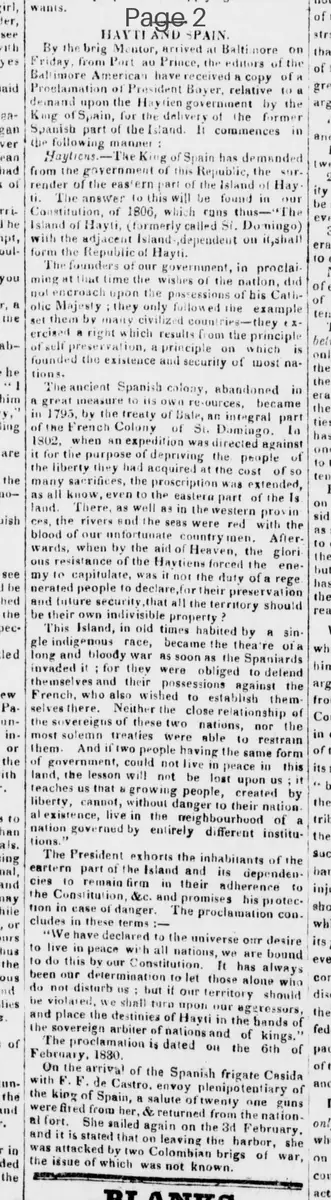
By the brig Mentor, arrived at Baltimore on Friday, from Port au Prince, the editors of the Baltimore American have received a copy of a Proclamation of President Boyer, relative to a demand upon the Haytien government by the King of Spain, for the delivery of the former Spanish part of the Island. It commences in the following manner:
Haytiens.-The King of Spain has demanded from the government of this Republic, the surrender of the eastern part of the island of Hayti. The answer to this will be found in our Constitution, of 1806, which runs thus-"The Island of Hayti, (formerly called St. Domingo) with the adjacent Islands, dependent on it, shall form the Republic of Hayti."
The founders of our government, in proclaiming at that time the wishes of the nation, did not encroach upon the possessions of his Catholic Majesty; they only followed the example set them by many civilized countries-they exercised a right which results from the principle of self preservation, a principle on which is founded the existence and security of most nations.
The ancient Spanish colony, abandoned in a great measure to its own resources, became in 1795, by the treaty of Bale, an integral part of the French Colony of St. Domingo. In 1802, when an expedition was directed against it for the purpose of depriving the people of the liberty they had acquired at the cost of so many sacrifices, the proscription was extended, as all know, even to the eastern part of the Island. There, as well as in the western provinces, the rivers and the seas were red with the blood of our unfortunate countrymen. Afterwards, when by the aid of Heaven, the glorious resistance of the Haytiens forced the enemy to capitulate, was it not the duty of a regenerated people to declare, for their preservation and future security, that all the territory should be their own indivisible property?
This Island, in old times inhabited by a single indigenous race, became the theatre of a long and bloody war as soon as the Spaniards invaded it; for they were obliged to defend themselves and their possessions against the French, who also wished to establish themselves there. Neither the close relationship of the sovereigns of these two nations, nor the most solemn treaties were able to restrain them. And if two people having the same form of government, could not live in peace in this land, the lesson will not be lost upon us; it teaches us that a growing people, created by liberty, cannot, without danger to their national existence, live in the neighbourhood of a nation governed by entirely different institutions.
The President exhorts the inhabitants of the eastern part of the Island and its dependencies to remain firm in their adherence to the Constitution, &c. and promises his protection in case of danger. The proclamation concludes in these terms:-
"We have declared to the universe our desire to live in peace with all nations, we are bound to do this by our Constitution. It has always been our determination to let those alone who do not disturb us; but if our territory should be violated, we shall turn upon our aggressors, and place the destinies of Hayti in the hands of the sovereign arbiter of nations and of kings."
The proclamation is dated on the 6th of February, 1830.
On the arrival of the Spanish frigate Casilda with F. F. de Castro, envoy plenipotentiary of the king of Spain, a salute of twenty one guns were fired from her, & returned from the national fort. She sailed again on the 3d February, and it is stated that on leaving the harbor, she was attacked by two Colombian brigs of war, the issue of which was not known.
What sub-type of article is it?
What keywords are associated?
What entities or persons were involved?
Where did it happen?
Foreign News Details
Primary Location
Hayti
Event Date
6th Of February, 1830
Key Persons
Outcome
issue of attack on spanish frigate by colombian brigs not known; proclamation affirms haitian sovereignty and threatens resistance if territory violated
Event Details
President Boyer issues proclamation rejecting Spain's demand for eastern part of Hayti, citing 1806 constitution, historical events including 1795 Treaty of Bale and 1802 expedition, and exhorting adherence to constitution with promise of protection. Spanish frigate Casilda arrives with envoy F. F. de Castro, exchanges 21-gun salute, sails on 3d February, and is attacked by two Colombian brigs of war upon leaving harbor.