Thank you for visiting SNEWPapers!
Sign up free
State Journal
Montpelier, Washington County, Vermont
What is this article about?
A letter to the State Journal editor criticizes the Danville 'Star' and Boston 'Advocate' for defending Martin Van Buren's vote for a bill abridging press freedom, arguing the bill is unconstitutional, violates republican principles, and that states cannot enact such laws without infringing on federal guarantees.
Merged-components note: The footnote component is part of the preceding letter to the editor on the freedom of the press and constitution; merged due to shared bounding box and contextual continuity.
Clipping
OCR Quality
Full Text
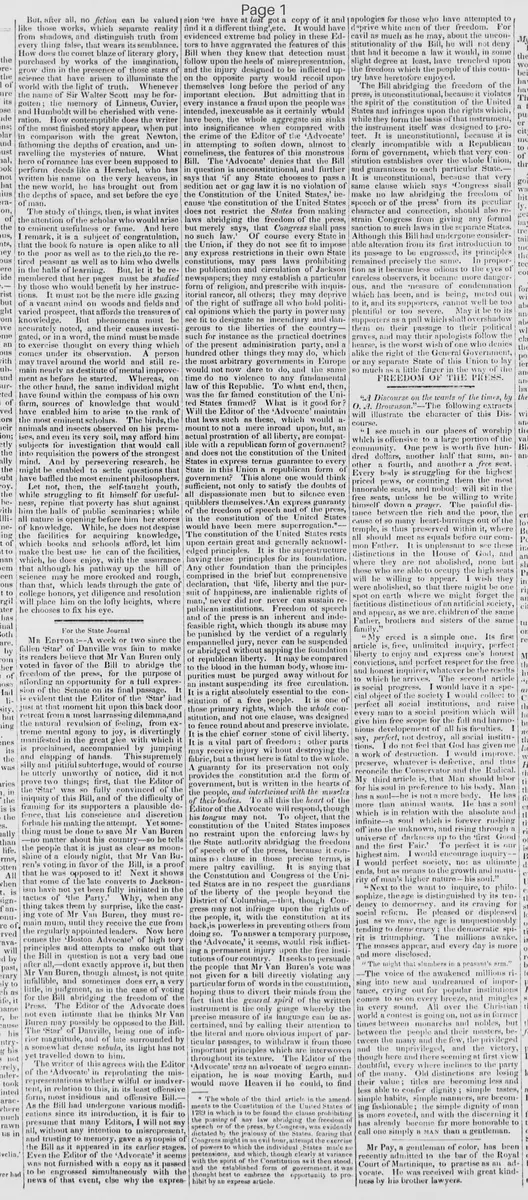
Mr. Editor:--A week or two since the fallen 'Star' of Danville was fain to make its readers believe that Mr. Van Buren only voted in favor of the Bill to abridge the freedom of the press, for the purpose of affording an opportunity for a full expression of the Senate on its final passage. It is evident that the Editor of the 'Star' had just at that moment hit upon this back door retreat from a most harrassing dilemma, and the natural revulsion of feeling, from extreme mental agony to joy, is divertingly manifested in the great glee with which it is proclaimed, accompanied by jumping and clapping of hands. This supremely silly and pitiful subterfuge, would of course be utterly unworthy of notice, did it not prove two things; first, that the Editor of the 'Star' was so fully convinced of the iniquity of this Bill, and of the difficulty of framing for its supporters a plausible defence, that his conscience and discretion forbade his making the attempt. Yet something must be done to save Mr. Van Buren--no matter about his country--so he tells the people that it is just as clear as moonlight of a cloudy night, that Mr. Van Buren's voting in favor of the Bill, is a proof that he was opposed to it! Next it shows that some of the late converts to Jacksonism have not yet been fully initiated in the tactics of 'the Party.' Why, when any thing takes them by surprise, like the casting vote of Mr. Van Buren, they must remain mum, until they receive the cue from the regularly appointed leaders. Now here comes the Boston 'Advocate' of high tory principles and attempts to make out that the Bill in question is not a very bad one after all,--don't exactly approve it, but then Mr. Van Buren, though almost, is not quite infallible, and sometimes does err, a very little, in judgment, as in the case of voting for the Bill abridging the freedom of the Press. The Editor of the 'Advocate' does not even intimate that he thinks Mr. Van Buren may possibly be opposed to the Bill. The 'Star' of Danville, being one of inferior magnitude, and of late surrounded by a somewhat dense nebula, its light has not yet travelled down to him.
The writer of this agrees with the Editor of the 'Advocate' in reprobating the misrepresentations whether wilful or inadvertent, in relation to this, in its least offensive form, most insidious and offensive Bill. As the Bill had undergone various modifications since its introduction, it is fair to presume that many Editors, I will not say all, without any intention to misrepresent, and trusting to memory, gave a synopsis of the Bill as it appeared in its earlier stages. Even the Editor of the 'Advocate' it seems was not furnished with a copy as it passed to be engrossed simultaneously with the news of that event, else why the expression we have at last got a copy of it and find it a different thing' etc. It would have evidenced extreme bad policy in these Editors to have aggravated the features of this Bill when they knew that detection must follow upon the heels of misrepresentation, and the injury designed to be inflicted upon the opposite party would recoil upon themselves long before the period of any important election. But admitting that in every instance a fraud upon the people was intended, inexcusable as it certainly would have been, the whole aggregate sin sinks into insignificance when compared with the crime of the Editor of the 'Advocate' in attempting to soften down, almost to comeliness, the features of this monstrous Bill. The 'Advocate' denies that the Bill in question is unconstitutional, and further says that if any State chooses to pass a sedition act or gag law it is no violation of the Constitution of the United States,' because the constitution of the United States does not restrict the States from making laws abridging the freedom of the press, but merely says, that Congress shall pass no such law.' Of course every State in the Union, if they do not see fit to impose any express restrictions in their own State constitutions, may pass laws prohibiting the publication and circulation of Jackson newspapers; they may establish a particular form of religion, and prescribe with inquisitorial rancor, all others; they may deprive of the right of suffrage all who hold political opinions which the party in power may see fit to designate as incendiary and dangerous to the liberties of the country--such for instance as the practical doctrines of the present administration party, and a hundred other things they may do, which the most arbitrary governments in Europe would not now dare to do, and the same time do no violence to any fundamental law of this Republic. To what end, then, was the far famed constitution of the United States framed? What is it good for? Will the Editor of the 'Advocate' maintain that laws such as these, which would amount to not a mere inroad upon, but, an actual prostration of all liberty, are compatible with a republican form of government? and does not the constitution of the United States in express terms guarantee to every State in this Union a republican form of government? This alone one would think sufficient, not only to satisfy the doubts of all dispassionate men but to silence even quibblers themselves. 'An express guaranty of the freedom of speech and of the press, in the constitution of the United States would have been mere supererogation.*-- The constitution of the United States rests upon certain great and generally acknowledged principles. It is the superstructure having these principles for its foundation. Any other foundation than the principles comprised in the brief but comprehensive declaration, that life, liberty and the pursuit of happiness, are inalienable rights of man,' never did nor never can sustain republican institutions. Freedom of speech and of the press is an inherent and indefeasible right, which though its abuse may be punished by the verdict of a regularly empannelled jury, never can be suspended or abridged without sapping the foundation of republican liberty. It may be compared to the blood in the human body, whose impurities must be purged away without for an instant suspending its free circulation. It is a right absolutely essential to the constitution of a free people. It is one of those primary rights, which the whole constitution, and not one clause, was designed to fence round about and preserve inviolate. It is the chief corner stone of civil liberty. It is a vital part of freedom; other parts may receive injury without destroying the fabric, but a thrust here is fatal to the whole. A guaranty for its preservation not only provides the constitution and the form of government, but is written in the hearts of the people, and intertwined with the muscles of their bodies. 'To all this the heart of the Editor of the Advocate will respond, though his tongue may not. To object, that the constitution of the United States imposes no restraint upon the enforcing laws by the State authority abridging the freedom of speech or of the press, because it contains no clause in those precise terms, is mere paltry cavilling. It is saying that the Constitution and Congress of the United States are in no respect the guardians of the liberty of the people beyond the District of Columbia,--that, though Congress may not infringe upon the rights of the people, it, with the constitution at its back, is powerless in preventing others from doing so. To answer a temporary purpose, the 'Advocate,' it seems, would risk inflicting a permanent injury upon the free institutions of our country. It seeks to persuade the people that Mr. Van Buren's vote was not given for a bill directly violating any particular form of words in the constitution, hoping thus to divert their minds from the fact that the general spirit of the written instrument is the only gauge whereby the precise measure of its language can be ascertained, and by calling their attention to the literal and more obvious import of particular passages, to withdraw it from those important principles which are interwoven throughout its texture. The Editor of the 'Advocate' was an advocate of negro emancipation, he is now moving Earth, and would move Heaven if he could, to find apologies for those who have attempted to deprive white men of their freedom. For cavil as much as he may, about the unconstitutionality of the Bill, he will not deny that had it become a law it would, in some slight degree at least, have trenched upon the freedom which the people of this country have heretofore enjoyed.
The Bill abridging the freedom of the press, is unconstitutional, because it violates the spirit of the constitution of the United States and infringes upon the rights which, while they form the basis of that instrument, the instrument itself was designed to protect. It is unconstitutional, because it is clearly incompatible with a Republican form of government, which that very constitution establishes over the whole Union, and guarantees to each particular State. It is unconstitutional, because that very same clause which says Congress shall make no law abridging the freedom of speech or of the press' from its peculiar character and connection, should also restrain Congress from giving any formal sanction to such laws in the separate States. Although this Bill had undergone considerable alteration from its first introduction to its passage to be engrossed, its principles remained precisely the same. In proportion as it became less odious to the eyes of careless observers, it became more dangerous, and the measure of condemnation which has been, and is being, meted out to it, and its supporters, cannot well be too plentiful or too severe. May it be to its supporters as a pall which shall overshadow them on their passage to their political graves, and may their apologists follow the hearse, is the worst wish of one who denies alike the right of the General Government, or any separate State of this Union to lay so much as a little finger in the way of the
FREEDOM OF THE PRESS.
* The whole of the third article in the amendments to the Constitution of the United States of 1789 in which is to be found the clause prohibiting the passing of any law abridging the freedom of speech or of the press, by Congress, was evidently dictated by the jealousy of the States, fearing that Congress might in an evil hour, attempt the exercise of powers to which the individual States made no pretensions, and which, though clearly at variance with the spirit of the Constitution as it then stood, and the established form of government, it was thought best to embrace the opportunity to prohibit by an express article.
What sub-type of article is it?
What themes does it cover?
What keywords are associated?
What entities or persons were involved?
Letter to Editor Details
Recipient
Mr. Editor
Main Argument
the bill abridging press freedom is unconstitutional as it violates the spirit of the u.s. constitution, is incompatible with republican government guaranteed to states, and congress cannot sanction such state laws; criticizes defenses of van buren's supportive vote by the danville 'star' and boston 'advocate'.
Notable Details