Thank you for visiting SNEWPapers!
Sign up free
The Daily Alaska Empire
Juneau, Juneau County, Alaska
What is this article about?
Japan is constructing eight 10,000-ton cruisers, the Nachi class, described as the world's most powerful, with the latest, Maya, having its keel laid in Kobe. Details include speed, armament, and comparisons to US and British cruisers, as part of a naval replacement program completing in 1932.
Merged-components note: Headline, body text on page 1, and continuation on page 5 form single foreign news story on Japanese cruisers.
Clippings
1 of 2
OCR Quality
Full Text
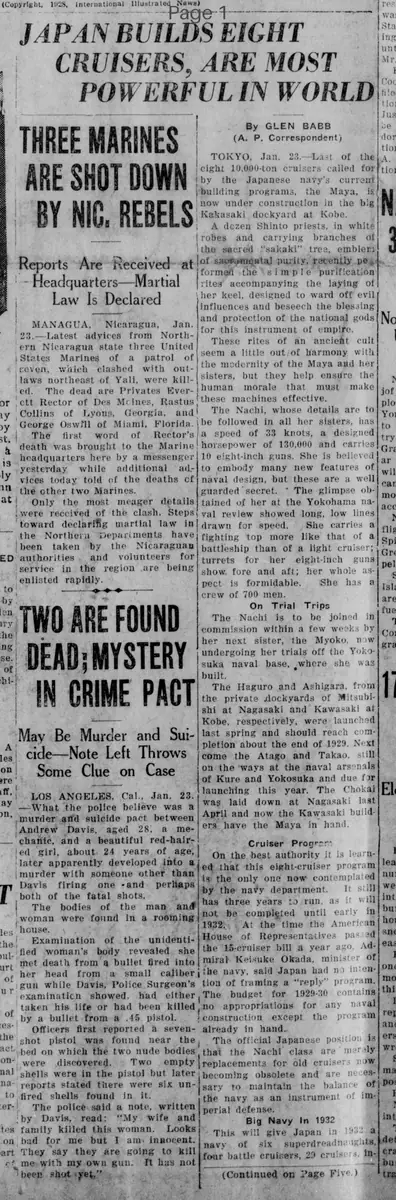
TOKYO, Jan. 23.—Last of the eight 10,000-ton cruisers called for by the Japanese navy's current building programs, the Maya, is now under construction in the big Kawasaki dockyard at Kobe.
A dozen Shinto priests, in white robes and carrying branches of the sacred "sakaki" tree, emblem of sacramental purity, recently performed the simple purification rites accompanying the laying of her keel, designed to ward off evil influences and beseech the blessing and protection of the national gods for this instrument of empire.
These rites of an ancient cult seem a little out of harmony with the modernity of the Maya and her sisters, but they help ensure the human morale that must make these machines effective.
The Nachi, whose details are to be followed in all her sisters, has a speed of 33 knots, a designed horsepower of 130,000 and carries 10 eight-inch guns. She is believed to embody many new features of naval design, but these are a well guarded secret. The glimpse obtained of her at the Yokohama naval review showed long, low lines drawn for speed. She carries a fighting top more like that of a battleship than of a light cruiser; turrets for her eight-inch guns show fore and aft; her whole aspect is formidable.
She has a crew of 700 men.
On Trial Trips
The Nachi is to be joined in commission within a few weeks by her next sister, the Myoko, now undergoing her trials off the Yokosuka naval base, where she was built.
The Haguro and Ashigara, from the private dockyards of Mitsubishi at Nagasaki and Kawasaki at Kobe, respectively, were launched last spring and should reach completion about the end of 1929. Next come the Atago and Takao, still on the ways at the naval arsenals of Kure and Yokosuka and due for launching this year. The Chokai was laid down at Nagasaki last April and now the Kawasaki builders have the Maya in hand.
Cruiser Program
On the best authority it is learned that this eight-cruiser program is the only one now contemplated by the navy department. It still has three years to run, as it will not be completed until early in 1932. At the time the American House of Representatives passed the 15-cruiser bill a year ago, Admiral Keisuke Okada, minister of the navy, said Japan had no intention of framing a "reply" program.
The budget for 1929-30 contains no appropriations for any naval construction except the program already in hand.
The official Japanese position is that the Nachi class are merely replacements for old cruisers now becoming obsolete and are necessary to maintain the balance of the navy as an instrument of imperial defense.
Big Navy In 1932
This will give Japan in 1932 a navy of six superdreadnaughts, four battle cruisers, 29 cruisers, including first line destroyers over 1,500 tons and second class under 1,500 tons, 54 first class destroyers, 40 second class destroyers and some campaign ships. The dozen include aircraft carriers which Japan has obsolete. The additional four carriers are coming each about $15,000,000. High feature of the program as of the new cruisers of all the naval powers, is the tremendous horsepower. The Nachi 130,000 horsepower is greater than that of any battleship afloat and only four naval craft in the world all of special designs exceed the American aircraft carriers Lexington and Saratoga of 180,000 the British battlecruiser Hood 144,000 and the Japanese aircraft carrier Akagi 131,200. U. S. and G. B. To compare with the Nachi class the United States has the new 10,000-ton cruisers Pensacola and Salt Lake City, with a designed horse power of 107,500, speed of 32.5 knots and a main armament of 10 eight inch guns. Six others of similar design are to follow these Great Britain has the Kent and her four sisters, 10,000-tons 80,000 designed horsepower, 32 knots and only eight eight-inch guns The Kent, Berwick and Suffolk of the class were guests at the Yokohama review and presented a very passable appearance as compared with the Nachi The British cruisers, painted white striding high and broad of beam because of their anti-torpedo blisters looked more like merchant ships than like the warlike Nachi. Japanese naval men are watching with interest the American cruiser program and the developments in cruiser design accomplished under it. The six cruisers authorized to follow the Pensacola and Salt Lake City are expected to exceed the Nachi and her sisters in speed about two knots, while still further advances are expected in the 15 cruisers which President Coolidge has asked the Senate to approve.
What sub-type of article is it?
What keywords are associated?
What entities or persons were involved?
Where did it happen?
Foreign News Details
Primary Location
Japan
Event Date
Jan. 23
Key Persons
Outcome
eight-cruiser program to complete in 1932, providing japan with a navy including six superdreadnoughts, four battle cruisers, 29 cruisers, and other vessels; nachi class features 33 knots speed, 130,000 horsepower, 10 eight-inch guns; comparisons show superiority over us pensacola class and british kent class in power and design.
Event Details
Japan's navy is building eight 10,000-ton cruisers of the Nachi class, with the Maya under construction at Kawasaki dockyard in Kobe following Shinto keel-laying rites. The Nachi, Myoko, Haguro, Ashigara, Atago, Takao, Chokai, and Maya are at various stages: Nachi commissioning soon, Myoko on trials, others launching or building in dockyards at Nagasaki, Kobe, Kure, Yokosuka. Program replaces obsolete cruisers for imperial defense, no new programs planned despite US 15-cruiser bill.