Thank you for visiting SNEWPapers!
Sign up free
Editorial
April 23, 1851
Weekly North Carolina Standard
Raleigh, Wake County, North Carolina
What is this article about?
Editorial in The Weekly Standard defends Gov. Reid against accusations from Wilmington Journal and Fayetteville Observer of promoting sectionalism by appointing a Wake County man as proxy for Fayetteville Plank Road. It refutes claims of Virginia bias in Raleigh and supports state infrastructure like railroads and plank roads.
Clipping
OCR Quality
88%
Good
Full Text
THE WEEKLY STANDARD.
The
Justices
and
10
your
by State:
They
must
RALEIGH:
Wednesday, April 23, 1851.
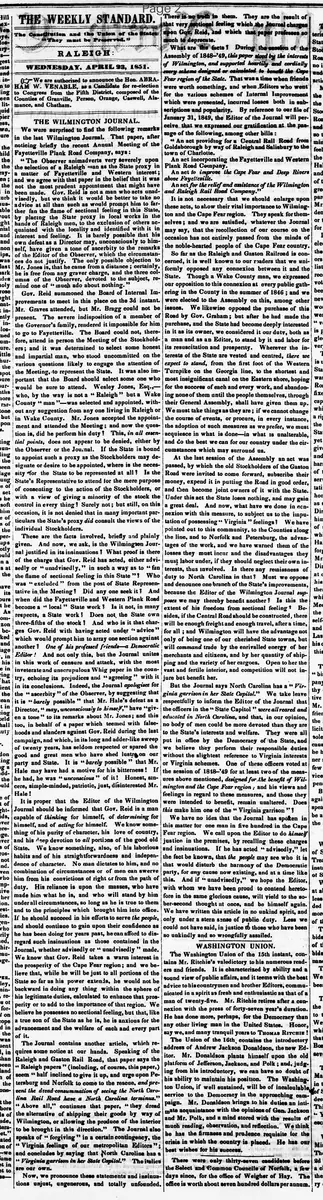
We are authorized to announce the Hon. ABRAHAM W. VENABLE, as a Candidate for re-election to Congress from the Fifth District, composed of the Counties of Granville, Person, Orange, Caswell, Alamance, and Chatham.
THE WILMINGTON JOURNAL.
We were surprised to find the following remarks in the last Wilmington Journal. That paper, after noticing briefly the recent Annual Meeting of the Fayetteville Plank Road Company, says:
"The Observer animadverts very severely upon the selection of a Raleigh man as the State proxy in a matter of Fayetteville and Western interest; and we agree with that paper in the belief that it was not the most prudent appointment that might have been made. Gov. Reid is not a man who acts unadvisedly, but we think it would be better to take no advice at all than such as would prompt him to further fan the flame of sectional feeling in this State, by placing the State proxy in local works in the hands of Raleigh men, to the exclusion of others acquainted with the locality and identified with it in interest and feeling. It is barely possible that his own defeat as a Director may, unconsciously to himself, have given a tone of ascerbity to the remarks of the Editor of the Observer, which the circumstances do not justify. The only possible objection to Mr. Jones is, that he came from a distance; certainly, he is free from any graver charge, and the three columns of the Observer, devoted to the subject, remind one of 'much ado about nothing.'"
Gov. Reid summoned the Board of Internal Improvements to meet in this place on the 3d instant. Mr. Graves attended, but Mr. Bragg could not be present. The severe indisposition of a member of the Governor's family, rendered it impossible for him to go to Fayetteville. The Board could not, therefore, attend in person the Meeting of the Stockholders; and it was determined to select some honest and impartial man, who stood uncommitted on the various questions likely to engage the attention of the Meeting,—to represent the State. It was also important that the Board should select some one who would be sure to attend. Wesley Jones, Esq., who, by the way is not a "Raleigh" but a Wake County "man"—was selected and appointed, without any suggestion from any one living in Raleigh or in Wake County. Mr. Jones accepted the appointment and attended the Meeting: and now the question is, did he perform his duty? This, in all essential points, does not appear to be denied, either by the Observer or the Journal. If the State is bound to appoint such a proxy as the Stockholders may designate or desire to be appointed, where is the necessity for the State to be represented at all? Is the State's Representative to attend for the mere purpose of consenting to the action of the Stockholders, or with a view of giving a minority of the stock the control in every thing? Surely not; but still, on this occasion, it is not denied that in many important particulars the State's proxy did consult the views of the individual Stockholders.
These are the facts involved, briefly and plainly given. And now, we ask, is the Wilmington Journal justified in its insinuations? What proof is there of the charge that Gov. Reid has acted, either advisedly or "unadvisedly," in such a way as to "fan the flame of sectional feeling in this State"? Who was "excluded" from the post of State Representative in the Meeting? Did any one seek it? And when did the Fayetteville and Western Plank Road become a "local" State work? Is it not, in many respects, a State work? Does not the State own three-fifths of the stock? And who is it that charges Gov. Reid with having acted under "advice" which would prompt him to array one section against another? One of his professed friends a Democratic Editor! And not only this, but the Journal unites in this work of censure and attack, with the most inveterate and unscrupulous Whig paper in the country, echoing its prejudices and "agreeing" with it in its conclusions. Indeed, the Journal apologises for the "ascerbity" of the Observer, by suggesting that it is "barely possible" that Mr. Hale's defeat as a Director, "may, unconsciously to himself," have "given a tone" to its remarks about Mr. Jones; and this too, in behalf of a paper which teemed with falsehoods and slanders against Gov. Reid during the last campaign, and which, in its long and adder-like sweep of twenty years, has seldom respected or spared the good and great men who have shed lustre on our party and State. It is "barely possible" that Mr. Hale may have had a motive for his bitterness! If he had, he was "unconscious" of it! Honest, sincere, simple-minded, patriotic, just, disinterested Mr. Hale!
It is proper that the Editor of the Wilmington Journal should be informed that Gov. Reid is a man capable of thinking for himself, of determining for himself, and of acting for himself. We know something of his purity of character, his love of country, and his deep devotion to all portions of the good old State. We know something, also, of his laborious habits and of his straightforwardness and independence of character. No man dictates to him, and no combination of circumstances or of men can swerve him from his convictions of right or from the path of duty. His reliance is upon the masses, who have made him what he is, and who will stand by him under all circumstances, so long as he is true to them and to the principles which brought him into office. If he should succeed in his efforts to serve the people, and should continue to gain upon their confidence as he has been doing for years past, he can afford to disregard such insinuations as those contained in the Journal, whether advisedly or "unadvisedly" made.
We know that Gov. Reid takes a warm interest in the prosperity of the Cape Fear region; and we believe that, while he will be just to all portions of the State so far as his power extends, he would not be backward in doing any thing within the sphere of his legitimate duties, calculated to enhance that prosperity or to add to the importance of that region. We believe he possesses no sectional feeling, but that, like a true son of the State as he is, he is anxious for the advancement and the welfare of each and every part of it.
The Journal contains another article, which requires some notice at our hands. Speaking of the Raleigh and Gaston Rail Road, that paper says the "Raleigh papers" (including, of course, this paper,) seem "half inclined to give it up, and urge upon Petersburg and Norfolk to come to the rescue, and prevent the dread consummation of seeing the North Carolina Rail Road have a North Carolina terminus."
"Above all," continues that paper, "they dread the alternative of shipping their goods by way of Wilmington, or allowing the produce of the interior to be brought in this direction." The Journal also speaks of "forgiving" in a certain contingency, the "Virginia feelings of our metropolitan Editors"; and concludes by saying that North Carolina has a "Virginia garrison in her State Capitol." The italics are our own.
Now, we pronounce these statements and insinuations unjust, ungenerous, and totally unfounded. There is no truth in them. They are the result of that very sectional feeling which the Journal charges upon Gov. Reid, and which that paper professes so much to deprecate.
What are the facts? During the session of the Assembly of 1848-'49, this paper stood by the interest of Wilmington, and supported heartily—and cordially every scheme designed or calculated to benefit the Cape Fear region of the State. That was a time when friends were worth something, and when Editors who went for the various schemes of Internal Improvement which were presented, incurred losses both in subscriptions and popularity. By reference to our file of January 31, 1849, the Editor of the Journal will perceive that we expressed our gratification at the passage of the following, among other bills:
"An act providing for a Central Rail Road from Goldsborough by way of Raleigh and Salisbury to the town of Charlotte.
An act incorporating the Fayetteville and Western Plank Road Company.
An act to improve the Cape Fear and Deep Rivers above Fayetteville.
An act for the relief and assistance of the Wilmington and Raleigh Rail Road Company"
It is not necessary that we should enlarge upon these acts, to show their vital importance to Wilmington and the Cape Fear region. They speak for themselves; and we are satisfied, whatever the Journal may say, that the recollection of our course on the occasion has not entirely passed from the minds of the noble-hearted people of the Cape Fear country.
So far as the Raleigh and Gaston Railroad is concerned, it is well known to our readers that we uniformly opposed any connexion between it and the State. Though a Wake County man, we expressed our opposition to this connexion at every public gathering in the County in the summer of 1846; and we were elected to the Assembly on this, among other issues. We likewise opposed the purchase of this Road by Gov. Graham; but after he had made the purchase, and the State had become deeply interested in it as its owner, we considered it our duty, both as a man and as an Editor, to stand by it and labor for its resuscitation and prosperity. Wherever the interests of the State are vested and centred, there we expect to stand, from the first foot of the Western Turnpike on the Georgia line, to the shortest and most insignificant canal on the Eastern shore, hoping for the success of each and every work, and abandoning none of them until the people themselves, through their General Assembly, shall have given them up.
We must take things as they are; if we cannot change the course of events, or procure, in every instance, the adoption of such measures as we prefer, we must acquiesce in what is done—in what is unalterable, and do the best we can for our country under the circumstances which may surround us.
At the last session of the Assembly an act was passed, by which the old Stockholders of the Gaston Road were invited to come forward, subscribe their money, expend it in putting the Road in good order, and then become joint owners of it with the State. Under this act the State loses nothing, and may gain a great deal. And now, what have we done in connection with this measure, to subject us to the imputation of possessing "Virginia" feelings? We have pointed out to this community, to the Counties along the line, and to Norfolk and Petersburg, the advantages of the work, and we have warned them of the losses they must incur and the disadvantages they must labor under, if they should neglect their own interests, thus involved. Is there any remissness of duty to North Carolina in that? Must we oppose and denounce one branch of the State's improvements, because the Editor of the Wilmington Journal supposes we may thereby benefit another? Is this the extent of his freedom from sectional feeling? Besides, if the Central Road should be constructed, there will be enough freight and enough travel, after a time, for all; and Wilmington will have the advantage not only of being one of our cherished State towns, but will command trade by the unrivalled energy of her merchants and citizens, and by her quantity of shipping and the variety of her cargoes. Open to her the vast and fertile interior, and competition will not injure but benefit her.
But the Journal says North Carolina has a "Virginia garrison in her State Capitol." We take leave respectfully to inform the Editor of the Journal that the officers in the "State Capitol" were all reared and educated in North Carolina, and that, in our opinion, no body of men could be more devoted than they are to the State's interests and welfare. They were all put in office by the Democracy of the State, and we believe they perform their responsible duties without the slightest reference to Virginia interests or Virginia schemes. One of these officers voted at the session of 1848-'49 for at least two of the measures above mentioned, designed for the benefit of Wilmington and the Cape Fear region; and his views and feelings in regard to these measures, and those they were intended to benefit, remain unaltered. Does this make him one of the "Virginia garrison"?
We have no idea that the Journal has spoken in this matter for one man in five hundred in the Cape Fear region. We call upon the Editor to do himself justice in the premises, by recalling these charges and insinuations. If he has acted "advisedly," let the fact be known, that the people may see who it is that would disturb the harmony of the Democratic party, for any cause now existing, and at a time like this. And if "unadvisedly," we hope the Editor, with whom we have been proud to contend heretofore in the same glorious cause, will yield to the sober second thought at once, and be himself again.
We have written this article in no unkind spirit, and only under a stern sense of public duty. Less we could not have said, in justice to those who have been so unkindly and so wrongfully assailed.
The
Justices
and
10
your
by State:
They
must
RALEIGH:
Wednesday, April 23, 1851.
We are authorized to announce the Hon. ABRAHAM W. VENABLE, as a Candidate for re-election to Congress from the Fifth District, composed of the Counties of Granville, Person, Orange, Caswell, Alamance, and Chatham.
THE WILMINGTON JOURNAL.
We were surprised to find the following remarks in the last Wilmington Journal. That paper, after noticing briefly the recent Annual Meeting of the Fayetteville Plank Road Company, says:
"The Observer animadverts very severely upon the selection of a Raleigh man as the State proxy in a matter of Fayetteville and Western interest; and we agree with that paper in the belief that it was not the most prudent appointment that might have been made. Gov. Reid is not a man who acts unadvisedly, but we think it would be better to take no advice at all than such as would prompt him to further fan the flame of sectional feeling in this State, by placing the State proxy in local works in the hands of Raleigh men, to the exclusion of others acquainted with the locality and identified with it in interest and feeling. It is barely possible that his own defeat as a Director may, unconsciously to himself, have given a tone of ascerbity to the remarks of the Editor of the Observer, which the circumstances do not justify. The only possible objection to Mr. Jones is, that he came from a distance; certainly, he is free from any graver charge, and the three columns of the Observer, devoted to the subject, remind one of 'much ado about nothing.'"
Gov. Reid summoned the Board of Internal Improvements to meet in this place on the 3d instant. Mr. Graves attended, but Mr. Bragg could not be present. The severe indisposition of a member of the Governor's family, rendered it impossible for him to go to Fayetteville. The Board could not, therefore, attend in person the Meeting of the Stockholders; and it was determined to select some honest and impartial man, who stood uncommitted on the various questions likely to engage the attention of the Meeting,—to represent the State. It was also important that the Board should select some one who would be sure to attend. Wesley Jones, Esq., who, by the way is not a "Raleigh" but a Wake County "man"—was selected and appointed, without any suggestion from any one living in Raleigh or in Wake County. Mr. Jones accepted the appointment and attended the Meeting: and now the question is, did he perform his duty? This, in all essential points, does not appear to be denied, either by the Observer or the Journal. If the State is bound to appoint such a proxy as the Stockholders may designate or desire to be appointed, where is the necessity for the State to be represented at all? Is the State's Representative to attend for the mere purpose of consenting to the action of the Stockholders, or with a view of giving a minority of the stock the control in every thing? Surely not; but still, on this occasion, it is not denied that in many important particulars the State's proxy did consult the views of the individual Stockholders.
These are the facts involved, briefly and plainly given. And now, we ask, is the Wilmington Journal justified in its insinuations? What proof is there of the charge that Gov. Reid has acted, either advisedly or "unadvisedly," in such a way as to "fan the flame of sectional feeling in this State"? Who was "excluded" from the post of State Representative in the Meeting? Did any one seek it? And when did the Fayetteville and Western Plank Road become a "local" State work? Is it not, in many respects, a State work? Does not the State own three-fifths of the stock? And who is it that charges Gov. Reid with having acted under "advice" which would prompt him to array one section against another? One of his professed friends a Democratic Editor! And not only this, but the Journal unites in this work of censure and attack, with the most inveterate and unscrupulous Whig paper in the country, echoing its prejudices and "agreeing" with it in its conclusions. Indeed, the Journal apologises for the "ascerbity" of the Observer, by suggesting that it is "barely possible" that Mr. Hale's defeat as a Director, "may, unconsciously to himself," have "given a tone" to its remarks about Mr. Jones; and this too, in behalf of a paper which teemed with falsehoods and slanders against Gov. Reid during the last campaign, and which, in its long and adder-like sweep of twenty years, has seldom respected or spared the good and great men who have shed lustre on our party and State. It is "barely possible" that Mr. Hale may have had a motive for his bitterness! If he had, he was "unconscious" of it! Honest, sincere, simple-minded, patriotic, just, disinterested Mr. Hale!
It is proper that the Editor of the Wilmington Journal should be informed that Gov. Reid is a man capable of thinking for himself, of determining for himself, and of acting for himself. We know something of his purity of character, his love of country, and his deep devotion to all portions of the good old State. We know something, also, of his laborious habits and of his straightforwardness and independence of character. No man dictates to him, and no combination of circumstances or of men can swerve him from his convictions of right or from the path of duty. His reliance is upon the masses, who have made him what he is, and who will stand by him under all circumstances, so long as he is true to them and to the principles which brought him into office. If he should succeed in his efforts to serve the people, and should continue to gain upon their confidence as he has been doing for years past, he can afford to disregard such insinuations as those contained in the Journal, whether advisedly or "unadvisedly" made.
We know that Gov. Reid takes a warm interest in the prosperity of the Cape Fear region; and we believe that, while he will be just to all portions of the State so far as his power extends, he would not be backward in doing any thing within the sphere of his legitimate duties, calculated to enhance that prosperity or to add to the importance of that region. We believe he possesses no sectional feeling, but that, like a true son of the State as he is, he is anxious for the advancement and the welfare of each and every part of it.
The Journal contains another article, which requires some notice at our hands. Speaking of the Raleigh and Gaston Rail Road, that paper says the "Raleigh papers" (including, of course, this paper,) seem "half inclined to give it up, and urge upon Petersburg and Norfolk to come to the rescue, and prevent the dread consummation of seeing the North Carolina Rail Road have a North Carolina terminus."
"Above all," continues that paper, "they dread the alternative of shipping their goods by way of Wilmington, or allowing the produce of the interior to be brought in this direction." The Journal also speaks of "forgiving" in a certain contingency, the "Virginia feelings of our metropolitan Editors"; and concludes by saying that North Carolina has a "Virginia garrison in her State Capitol." The italics are our own.
Now, we pronounce these statements and insinuations unjust, ungenerous, and totally unfounded. There is no truth in them. They are the result of that very sectional feeling which the Journal charges upon Gov. Reid, and which that paper professes so much to deprecate.
What are the facts? During the session of the Assembly of 1848-'49, this paper stood by the interest of Wilmington, and supported heartily—and cordially every scheme designed or calculated to benefit the Cape Fear region of the State. That was a time when friends were worth something, and when Editors who went for the various schemes of Internal Improvement which were presented, incurred losses both in subscriptions and popularity. By reference to our file of January 31, 1849, the Editor of the Journal will perceive that we expressed our gratification at the passage of the following, among other bills:
"An act providing for a Central Rail Road from Goldsborough by way of Raleigh and Salisbury to the town of Charlotte.
An act incorporating the Fayetteville and Western Plank Road Company.
An act to improve the Cape Fear and Deep Rivers above Fayetteville.
An act for the relief and assistance of the Wilmington and Raleigh Rail Road Company"
It is not necessary that we should enlarge upon these acts, to show their vital importance to Wilmington and the Cape Fear region. They speak for themselves; and we are satisfied, whatever the Journal may say, that the recollection of our course on the occasion has not entirely passed from the minds of the noble-hearted people of the Cape Fear country.
So far as the Raleigh and Gaston Railroad is concerned, it is well known to our readers that we uniformly opposed any connexion between it and the State. Though a Wake County man, we expressed our opposition to this connexion at every public gathering in the County in the summer of 1846; and we were elected to the Assembly on this, among other issues. We likewise opposed the purchase of this Road by Gov. Graham; but after he had made the purchase, and the State had become deeply interested in it as its owner, we considered it our duty, both as a man and as an Editor, to stand by it and labor for its resuscitation and prosperity. Wherever the interests of the State are vested and centred, there we expect to stand, from the first foot of the Western Turnpike on the Georgia line, to the shortest and most insignificant canal on the Eastern shore, hoping for the success of each and every work, and abandoning none of them until the people themselves, through their General Assembly, shall have given them up.
We must take things as they are; if we cannot change the course of events, or procure, in every instance, the adoption of such measures as we prefer, we must acquiesce in what is done—in what is unalterable, and do the best we can for our country under the circumstances which may surround us.
At the last session of the Assembly an act was passed, by which the old Stockholders of the Gaston Road were invited to come forward, subscribe their money, expend it in putting the Road in good order, and then become joint owners of it with the State. Under this act the State loses nothing, and may gain a great deal. And now, what have we done in connection with this measure, to subject us to the imputation of possessing "Virginia" feelings? We have pointed out to this community, to the Counties along the line, and to Norfolk and Petersburg, the advantages of the work, and we have warned them of the losses they must incur and the disadvantages they must labor under, if they should neglect their own interests, thus involved. Is there any remissness of duty to North Carolina in that? Must we oppose and denounce one branch of the State's improvements, because the Editor of the Wilmington Journal supposes we may thereby benefit another? Is this the extent of his freedom from sectional feeling? Besides, if the Central Road should be constructed, there will be enough freight and enough travel, after a time, for all; and Wilmington will have the advantage not only of being one of our cherished State towns, but will command trade by the unrivalled energy of her merchants and citizens, and by her quantity of shipping and the variety of her cargoes. Open to her the vast and fertile interior, and competition will not injure but benefit her.
But the Journal says North Carolina has a "Virginia garrison in her State Capitol." We take leave respectfully to inform the Editor of the Journal that the officers in the "State Capitol" were all reared and educated in North Carolina, and that, in our opinion, no body of men could be more devoted than they are to the State's interests and welfare. They were all put in office by the Democracy of the State, and we believe they perform their responsible duties without the slightest reference to Virginia interests or Virginia schemes. One of these officers voted at the session of 1848-'49 for at least two of the measures above mentioned, designed for the benefit of Wilmington and the Cape Fear region; and his views and feelings in regard to these measures, and those they were intended to benefit, remain unaltered. Does this make him one of the "Virginia garrison"?
We have no idea that the Journal has spoken in this matter for one man in five hundred in the Cape Fear region. We call upon the Editor to do himself justice in the premises, by recalling these charges and insinuations. If he has acted "advisedly," let the fact be known, that the people may see who it is that would disturb the harmony of the Democratic party, for any cause now existing, and at a time like this. And if "unadvisedly," we hope the Editor, with whom we have been proud to contend heretofore in the same glorious cause, will yield to the sober second thought at once, and be himself again.
We have written this article in no unkind spirit, and only under a stern sense of public duty. Less we could not have said, in justice to those who have been so unkindly and so wrongfully assailed.
What sub-type of article is it?
Partisan Politics
Infrastructure
Trade Or Commerce
What keywords are associated?
Gov Reid Defense
Sectional Feeling
Fayetteville Plank Road
Raleigh Gaston Railroad
Internal Improvements
Wilmington Journal
State Proxy Appointment
Cape Fear Region
What entities or persons were involved?
Gov. Reid
Wesley Jones
Wilmington Journal
Fayetteville Observer
Mr. Hale
Mr. Graves
Mr. Bragg
Abraham W. Venable
Editorial Details
Primary Topic
Defense Of Gov. Reid's Appointment Of State Proxy For Fayetteville Plank Road And Refutation Of Sectionalism Charges
Stance / Tone
Defensive Of Gov. Reid And State Policies, Critical Of Sectional Accusations From Democratic And Whig Papers
Key Figures
Gov. Reid
Wesley Jones
Wilmington Journal
Fayetteville Observer
Mr. Hale
Mr. Graves
Mr. Bragg
Abraham W. Venable
Key Arguments
Appointment Of Wesley Jones As Impartial State Proxy Was Necessary Due To Board Absences And His Attendance Ensured Representation
No Evidence Gov. Reid Fanned Sectional Feelings; Selection Was Unbiased And Not Exclusionary
State Owns Majority Stock In Plank Road, Making It A State Interest Not Purely Local
Wilmington Journal Unjustly Aligns With Whig Observer Against Democratic Gov. Reid
Editor Defends Past Support For Cape Fear Improvements And Opposes Virginia Bias Claims
Raleigh And Gaston Railroad Support Is Duty Bound After State Purchase, Benefits All Without Harming Wilmington
State Capitol Officers Are North Carolina Natives Devoted To State Interests
Call For Journal To Retract Charges To Preserve Democratic Party Harmony