Thank you for visiting SNEWPapers!
Sign up free
Story
January 30, 1806
Rhode Island Republican
Newport, Newport County, Rhode Island
What is this article about?
Journal entries from Dr. Cowdery, an American captive in Tripoli, describe U.S. Navy attacks on the city in August 1804 under Commodore Preble, including captures, a gunboat explosion, and prisoners' petition against mistreatment.
Clipping
OCR Quality
95%
Excellent
Full Text
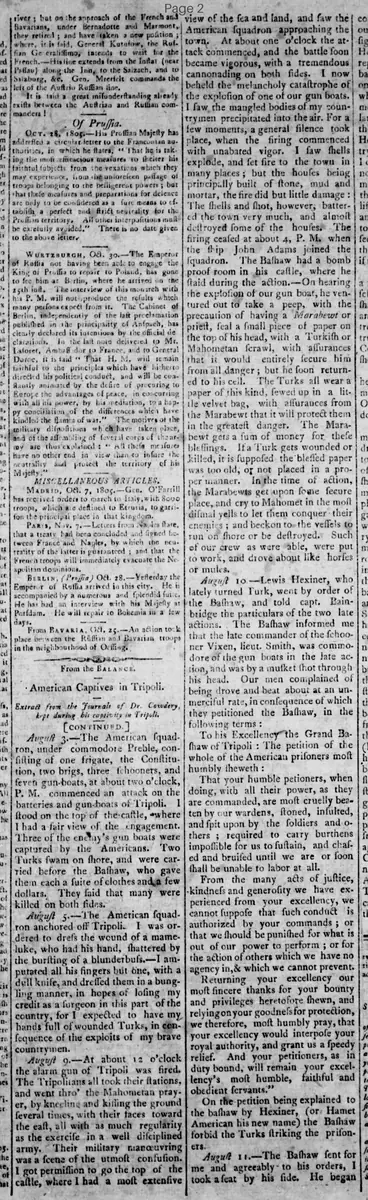
From the Balance.
American Captives in Tripoli.
Extract from the Journals of Dr. Cowdery, kept during his captivity in Tripoli.
[continued.]
August 3.—The American Squadron, under commodore Preble, consisting of one frigate, the Constitution, two brigs, three schooners, and seven gun-boats, at about two o'clock, P. M. commenced an attack on the batteries and gun-boats of Tripoli. I stood on the top of the castle, where I had a fair view of the engagement. Three of the enemy's gun boats were captured by the Americans. Two Turks swam on shore, and were carried before the Bashaw, who gave them each a suit of clothes and a few dollars. They said that many were killed on both sides.
August 5.—The American squadron anchored off Tripoli. I was ordered to dress the wound of a Maltese, who had his hand shattered by the bursting of a blunderbuss.—I amputated all his fingers but one, with a dull knife, and dressed them in a bungling manner, in hopes of losing my credit as a surgeon in this part of the country, for I expected to have my hands full of wounded Turks, in consequence of the exploits of my brave countrymen.
August 9.—At about 12 o'clock the alarm gun of Tripoli was fired. The Tripolitans all took their stations, and went thro' the Mahometan prayer, by kneeling and kissing the ground several times, with their faces toward the east, all with as much regularity as the exercise in a well disciplined army. Their military manœuvring was a scene of the utmost confusion. I got permission to go the top of the castle, where I had a most extensive view of the sea and land, and saw the American squadron approaching the town. At about one o'clock the attack commenced, and the battle soon became vigorous, with a tremendous cannonading on both sides. I now beheld the melancholy catastrophe of the explosion of one of our gun boats. I saw the mangled bodies of my countrymen precipitated into the air. For a few moments, a general silence took place, when the firing commenced with unabated vigor. I saw shells explode, and set fire to the town in many places; but the houses being principally built of stone, mud and mortar, the fire did but little damage: The shells and shot, however, battered the town very much, and almost destroyed some of the houses. The firing ceased at about 4, P. M. when the Ship John Adams joined the squadron. The Bashaw had a bomb proof room in his castle, where he staid during the action.—On hearing the explosion of our gun boat, he ventured out to take a peep, with the precaution of having a Marabutt or priest, seal a small piece of paper on the top of his head, with a Turkish or Mahometan charm, with assurances that it would entirely secure him from all danger; but he soon returned to his cell. The Turks all wear a paper of this kind, sewed up in a little velvet bag, with assurances from the Marabutt that it will protect them in the greatest danger. The Marabutt gets a sum of money for these blessings. If a Turk gets wounded or killed, it is supposed the blessed paper was too old; or not placed in a proper manner. In the time of action, the Marabutts get upon some secure place, and cry to Mahomet in the most dismal yells to let them conquer their enemies; and beckon to the vessels to run on shore or be destroyed. Such of our crew as were able, were put to work, and drove about like horses or mules.
August 10—Lewis Heximer, who lately turned Turk, went by order of the Bashaw, and told capt. Bainbridge the particulars of the two late actions. The Bashaw informed me that the late commander of the schooner Vixen, lieut. Smith, was commodore of the gun boats in the late action, and was by a musket shot through his head. Our men complained of being drove and beat about at an unmerciful rate, in consequence of which they petitioned the Bashaw, in the following terms:
To his Excellency the Grand Bashaw of Tripoli: The petition of the whole of the American prisoners most humbly sheweth:
That your humble petitioners, when doing, with all their power, as they are commanded, are most cruelly beaten by our wardens, stoned, insulted, and spit upon by the soldiers and others; required to carry burthens impossible for us to sustain, and chased and bruised until we are or soon shall be unable to labor at all.
From the many acts of justice, kindness and generosity we have experienced from your excellency, we cannot suppose that such conduct is authorized by your commands; or that we should be punished for what is out of our power to perform; or for the action of others which we have no agency in, & which we cannot prevent.
Returning your excellency our most sincere thanks for your bounty and privileges heretofore shewn, and relying on your goodness for protection, we therefore, most humbly pray, that your excellency would interpose your royal authority, and grant us a speedy relief. And your petitioners, as in duty bound, will remain your excellency's most humble, faithful and obedient servants.
American Captives in Tripoli.
Extract from the Journals of Dr. Cowdery, kept during his captivity in Tripoli.
[continued.]
August 3.—The American Squadron, under commodore Preble, consisting of one frigate, the Constitution, two brigs, three schooners, and seven gun-boats, at about two o'clock, P. M. commenced an attack on the batteries and gun-boats of Tripoli. I stood on the top of the castle, where I had a fair view of the engagement. Three of the enemy's gun boats were captured by the Americans. Two Turks swam on shore, and were carried before the Bashaw, who gave them each a suit of clothes and a few dollars. They said that many were killed on both sides.
August 5.—The American squadron anchored off Tripoli. I was ordered to dress the wound of a Maltese, who had his hand shattered by the bursting of a blunderbuss.—I amputated all his fingers but one, with a dull knife, and dressed them in a bungling manner, in hopes of losing my credit as a surgeon in this part of the country, for I expected to have my hands full of wounded Turks, in consequence of the exploits of my brave countrymen.
August 9.—At about 12 o'clock the alarm gun of Tripoli was fired. The Tripolitans all took their stations, and went thro' the Mahometan prayer, by kneeling and kissing the ground several times, with their faces toward the east, all with as much regularity as the exercise in a well disciplined army. Their military manœuvring was a scene of the utmost confusion. I got permission to go the top of the castle, where I had a most extensive view of the sea and land, and saw the American squadron approaching the town. At about one o'clock the attack commenced, and the battle soon became vigorous, with a tremendous cannonading on both sides. I now beheld the melancholy catastrophe of the explosion of one of our gun boats. I saw the mangled bodies of my countrymen precipitated into the air. For a few moments, a general silence took place, when the firing commenced with unabated vigor. I saw shells explode, and set fire to the town in many places; but the houses being principally built of stone, mud and mortar, the fire did but little damage: The shells and shot, however, battered the town very much, and almost destroyed some of the houses. The firing ceased at about 4, P. M. when the Ship John Adams joined the squadron. The Bashaw had a bomb proof room in his castle, where he staid during the action.—On hearing the explosion of our gun boat, he ventured out to take a peep, with the precaution of having a Marabutt or priest, seal a small piece of paper on the top of his head, with a Turkish or Mahometan charm, with assurances that it would entirely secure him from all danger; but he soon returned to his cell. The Turks all wear a paper of this kind, sewed up in a little velvet bag, with assurances from the Marabutt that it will protect them in the greatest danger. The Marabutt gets a sum of money for these blessings. If a Turk gets wounded or killed, it is supposed the blessed paper was too old; or not placed in a proper manner. In the time of action, the Marabutts get upon some secure place, and cry to Mahomet in the most dismal yells to let them conquer their enemies; and beckon to the vessels to run on shore or be destroyed. Such of our crew as were able, were put to work, and drove about like horses or mules.
August 10—Lewis Heximer, who lately turned Turk, went by order of the Bashaw, and told capt. Bainbridge the particulars of the two late actions. The Bashaw informed me that the late commander of the schooner Vixen, lieut. Smith, was commodore of the gun boats in the late action, and was by a musket shot through his head. Our men complained of being drove and beat about at an unmerciful rate, in consequence of which they petitioned the Bashaw, in the following terms:
To his Excellency the Grand Bashaw of Tripoli: The petition of the whole of the American prisoners most humbly sheweth:
That your humble petitioners, when doing, with all their power, as they are commanded, are most cruelly beaten by our wardens, stoned, insulted, and spit upon by the soldiers and others; required to carry burthens impossible for us to sustain, and chased and bruised until we are or soon shall be unable to labor at all.
From the many acts of justice, kindness and generosity we have experienced from your excellency, we cannot suppose that such conduct is authorized by your commands; or that we should be punished for what is out of our power to perform; or for the action of others which we have no agency in, & which we cannot prevent.
Returning your excellency our most sincere thanks for your bounty and privileges heretofore shewn, and relying on your goodness for protection, we therefore, most humbly pray, that your excellency would interpose your royal authority, and grant us a speedy relief. And your petitioners, as in duty bound, will remain your excellency's most humble, faithful and obedient servants.
What sub-type of article is it?
Historical Event
Military Action
Naval Engagement
What themes does it cover?
Bravery Heroism
Misfortune
Justice
What keywords are associated?
American Squadron
Tripoli Attack
Gunboat Explosion
Prisoner Petition
Barbary War
Captivity Journal
What entities or persons were involved?
Dr. Cowdery
Commodore Preble
Bashaw
Capt. Bainbridge
Lieut. Smith
Lewis Heximer
Where did it happen?
Tripoli
Story Details
Key Persons
Dr. Cowdery
Commodore Preble
Bashaw
Capt. Bainbridge
Lieut. Smith
Lewis Heximer
Location
Tripoli
Event Date
August 3, 5, 9, 10, 1804
Story Details
Dr. Cowdery records U.S. squadron attacks on Tripoli batteries and gunboats, capturing enemy vessels; treats a wounded Maltese; witnesses chaotic Tripolitan preparations, intense battle with gunboat explosion killing Americans including Lieut. Smith, town bombardment; describes Turkish charms and prayers; prisoners petition Bashaw against cruel treatment.