Thank you for visiting SNEWPapers!
Sign up free
Lincoln Telegraph
Bath, Sagadahoc County, Maine
What is this article about?
Account of the June 11 celebration at Fort Meigs, with speeches by Thomas Ewing, Mr. Schenck, George C. Bates, Col. Clarkson, and others praising General Harrison's bravery in the War of 1812, including anecdotes from the siege, amid Whig political enthusiasm for the 1840 election.
Merged-components note: Continuation of the Fort Meigs celebration story across pages.
Clippings
1 of 2
OCR Quality
Full Text
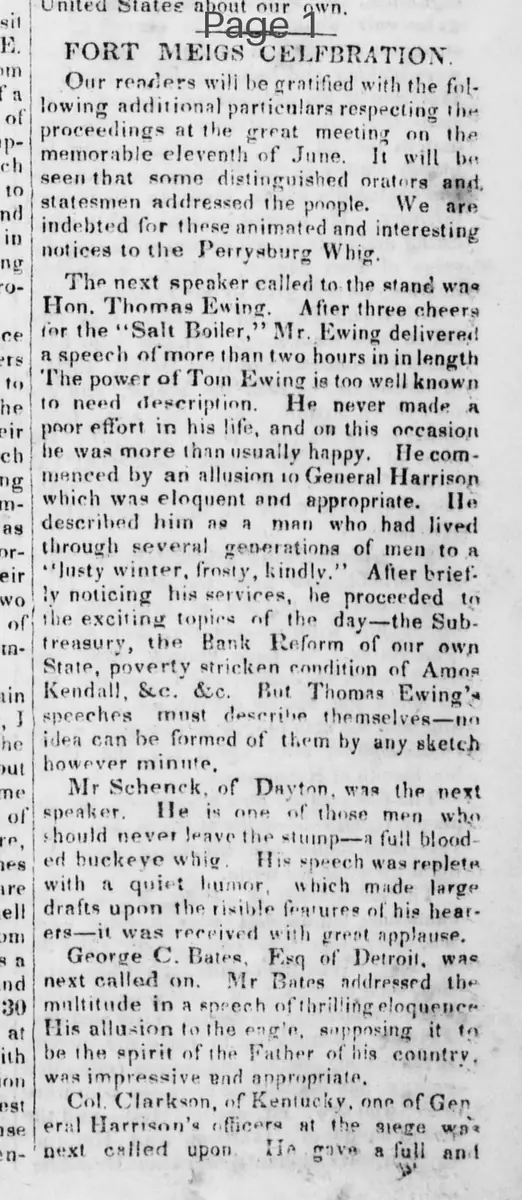
Our readers will be gratified with the following additional particulars respecting the proceedings at the great meeting on the memorable eleventh of June. It will be seen that some distinguished orators and, statesmen addressed the people. We are indebted for these animated and interesting notices to the Perrysburg Whig.
The next speaker called to the stand was Hon. Thomas Ewing. After three cheers for the "Salt Boiler," Mr. Ewing delivered a speech of more than two hours in length The power of Thomas Ewing is too well known to need description. He never made a poor effort in his life, and on this occasion he was more than usually happy. He commenced by an allusion to General Harrison which was eloquent and appropriate. He described him as a man who had lived through several generations of men to a "lusty winter, rosy, kindly." After briefly noticing his services, he proceeded to the exciting topics of the day—the Sub-treasury, the Bank Reform of our own State, poverty stricken condition of Amos Kendall, &c. &c. But Thomas Ewing's speeches must describe themselves—no idea can be formed of them by any sketch however minute.
Mr Schenck, of Dayton, was the next speaker. He is one of those men who should never leave the stump—a full blooded buckeye whig. His speech was replete with a quiet humor, which made large drafts upon the risible features of his hearers—it was received with great applause.
George C. Bates, Esq of Detroit. was next called on. Mr Bates addressed the multitude in a speech of thrilling eloquence His allusion to the eagle, supposing it to be the spirit of the Father of his country. was impressive and appropriate.
Col. Clarkson, of Kentucky, one of Gen eral Harrison's officers at the siege was next called upon He gave a full and
Circumstantial account of the sortie, pointed out the localities, and told some truths of General Harrison, which proves him anything but a "coward." He said that a cannon ball was shot directly through the General's marquee, on the first day of the siege, that a bomb fell once directly under the General's table while he and his officers were at dinner, and that it burst there, and that the General did not "run away from it." He told of the General's custom of walking along the front line of embankments, where balls came the thickest and fastest, and among other things which have been denied by the Loco-foco party, he did say that General Harrison had been wounded in battle!! Nay, he even went so far as to assert that he had seen General Harrison, in such dangerous situations, repeatedly, that he had thought his escape with his life was a miracle, and that nothing but an overruling Providence, who had preserved his life for some great purpose, had interposed between him and the grave. He said, too, that the first man to land on the Canada shore, in pursuit of the British, at the time they were overtaken at the Thames, was Gen. Wm. H. Harrison. "And the second," said he, "fellow-citizens," is now sitting before me in the person of his gallant aid, Col. Todd of Kentucky.
After Colonel Clarkson had concluded, the Convention took a recess of an hour and a half, during which, the multitude, but few of which dispersed, were addressed by Mr. Saxton, an old Revolutionary Soldier from Connecticut, and James Fitch another from Fredonia, N. Y. The former of these veterans told the people that all the soldiers of the Revolution living were Whigs in '76, and were Whigs in '40. He said that he had known General Harrison, and that none but a Tory—a Tory of the old and new schools would brand him with a degrading epithet.
The tents of different military companies and delegations were pitched along the front embankment of the fort. We counted two hundred, but this was not the half—many were pitched along the outskirts of the forest in rear of the fort, and some of the delegations constructed rude wigwams of buckeyes, and other bowers; others used Buffalo robes, and slept in the wilderness, and very many walked the streets and the fort during the night previous to the celebration and sung Tippecanoe songs.
Let us now return to the speaker's stand, and listen to the oration, commemorative of the civil and military services of Gen. Harrison, prepared for the occasion by Hon. E. Cook, of Sandusky city. Mr. Cook is one of the happiest speakers in Northern Ohio. His oration occupied about an hour and a half in delivering, was written in glowing style, with great power of language and felicity of expression. Col. Todd, of Kentucky, one of the regular aids of Gen. Harrison during the last war, was called to the stand. He commenced by saying to the multitude that "If Gen. Harrison had been commander of as many true hearts in May, 1813, as appeared here to-day to honor him, Gen. Proctor never would have left that field." He bore thrilling evidence of the personal bravery of his old commander. "I was with him," said he, "and knew all his plans, and can testify as well to his skill as a military tactician as to his bravery in the field. I was with him here, and on the Thames—he fought there, and was the author of the charge upon the British by Col. Johnson's company of Infantry." This had been ascribed by some to Gov. Shelby; Col. Todd, who is the son-in-law of Gov. Shelby, repelled this charge as false, and as his living representative declared, that the Hero of King's Mountain, were he living, would spurn it with indignation. He spoke of the soldier's honor as his only wealth, and in terms of the strongest reprobation of the efforts which were making, and being made, to rob Gen. Harrison of his well-earned laurels. He said that Gen. Harrison was the only man in the last war, notwithstanding the bloody battles on the Niagara frontier, who had captured a whole army in their own territory. He related several highly interesting incidents which occurred during the siege of Fort Meigs, which, when less hurried, we will give to our readers.
Our friend Titus, of Toledo, was now called upon for a song. Those who have heard him once do not tire; twice, thrice, in succession, he took the stand, and yet they called for him again. He sung, in addition to the National Whig Song, to the tune of Marseilles Hymn, and "Up Salt River," another, prepared especially for the occasion to the tune of the "Hunters of Kentucky."
Mr. Chamberlain, a blacksmith, from Kinderhook, now took the stand. Here was an odd genius, full of anecdote and humor, and witness—not for, but against Van Buren. "I have known him," said he, "I knew his daddy, and I can tell you all about him," and he did tell us all about him, and his acts too, in a manner which excited shout after shout for the Whig blacksmith of Kinderhook.
The Convention now adjourned, but the people remained—many of them are there yet—their shouts are breaking upon the night air while we write.
The celebration is over. Those who came have left us, but who among them will carry away less enthusiasm than he brought? What mechanic, what log-cabin boy, what merchant, or professional man, will not remember the doings of the past day? Let it be a watchword to rally the people at the coming contest, and infuse redoubled energy into the bosoms of those who were here, who saw, heard, participated—and the broad banner of "Harrison and Reform" will wave triumphantly over this Republic.
What sub-type of article is it?
What themes does it cover?
What keywords are associated?
What entities or persons were involved?
Where did it happen?
Story Details
Key Persons
Location
Fort Meigs
Event Date
Eleventh Of June
Story Details
Detailed account of speeches, orations, songs, and anecdotes at the Fort Meigs celebration honoring General Harrison's military services during the War of 1812, defending his bravery against political attacks, with Whig rally enthusiasm for the 1840 election.