Thank you for visiting SNEWPapers!
Sign up free
Alexandria Gazette & Daily Advertiser
Alexandria, Virginia
What is this article about?
Napoleon Bonaparte died on May 5 at St. Helena, coinciding with the anniversary of his Elba landing. The London Courier reflects on his unostentatious end, contrasting it with his tyrannical career, originality, and lack of lasting positive legacy.
Clipping
OCR Quality
Full Text
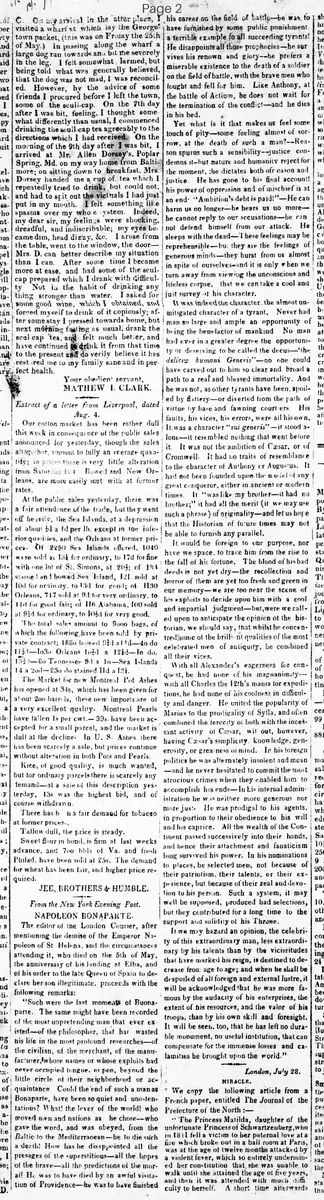
NAPOLEON BONAPARTE.
The editor of the London Courier, after mentioning the demise of the Emperor Napoleon of St. Helena, and the circumstances attending it, who died on the 5th of May, the anniversary of his landing at Elba, and of his order to the late Queen of Spain to declare her son illegitimate, proceeds with the following remarks:
"Such were the last moments of Buonaparte. The same might have been recorded of the most unpretending man that ever existed--of the philosopher, that had wasted his life in the most profound researches--of the civilian, of the merchant, of the manufacturer, whose names or whose exploits had never occupied tongue, or pen, beyond the little circle of their neighborhood or acquaintance. Could the end of such a man as Bonaparte, have been so quiet and unostentatious? What! the lever of the world! who moved men and nations as he chose--who gave the word, and was obeyed, from the Baltic to the Mediterranean--be to die such a death! How has he disappointed all the presages of the superstitious--all the hopes of the brave--all the predictions of the moralist! He was to have died by an awful visitation of Providence--he was to have finished his career on the field of battle--he was to have furnished by some public punishment a terrible example to all succeeding tyrants! He disappoints all those prophecies--he survives his renown and glory--he prefers a miserable existence to the death of a soldier on the field of battle, with the brave men who fought and fell for him. Like Anthony, at the battle of Actium, he does not wait for the termination of the conflict--and he dies in his bed.
Yet what is it that makes us feel some touch of pity--some feeling almost of sorrow, at the death of such a man?--Reason spurns such a sensibility--justice condemns it--but nature and humanity reject for the moment, the dictates both of reason and justice. He has gone to his final account! his power of oppression and of mischief is at an end. "Ambition's debt is paid!"--He can harm us no longer--he hears us no more--he cannot reply to our accusations--he can not defend himself from our attack. He sleeps with the dead--These feelings may be reprehensible--but they are the feelings of generous minds--they burst from us almost in spite of ourselves--and it is only when we turn away from viewing the unconscious and lifeless corpse, that we can take a cool and just survey of his character.
It was indeed the character, the almost unmitigated character of a tyrant. Never had man so large and ample an opportunity of being the benefactor of mankind. No man had ever in a greater degree the opportunity of deserving to be called the decus--the deliciae humani Generis"--no one could have carved out to him so clear and broad a path to a real and blessed immortality. And he was not, as other tyrants have been, spoiled by flattery--or diverted from the path of virtue by base and fawning courtiers. His faults, his vices, his errors, were all his own. It was a character "sui generis"--it stood alone--it resembled nothing that went before it. It was not the ambition of Caesar, or of Cromwell, it had no traits of resemblance to the character of Anthony or Augustus. It had not been founded upon the model of any great conqueror, either in ancient or modern times. It "was like my brother--it had no brother;" it had all the merit (if we may use such a phrase) of originality--and let us hope that the Historian of future times may not be able to furnish any parallel.
It would be foreign to our purpose, nor have we space, to trace him from the rise to the fall of his fortune. The blood of his bad deeds is not yet dry--the recollection and horror of them are yet too fresh and green in our memory--we are too near the scene of his exploits to decide upon him with a cool and impartial judgment--but, were we called upon to anticipate the opinion of the historian, we should say, that whilst he concentred some of the brilliant qualities of the most celebrated men of antiquity, he combined all their vices.
With all Alexander's eagerness for conquest, he had none of his magnanimity--with all Charles the 12th's mania for expeditions, he had none of his coolness in difficulty and danger. He united the popularity of Marius to the prodigality of Sylla, and often combined the ferocity of both with the incessant activity of Caesar, without, however, having Caesar's simplicity, knowledge, generosity, or greatness of mind. In his foreign politics he was alternately insolent and mean--and he never hesitated to commit the most atrocious crimes when they enabled him to accomplish his ends--In his internal administration he was neither more generous nor more just. He was prodigal to his agents, in proportion to their obedience to his will and his caprice. All the wealth of the Continent passed successively into their hands, and hence their attachment and fanaticism long survived his power. In his nominations to places, he selected men, not because of their patriotism, their talents, or their experience, but because of their zeal and devotion to his person. Such a system, it may well be supposed, produced bad selections, but they contributed for a long time to the support and solidity of his Throne.
If we may hazard an opinion, the celebrity of this extraordinary man, less extraordinary by his talents than by the vicissitudes that have marked his reign, is destined to decrease from age to age; and when he shall be despoiled of all foreign and external lustre, it will be acknowledged but he was more famous by the audacity of his enterprises, the extent of his resources, and the valor of his troops, than by his own skill and foresight. It will be seen, too, that he has left no durable monument, no useful institution, that can compensate for the immense losses and calamities he brought upon the world."
What sub-type of article is it?
What keywords are associated?
What entities or persons were involved?
Where did it happen?
Foreign News Details
Primary Location
St. Helena
Event Date
5th Of May
Key Persons
Outcome
died quietly and unostentatiously in his bed, ending his power of oppression.
Event Details
The London Courier reports the death of Emperor Napoleon Bonaparte on the 5th of May at St. Helena, notes the circumstances and anniversaries, and offers remarks on his character as a unique tyrant who squandered opportunities to benefit mankind, combining vices of historical figures without their virtues, with a legacy destined to fade.