Thank you for visiting SNEWPapers!
Sign up free
Republican Herald
Providence, Providence County, Rhode Island
What is this article about?
Accounts of the origins of 'Judge Lynch' and Lynch Law: a Pennsylvania farmer story involving a poacher, a Kentucky tale with Daniel Boone trying an Indian horse thief, and a 1833 Mississippi hanging. Discusses vigilante justice among pioneers.
Clipping
OCR Quality
Full Text
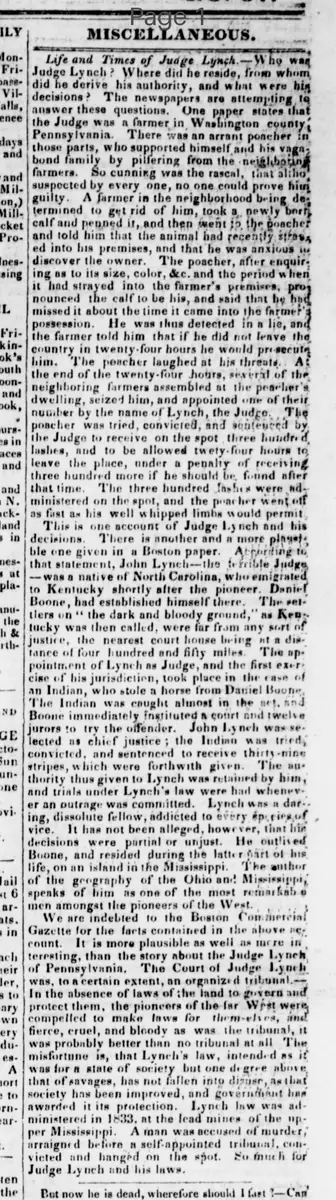
Life and Times of Judge Lynch.—Who was Judge Lynch? Where did he reside, from whom did he derive his authority, and what were his decisions? The newspapers are attempting to answer these questions. One paper states that the Judge was a Farmer in Washington county Pennsylvania. There was an arrant poacher in those parts, who supported himself and his vagabond family by pilfering from the neighboring farmers. So cunning was the rascal, that altho suspected by every one, no one could prove him guilty. A farmer in the neighborhood being determined to get rid of him, took a newly born calf and penned it, and then went to the poacher and told him that the animal had recently strayed into his premises, and that he was anxious to discover the owner. The poacher, after enquiring as to its size, color, &c. and the period when it had strayed into the farmer's possession, pronounced the calf to be his, and said that he had missed it about the time it came into the farmer's possession. He was thus detected in a lie, and the farmer told him that if he did not leave the country in twenty-four hours he would prosecute him. The poacher laughed at his threat. At the end of the twenty-four hours, several of the neighboring farmers assembled at the poacher's dwelling, seized him, and appointed one of their number by the name of Lynch, the Judge. The poacher was tried, convicted, and sentenced by the Judge to receive on the spot three hundred lashes, and to be allowed twenty-four hours to leave the place, under a penalty of receiving three hundred more if he should be found after that time. The three hundred lashes were administered on the spot, and the poacher went off as fast as his well whipped limbs would permit. This is one account of Judge Lynch and his decisions.
There is another and a more plausible one given in a Boston paper. According to that statement, John Lynch—the terrible Judge—was a native of North Carolina, who emigrated to Kentucky shortly after the pioneer, Daniel Boone, had established himself there. The settlers on "the dark and bloody ground," as Kentucky was then called, were far from any sort of justice, the nearest court house being at a distance of four hundred and fifty miles. The appointment of Lynch as Judge, and the first exercise of his jurisdiction, took place in the case of an Indian, who stole a horse from Daniel Boone. The Indian was caught almost in the act, and Boone immediately instituted a court and twelve jurors to try the offender. John Lynch was selected as chief justice; the Indian was tried, convicted, and sentenced to receive thirty-nine stripes, which were forthwith given. The authority thus given to Lynch was retained by him, and trials under Lynch's law were had whenever an outrage was committed. Lynch was a daring, dissolute fellow, addicted to every species of vice. It has not been alleged, however, that his decisions were partial or unjust. He outlived Boone, and resided during the latter part of his life, on an island in the Mississippi. The author of the geography of the Ohio and Mississippi, speaks of him as one of the most remarkable men amongst the pioneers of the West.
We are indebted to the Boston Commercial Gazette for the facts contained in the above narrative. It is more plausible as well as more interesting, than the story about the Judge Lynch of Pennsylvania. The Court of Judge Lynch was, to a certain extent, an organized tribunal.—In the absence of laws of the land to govern and protect them, the pioneers of the far West were compelled to make laws for themselves, and fierce, cruel, and bloody as was the tribunal, it was probably better than no tribunal at all. The misfortune is, that Lynch's law, intended as it was for a state of society but one degree above that of savages, has not fallen into disuse, as that society has been improved, and government has awarded it its protection. Lynch Law was administered in 1833, at the lead mines of the upper Mississippi. A man was accused of murder, arraigned before a self-appointed tribunal, convicted and hanged on the spot. So much for Judge Lynch and his laws.
What sub-type of article is it?
What themes does it cover?
What keywords are associated?
What entities or persons were involved?
Where did it happen?
Story Details
Key Persons
Location
Washington County Pennsylvania; Kentucky; Mississippi Island; Upper Mississippi Lead Mines
Event Date
Shortly After Daniel Boone Established In Kentucky; 1833
Story Details
Two accounts of Judge Lynch's origins: Pennsylvania farmers whip a poacher after trapping him in a lie, appointing Lynch as judge; in Kentucky, Lynch judges an Indian horse thief for Boone, establishing vigilante law among pioneers, later used in 1833 hanging.