Thank you for visiting SNEWPapers!
Sign up free
Literary
February 11, 1785
Fowle's New Hampshire Gazette And General Advertiser
Portsmouth, Rockingham County, New Hampshire
What is this article about?
In this excerpt from Dr. Price's Observations, he argues that civil magistrates should not suppress public discussion of any doctrines, sacred or dangerous, as this leads to persecution and hinders truth. He cites historical examples like Socrates, Galileo, and early Christianity, advocating for government neutrality to protect free inquiry and civil rights.
Clipping
OCR Quality
98%
Excellent
Full Text
From Doctor Price's Observations.
(CONTINUED.)
Of LIBERTY of DISCUSSION.
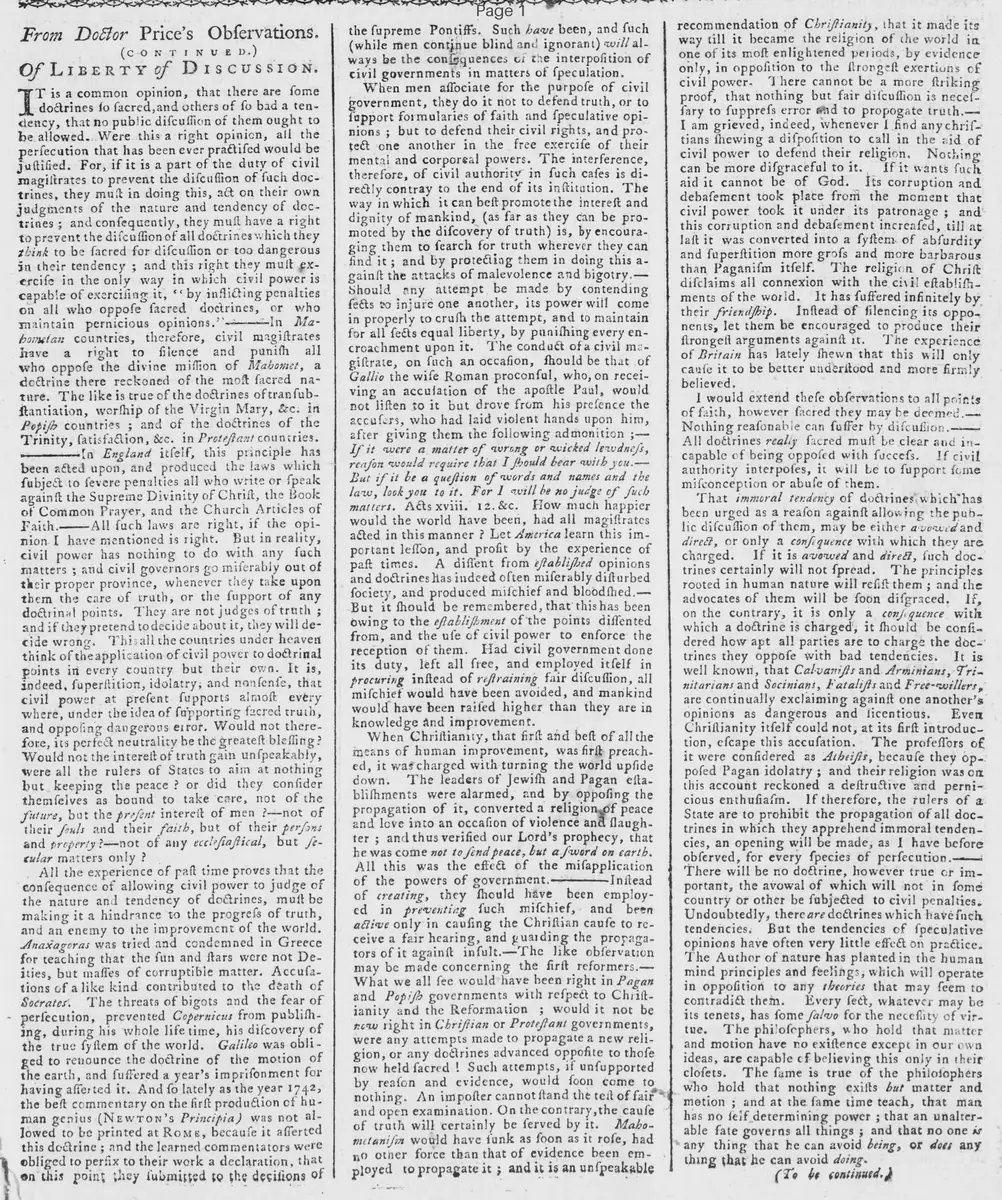
It is a common opinion, that there are some doctrines so sacred, and others of so bad a tendency, that no public discussion of them ought to be allowed. Were this a right opinion, all the persecution that has been ever practised would be justified. For, if it is a part of the duty of civil magistrates to prevent the discussion of such doctrines, they must in doing this, act on their own judgments of the nature and tendency of doctrines; and consequently, they must have a right to prevent the discussion of all doctrines which they think to be sacred for discussion or too dangerous in their tendency; and this right they must exercise in the only way in which civil power is capable of exercising it, by inflicting penalties on all who oppose sacred doctrines, or who maintain pernicious opinions. In Mahometan countries, therefore, civil magistrates have a right to silence and punish all who oppose the divine mission of Mahomet, a doctrine there reckoned of the most sacred nature. The like is true of the doctrines of transubstantiation, worship of the Virgin Mary, &c. in Popish countries: and of the doctrines of the Trinity, satisfaction, &c. in Protestant countries. In England itself, this principle has been acted upon, and produced the laws which subject to severe penalties all who write or speak against the Supreme Divinity of Christ, the Book of Common Prayer, and the Church Articles of Faith. All such laws are right, if the opinion I have mentioned is right. But in reality, civil power has nothing to do with any such matters; and civil governors go miserably out of their proper province, whenever they take upon them the care of truth, or the support of any doctrinal points. They are not judges of truth; and if they pretend to decide about it, they will decide wrong. This all the countries under heaven think of the application of civil power to doctrinal points in every country but their own. It is, indeed, superstition, idolatry, and nonsense, that civil power at present supports almost everywhere, under the idea of supporting sacred truth, and opposing dangerous error. Would not therefore, its perfect neutrality be the greatest blessing? Would not the interest of truth gain unspeakably, were all the rulers of States to aim at nothing but keeping the peace? or did they consider themselves as bound to take care, not of the future, but the present interest of men?---not of their Souls and their faith, but of their persons and property?---not of any ecclesiastical, but secular matters only?
All the experience of past time proves that the consequence of allowing civil power to judge of the nature and tendency of doctrines, must be making it a hindrance to the progress of truth, and an enemy to the improvement of the world. Anaxagoras was tried and condemned in Greece for teaching that the sun and stars were not Deities, but masses of corruptible matter. Accusations of a like kind contributed to the death of Socrates. The threats of bigots and the fear of persecution, prevented Copernicus from publishing, during his whole life time, his discovery of the true system of the world. Galileo was obliged to renounce the doctrine of the motion of the earth, and suffered a year's imprisonment for having asserted it. And so lately as the year 1742, the best commentary on the first production of human genius (Newton's Principia) was not allowed to be printed at Rome, because it asserted this doctrine; and the learned commentators were obliged to prefix to their work a declaration, that on this point they submitted to the decisions of the supreme Pontiffs. Such have been, and such (while men continue blind and ignorant) will always be the consequences of the interposition of civil governments in matters of speculation.
When men associate for the purpose of civil government, they do it not to defend truth, or to support formularies of faith and speculative opinions; but to defend their civil rights, and protect one another in the free exercise of their mental and corporeal powers. The interference, therefore, of civil authority in such cases is directly contrary to the end of its institution. The way in which it can best promote the interest and dignity of mankind, (as far as they can be promoted by the discovery of truth) is, by encouraging them to search for truth wherever they can find it; and by protecting them in doing this against the attacks of malevolence and bigotry. Should any attempt be made by contending sects to injure one another, its power will come in properly to crush the attempt, and to maintain for all sects equal liberty, by punishing every encroachment upon it. The conduct of a civil magistrate, on such an occasion, should be that of Gallio the wise Roman proconsul, who, on receiving an accusation of the apostle Paul, would not listen to it but drove from his presence the accusers, who had laid violent hands upon him, after giving them the following admonition;-- If it were a matter of wrong or wicked lewdness, reason would require that I should bear with you. But if it be a question of words and names and the law, look you to it. For I will be no judge of such matters. Acts xviii. 12.&c. How much happier would the world have been, had all magistrates acted in this manner? Let America learn this important lesson, and profit by the experience of past times. A dissent from established opinions and doctrines has indeed often miserably disturbed society, and produced mischief and bloodshed. But it should be remembered, that this has been owing to the establishment of the points dissented from, and the use of civil power to enforce the reception of them. Had civil government done its duty, left all free, and employed itself in procuring instead of restraining fair discussion, all mischief would have been avoided, and mankind would have been raised higher than they are in knowledge and improvement.
When Christianity, that first and best of all the means of human improvement, was first preached, it was charged with turning the world upside down. The leaders of Jewish and Pagan establishments were alarmed, and by opposing the propagation of it, converted a religion of peace and love into an occasion of violence and slaughter; and thus verified our Lord's prophecy, that he was come not to send peace, but a sword on earth. All this was the effect of the misapplication of the powers of government. Instead of creating, they should have been employed in preventing such mischief, and been active only in causing the Christian cause to receive a fair hearing, and guarding the propagators of it against insult. The like observation may be made concerning the first reformers. What we all see would have been right in Pagan and Popish governments with respect to Christianity and the Reformation; would it not be now right in Christian or Protestant governments, were any attempts made to propagate a new religion, or any doctrines advanced opposite to those now held sacred! Such attempts, if unsupported by reason and evidence, would soon come to nothing. An imposter cannot stand the test of fair and open examination. On the contrary, the cause of truth will certainly be served by it. Mahometanism would have sunk as soon as it rose, had no other force than that of evidence been employed to propagate it; and it is an unspeakable recommendation of Christianity, that it made its way till it became the religion of the world in one of its most enlightened periods, by evidence only, in opposition to the strongest exertions of civil power. There cannot be a more striking proof, that nothing but fair discussion is necessary to suppress error and to propagate truth.
I am grieved, indeed, whenever I find any Christians shewing a disposition to call in the aid of civil power to defend their religion. Nothing can be more disgraceful to it. If it wants such aid it cannot be of God. Its corruption and debasement took place from the moment that civil power took it under its patronage; and this corruption and debasement increased, till at last it was converted into a system of absurdity and superstition more gross and more barbarous than Paganism itself. The religion of Christ disclaims all connexion with the civil establishments of the world. It has suffered infinitely by their friendship. Instead of silencing its opponents, let them be encouraged to produce their strongest arguments against it. The experience of Britain has lately shewn that this will only cause it to be better understood and more firmly believed.
I would extend these observations to all points of faith, however sacred they may be deemed. Nothing reasonable can suffer by discussion. All doctrines really sacred must be clear and incapable of being opposed with success. If civil authority interposes, it will be to support some misconception or abuse of them.
That immoral tendency of doctrines which has been urged as a reason against allowing the public discussion of them, may be either avowed and direct, or only a consequence with which they are charged. If it is avowed and direct, such doctrines certainly will not spread. The principles rooted in human nature will resist them; and the advocates of them will be soon disgraced. If, on the contrary, it is only a consequence with which a doctrine is charged, it should be considered how apt all parties are to charge the doctrines they oppose with bad tendencies. It is well known, that Calvinists and Arminians, Trinitarians and Socinians, Fatalists and Free-willers are continually exclaiming against one another's opinions as dangerous and licentious. Even Christianity itself could not, at its first introduction, escape this accusation. The professors of it were considered as Atheists, because they opposed Pagan idolatry; and their religion was on this account reckoned a destructive and pernicious enthusiasm. If therefore, the rulers of a State are to prohibit the propagation of all doctrines in which they apprehend immoral tendencies, an opening will be made, as I have before observed, for every species of persecution. There will be no doctrine, however true or important, the avowal of which will not in some country or other be subjected to civil penalties.
Undoubtedly, there are doctrines which have such tendencies. But the tendencies of speculative opinions have often very little effect on practice. The Author of nature has planted in the human mind principles and feelings, which will operate in opposition to any theories that may seem to contradict them. Every sect, whatever may be its tenets, has some salvo for the necessity of virtue. The philosophers, who hold that matter and motion have no existence except in our own ideas, are capable of believing this only in their closets. The same is true of the philosophers who hold that nothing exists but matter and motion: and at the same time teach, that man has no self determining power; that an unalterable fate governs all things; and that no one is any thing that he can avoid being, or does any thing that he can avoid doing.
(To be continued.)
(CONTINUED.)
Of LIBERTY of DISCUSSION.
It is a common opinion, that there are some doctrines so sacred, and others of so bad a tendency, that no public discussion of them ought to be allowed. Were this a right opinion, all the persecution that has been ever practised would be justified. For, if it is a part of the duty of civil magistrates to prevent the discussion of such doctrines, they must in doing this, act on their own judgments of the nature and tendency of doctrines; and consequently, they must have a right to prevent the discussion of all doctrines which they think to be sacred for discussion or too dangerous in their tendency; and this right they must exercise in the only way in which civil power is capable of exercising it, by inflicting penalties on all who oppose sacred doctrines, or who maintain pernicious opinions. In Mahometan countries, therefore, civil magistrates have a right to silence and punish all who oppose the divine mission of Mahomet, a doctrine there reckoned of the most sacred nature. The like is true of the doctrines of transubstantiation, worship of the Virgin Mary, &c. in Popish countries: and of the doctrines of the Trinity, satisfaction, &c. in Protestant countries. In England itself, this principle has been acted upon, and produced the laws which subject to severe penalties all who write or speak against the Supreme Divinity of Christ, the Book of Common Prayer, and the Church Articles of Faith. All such laws are right, if the opinion I have mentioned is right. But in reality, civil power has nothing to do with any such matters; and civil governors go miserably out of their proper province, whenever they take upon them the care of truth, or the support of any doctrinal points. They are not judges of truth; and if they pretend to decide about it, they will decide wrong. This all the countries under heaven think of the application of civil power to doctrinal points in every country but their own. It is, indeed, superstition, idolatry, and nonsense, that civil power at present supports almost everywhere, under the idea of supporting sacred truth, and opposing dangerous error. Would not therefore, its perfect neutrality be the greatest blessing? Would not the interest of truth gain unspeakably, were all the rulers of States to aim at nothing but keeping the peace? or did they consider themselves as bound to take care, not of the future, but the present interest of men?---not of their Souls and their faith, but of their persons and property?---not of any ecclesiastical, but secular matters only?
All the experience of past time proves that the consequence of allowing civil power to judge of the nature and tendency of doctrines, must be making it a hindrance to the progress of truth, and an enemy to the improvement of the world. Anaxagoras was tried and condemned in Greece for teaching that the sun and stars were not Deities, but masses of corruptible matter. Accusations of a like kind contributed to the death of Socrates. The threats of bigots and the fear of persecution, prevented Copernicus from publishing, during his whole life time, his discovery of the true system of the world. Galileo was obliged to renounce the doctrine of the motion of the earth, and suffered a year's imprisonment for having asserted it. And so lately as the year 1742, the best commentary on the first production of human genius (Newton's Principia) was not allowed to be printed at Rome, because it asserted this doctrine; and the learned commentators were obliged to prefix to their work a declaration, that on this point they submitted to the decisions of the supreme Pontiffs. Such have been, and such (while men continue blind and ignorant) will always be the consequences of the interposition of civil governments in matters of speculation.
When men associate for the purpose of civil government, they do it not to defend truth, or to support formularies of faith and speculative opinions; but to defend their civil rights, and protect one another in the free exercise of their mental and corporeal powers. The interference, therefore, of civil authority in such cases is directly contrary to the end of its institution. The way in which it can best promote the interest and dignity of mankind, (as far as they can be promoted by the discovery of truth) is, by encouraging them to search for truth wherever they can find it; and by protecting them in doing this against the attacks of malevolence and bigotry. Should any attempt be made by contending sects to injure one another, its power will come in properly to crush the attempt, and to maintain for all sects equal liberty, by punishing every encroachment upon it. The conduct of a civil magistrate, on such an occasion, should be that of Gallio the wise Roman proconsul, who, on receiving an accusation of the apostle Paul, would not listen to it but drove from his presence the accusers, who had laid violent hands upon him, after giving them the following admonition;-- If it were a matter of wrong or wicked lewdness, reason would require that I should bear with you. But if it be a question of words and names and the law, look you to it. For I will be no judge of such matters. Acts xviii. 12.&c. How much happier would the world have been, had all magistrates acted in this manner? Let America learn this important lesson, and profit by the experience of past times. A dissent from established opinions and doctrines has indeed often miserably disturbed society, and produced mischief and bloodshed. But it should be remembered, that this has been owing to the establishment of the points dissented from, and the use of civil power to enforce the reception of them. Had civil government done its duty, left all free, and employed itself in procuring instead of restraining fair discussion, all mischief would have been avoided, and mankind would have been raised higher than they are in knowledge and improvement.
When Christianity, that first and best of all the means of human improvement, was first preached, it was charged with turning the world upside down. The leaders of Jewish and Pagan establishments were alarmed, and by opposing the propagation of it, converted a religion of peace and love into an occasion of violence and slaughter; and thus verified our Lord's prophecy, that he was come not to send peace, but a sword on earth. All this was the effect of the misapplication of the powers of government. Instead of creating, they should have been employed in preventing such mischief, and been active only in causing the Christian cause to receive a fair hearing, and guarding the propagators of it against insult. The like observation may be made concerning the first reformers. What we all see would have been right in Pagan and Popish governments with respect to Christianity and the Reformation; would it not be now right in Christian or Protestant governments, were any attempts made to propagate a new religion, or any doctrines advanced opposite to those now held sacred! Such attempts, if unsupported by reason and evidence, would soon come to nothing. An imposter cannot stand the test of fair and open examination. On the contrary, the cause of truth will certainly be served by it. Mahometanism would have sunk as soon as it rose, had no other force than that of evidence been employed to propagate it; and it is an unspeakable recommendation of Christianity, that it made its way till it became the religion of the world in one of its most enlightened periods, by evidence only, in opposition to the strongest exertions of civil power. There cannot be a more striking proof, that nothing but fair discussion is necessary to suppress error and to propagate truth.
I am grieved, indeed, whenever I find any Christians shewing a disposition to call in the aid of civil power to defend their religion. Nothing can be more disgraceful to it. If it wants such aid it cannot be of God. Its corruption and debasement took place from the moment that civil power took it under its patronage; and this corruption and debasement increased, till at last it was converted into a system of absurdity and superstition more gross and more barbarous than Paganism itself. The religion of Christ disclaims all connexion with the civil establishments of the world. It has suffered infinitely by their friendship. Instead of silencing its opponents, let them be encouraged to produce their strongest arguments against it. The experience of Britain has lately shewn that this will only cause it to be better understood and more firmly believed.
I would extend these observations to all points of faith, however sacred they may be deemed. Nothing reasonable can suffer by discussion. All doctrines really sacred must be clear and incapable of being opposed with success. If civil authority interposes, it will be to support some misconception or abuse of them.
That immoral tendency of doctrines which has been urged as a reason against allowing the public discussion of them, may be either avowed and direct, or only a consequence with which they are charged. If it is avowed and direct, such doctrines certainly will not spread. The principles rooted in human nature will resist them; and the advocates of them will be soon disgraced. If, on the contrary, it is only a consequence with which a doctrine is charged, it should be considered how apt all parties are to charge the doctrines they oppose with bad tendencies. It is well known, that Calvinists and Arminians, Trinitarians and Socinians, Fatalists and Free-willers are continually exclaiming against one another's opinions as dangerous and licentious. Even Christianity itself could not, at its first introduction, escape this accusation. The professors of it were considered as Atheists, because they opposed Pagan idolatry; and their religion was on this account reckoned a destructive and pernicious enthusiasm. If therefore, the rulers of a State are to prohibit the propagation of all doctrines in which they apprehend immoral tendencies, an opening will be made, as I have before observed, for every species of persecution. There will be no doctrine, however true or important, the avowal of which will not in some country or other be subjected to civil penalties.
Undoubtedly, there are doctrines which have such tendencies. But the tendencies of speculative opinions have often very little effect on practice. The Author of nature has planted in the human mind principles and feelings, which will operate in opposition to any theories that may seem to contradict them. Every sect, whatever may be its tenets, has some salvo for the necessity of virtue. The philosophers, who hold that matter and motion have no existence except in our own ideas, are capable of believing this only in their closets. The same is true of the philosophers who hold that nothing exists but matter and motion: and at the same time teach, that man has no self determining power; that an unalterable fate governs all things; and that no one is any thing that he can avoid being, or does any thing that he can avoid doing.
(To be continued.)
What sub-type of article is it?
Essay
What themes does it cover?
Liberty Freedom
Political
Religious
What keywords are associated?
Liberty Of Discussion
Civil Power
Persecution
Truth
Religion
Free Inquiry
Historical Examples
Christianity
What entities or persons were involved?
From Doctor Price's Observations.
Literary Details
Title
Of Liberty Of Discussion.
Author
From Doctor Price's Observations.
Key Lines
It Is A Common Opinion, That There Are Some Doctrines So Sacred, And Others Of So Bad A Tendency, That No Public Discussion Of Them Ought To Be Allowed.
All The Experience Of Past Time Proves That The Consequence Of Allowing Civil Power To Judge Of The Nature And Tendency Of Doctrines, Must Be Making It A Hindrance To The Progress Of Truth, And An Enemy To The Improvement Of The World.
The Way In Which It Can Best Promote The Interest And Dignity Of Mankind, (As Far As They Can Be Promoted By The Discovery Of Truth) Is, By Encouraging Them To Search For Truth Wherever They Can Find It; And By Protecting Them In Doing This Against The Attacks Of Malevolence And Bigotry.
There Cannot Be A More Striking Proof, That Nothing But Fair Discussion Is Necessary To Suppress Error And To Propagate Truth.
Nothing Reasonable Can Suffer By Discussion.