Thank you for visiting SNEWPapers!
Sign up free
Story
September 22, 1911
Northern Wisconsin Advertiser
Wabeno, Forest County, Wisconsin
What is this article about?
Detailed description of the ideal conformation and qualities of typical draft horses, emphasizing strength, proportion, and specific anatomical features for vigor and durability.
Clipping
OCR Quality
98%
Excellent
Full Text
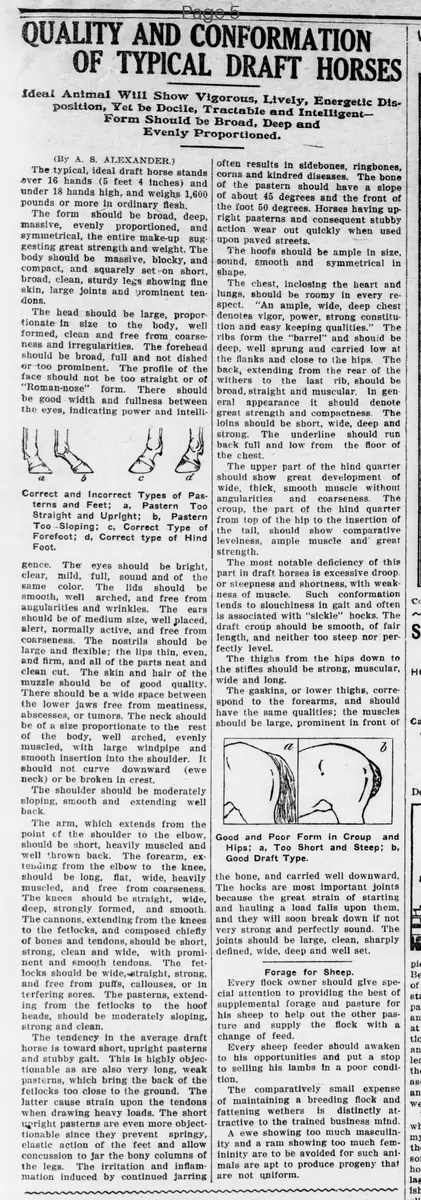
QUALITY AND CONFORMATION
OF TYPICAL DRAFT HORSES
Ideal Animal Will Show Vigorous, Lively, Energetic Disposition, Yet be Docile, Tractable and Intelligent-
Form Should be Broad, Deep and Evenly Proportioned.
The typical, ideal draft horse stands over 16 hands (5 feet 4 inches) and under 18 hands high, and weighs 1,600 pounds or more in ordinary flesh.
The form should be broad, deep, massive, evenly proportioned, and symmetrical, the entire make-up suggesting great strength and weight. The body should be massive, blocky, and compact, and squarely set on short, broad, clean, sturdy legs showing fine skin, large joints and prominent tendons.
The head should be large, proportionate in size to the body, well formed, clean and free from coarseness and irregularities. The forehead should be broad, full and not dished or too prominent. The profile of the face should not be too straight or of "Roman-nose" form. There should be good width and fullness between the eyes, indicating power and intelligence.
The eyes should be bright, clear, mild, full, sound and of the same color. The lids should be smooth, well arched, and free from angularities and wrinkles.
The ears should be of medium size, well placed, alert, normally active, and free from coarseness. The nostrils should be large and flexible; the lips thin, even, and firm, and all of the parts neat and clean cut. The skin and hair of the muzzle should be of good quality.
There should be a wide space between the lower jaws free from meatiness, abscesses, or tumors. The neck should be of a size proportionate to the rest of the body, well arched, evenly muscled, with large windpipe and smooth insertion into the shoulder. It should not curve downward (ewe neck) or be broken in crest.
The shoulder should be moderately sloping, smooth and extending well back. The arm, which extends from the point of the shoulder to the elbow, should be short, heavily muscled and well thrown back. The forearm, extending from the elbow to the knee, should be long, flat, wide, heavily muscled, and free from coarseness.
The knees should be straight, wide, deep, strongly formed, and smooth.
The cannons, extending from the knees to the fetlocks, and composed chiefly of bones and tendons, should be short, strong, clean and wide, with prominent and smooth tendons. The fetlocks should be wide, straight, strong, and free from puffs, callouses, or interfering sores. The pasterns, extending from the fetlocks to the hoof heads, should be moderately sloping, strong and clean.
The tendency in the average draft horse is toward short, upright pasterns and stubby gait. This is highly objectionable as are also very long, weak pasterns, which bring the back of the fetlocks too close to the ground. The latter cause strain upon the tendons when drawing heavy loads. The short upright pasterns are even more objectionable since they prevent springy, elastic action of the feet and allow concussion to jar the bony columns of the legs. The irritation and inflammation induced by continued jarring often results in sidebones, ringbones, corns and kindred diseases. The bone of the pastern should have a slope of about 45 degrees and the front of the foot 50 degrees. Horses having upright pasterns and consequent stubby action wear out quickly when used upon paved streets.
The hoofs should be ample in size, sound, smooth and symmetrical in shape.
The chest, inclosing the heart and lungs, should be roomy in every respect. "An ample, wide, deep chest denotes vigor, power, strong constitution and easy keeping qualities." The ribs form the "barrel" and should be deep, well sprung and carried low at the flanks and close to the hips. The back, extending from the rear of the withers to the last rib, should be broad, straight and muscular. In general appearance it should denote great strength and compactness. The loins should be short, wide, deep and strong.
The underline should run back full and low from the floor of the chest.
The upper part of the hind quarter should show great development of wide, thick, smooth muscle without angularities and coarseness.
The croup, the part of the hind quarter from top of the hip to the insertion of the tail, should show comparative levelness, ample muscle and great strength.
The most notable deficiency of this part in draft horses is excessive droop, or steepness and shortness, with weakness of muscle. Such conformation tends to slouchiness in gait and often is associated with "sickle" hocks. The draft croup should be smooth, of fair length, and neither too steep nor perfectly level.
The thighs from the hips down to the stifles should be strong, muscular, wide and long. The gaskins, or lower thighs, correspond to the forearms, and should have the same qualities; the muscles should be large, prominent in front of the bone, and carried well downward.
The hocks are most important joints because the great strain of starting and hauling a load falls upon them, and they will soon break down if not very strong and perfectly sound. The joints should be large, clean, sharply defined, wide, deep and well set.
Correct and Incorrect Types of Pasterns and Feet; a, Pastern Too Straight and Upright; b, Pastern Too Sloping; C, Correct Type of Forefoot; d, Correct type of Hind Foot.
Good and Poor Form in Croup and Hips; a, Too Short and Steep; b, Good Draft Type.
OF TYPICAL DRAFT HORSES
Ideal Animal Will Show Vigorous, Lively, Energetic Disposition, Yet be Docile, Tractable and Intelligent-
Form Should be Broad, Deep and Evenly Proportioned.
The typical, ideal draft horse stands over 16 hands (5 feet 4 inches) and under 18 hands high, and weighs 1,600 pounds or more in ordinary flesh.
The form should be broad, deep, massive, evenly proportioned, and symmetrical, the entire make-up suggesting great strength and weight. The body should be massive, blocky, and compact, and squarely set on short, broad, clean, sturdy legs showing fine skin, large joints and prominent tendons.
The head should be large, proportionate in size to the body, well formed, clean and free from coarseness and irregularities. The forehead should be broad, full and not dished or too prominent. The profile of the face should not be too straight or of "Roman-nose" form. There should be good width and fullness between the eyes, indicating power and intelligence.
The eyes should be bright, clear, mild, full, sound and of the same color. The lids should be smooth, well arched, and free from angularities and wrinkles.
The ears should be of medium size, well placed, alert, normally active, and free from coarseness. The nostrils should be large and flexible; the lips thin, even, and firm, and all of the parts neat and clean cut. The skin and hair of the muzzle should be of good quality.
There should be a wide space between the lower jaws free from meatiness, abscesses, or tumors. The neck should be of a size proportionate to the rest of the body, well arched, evenly muscled, with large windpipe and smooth insertion into the shoulder. It should not curve downward (ewe neck) or be broken in crest.
The shoulder should be moderately sloping, smooth and extending well back. The arm, which extends from the point of the shoulder to the elbow, should be short, heavily muscled and well thrown back. The forearm, extending from the elbow to the knee, should be long, flat, wide, heavily muscled, and free from coarseness.
The knees should be straight, wide, deep, strongly formed, and smooth.
The cannons, extending from the knees to the fetlocks, and composed chiefly of bones and tendons, should be short, strong, clean and wide, with prominent and smooth tendons. The fetlocks should be wide, straight, strong, and free from puffs, callouses, or interfering sores. The pasterns, extending from the fetlocks to the hoof heads, should be moderately sloping, strong and clean.
The tendency in the average draft horse is toward short, upright pasterns and stubby gait. This is highly objectionable as are also very long, weak pasterns, which bring the back of the fetlocks too close to the ground. The latter cause strain upon the tendons when drawing heavy loads. The short upright pasterns are even more objectionable since they prevent springy, elastic action of the feet and allow concussion to jar the bony columns of the legs. The irritation and inflammation induced by continued jarring often results in sidebones, ringbones, corns and kindred diseases. The bone of the pastern should have a slope of about 45 degrees and the front of the foot 50 degrees. Horses having upright pasterns and consequent stubby action wear out quickly when used upon paved streets.
The hoofs should be ample in size, sound, smooth and symmetrical in shape.
The chest, inclosing the heart and lungs, should be roomy in every respect. "An ample, wide, deep chest denotes vigor, power, strong constitution and easy keeping qualities." The ribs form the "barrel" and should be deep, well sprung and carried low at the flanks and close to the hips. The back, extending from the rear of the withers to the last rib, should be broad, straight and muscular. In general appearance it should denote great strength and compactness. The loins should be short, wide, deep and strong.
The underline should run back full and low from the floor of the chest.
The upper part of the hind quarter should show great development of wide, thick, smooth muscle without angularities and coarseness.
The croup, the part of the hind quarter from top of the hip to the insertion of the tail, should show comparative levelness, ample muscle and great strength.
The most notable deficiency of this part in draft horses is excessive droop, or steepness and shortness, with weakness of muscle. Such conformation tends to slouchiness in gait and often is associated with "sickle" hocks. The draft croup should be smooth, of fair length, and neither too steep nor perfectly level.
The thighs from the hips down to the stifles should be strong, muscular, wide and long. The gaskins, or lower thighs, correspond to the forearms, and should have the same qualities; the muscles should be large, prominent in front of the bone, and carried well downward.
The hocks are most important joints because the great strain of starting and hauling a load falls upon them, and they will soon break down if not very strong and perfectly sound. The joints should be large, clean, sharply defined, wide, deep and well set.
Correct and Incorrect Types of Pasterns and Feet; a, Pastern Too Straight and Upright; b, Pastern Too Sloping; C, Correct Type of Forefoot; d, Correct type of Hind Foot.
Good and Poor Form in Croup and Hips; a, Too Short and Steep; b, Good Draft Type.
What sub-type of article is it?
Curiosity
Animal Story
What themes does it cover?
Nature
What keywords are associated?
Draft Horses
Conformation
Ideal Traits
Horse Anatomy
Strength
Pasterns
Croup
Story Details
Story Details
Description of the ideal physical conformation of draft horses, including height, weight, body proportions, head, neck, legs, hooves, chest, back, and hindquarters, with warnings on undesirable traits like upright pasterns.