Thank you for visiting SNEWPapers!
Sign up free
Story
February 6, 1894
The Durham Daily Globe
Durham, Durham County, North Carolina
What is this article about?
In 1894, Ellen Osborn describes social observations where young mothers and mature daughters are hard to distinguish by age, highlighting shifts in women's roles, youthful dressing, and bizarre evening fashion costumes at smart affairs.
Merged-components note: Continuation of the same literary article 'Ellen Osborn's Letter' with embedded images showing spatial relation.
Clipping
OCR Quality
75%
Good
Full Text
ELLEN OSBORN'S LETTER.
The Age of Young Mothers and Mature Daughters
The Days of the Sovereignty of Youth Are Gone Forever—Bizarre Costumes That Were Certainly Very Striking.
[COPYRIGHT, 1894.]
"Oh, there are Mrs. -- and her daughter over there. Let me introduce you."
"Yes, but which is—"
"You notice that, too? Singular, isn't it," said my guide and friend. "Everybody does. It's pretty hard for a stranger to tell which is the older at a little distance. I can tell, though. That is Mrs. -- on the left. No it isn't," she added a moment later as we drew nearer. "She's on the right. She's a little stouter, you see."
A little later I was chatting merrily with a nice, plump little lady dressed in a moire gown with black velvet sleeves and revers, heavy lace falling from the latter with long tabs depending to the knee. The occasion was an afternoon affair of considerable smartness and in the bustle and buzz I felt in a few minutes as if I knew my chance acquaintance well enough to say:
"Do you know, Mrs. --, you remind me of the old business maxim: 'Seem old when you are young and young when you are old.'"
"And there's more of it," she rejoined, with a merry laugh. "'Seem rich when you are poor and poor when you are rich.' It's true, too. The first part of it, at least. We're too poor even to seem rich this terrible year, but I know I feel younger than my mother did at my age. All the women do. Our interests are younger, we go out more, we retain our hold upon affairs. And we dress as we please, and shock no one by 'dressing young,' as the saying is. Why, society is ruled by married belles of thirty-five to fifty, women who have children grown or growing. We don't efface ourselves for the young chits as they used to. Daughter worship has gone out of fashion."
"That's very well for you, mamma," said Miss --, a tall, serious-looking girl simply dressed in a black gown—one of the kind you "fill in" with lace for afternoon use when its first freshness has been worn off as a low-cut evening dress. "I like to have you look young and dress young and feel young, but I don't like to be held up as an awful example of decrepit age myself."
ment with a set of dinner plates. But when Stella looked at me with mild surprise I surrendered at once and said: 'Oh, my dear, never tell anyone I proposed it.' And three days later I got a particularly crony of mine to help me at it, and we had no end of fun. And she's three years older than I, if a day, and Stella never knew that until this minute."
"…Yes. I did, mamma," said the girl. "I heard the pair of you giggling and the smashing dishes could have been heard across the street." And she laughed merrily enough herself.
"Well, I don't care," said the elder lady, with something like a pout, "I was bored by the old things. It is a fact that there was never a time when mothers were so young and had such good times and when daughters were so mature and womanly and sensible. It's in their bringing up. Exercise, fresh air, plain food and good education are all that a girl of the upper ten has had or suffered up to the day of her "coming out." No wonder she's sensible!
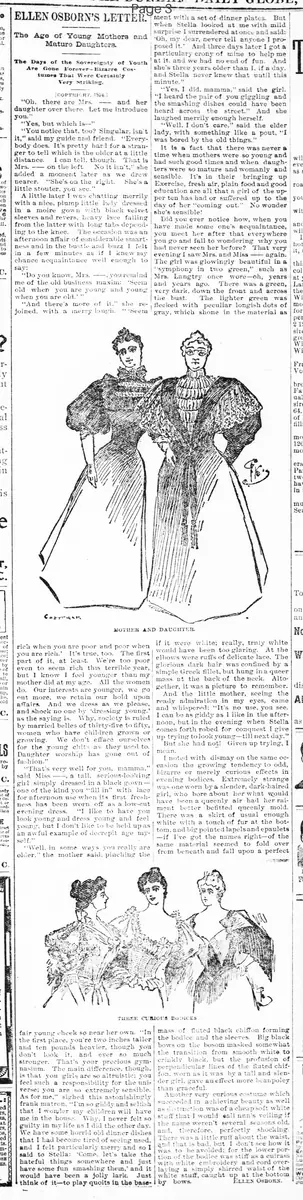
Did you ever notice how, when you have made some one's acquaintance, you meet her after that everywhere you go and fall to wondering why you had never seen her before? That very evening I saw Mrs. -- and Miss -- again. The girl was glowingly beautiful in a "symphony in two green," such as Mrs. Langtry once wore—oh, years and years ago. There was a green, very dark, down the front and across the bust. The lighter green was flecked with peculiar longish dots of gray, which shone in the material as if it were white; really, truly white would have been too glaring. At the elbows were ruffs of delicate lace. The glorious dark hair was confined by a simple Greek fillet, but hung in a queer mass at the back of the neck. Altogether, it was a picture to remember. And the little mother, seeing the ready admiration in my eyes, came and whispered: "It's no use, you see. I can be as giddy as I like in the afternoon, but in the evening when Stella comes forth robed for conquest I give up trying to look young—till next day." But she had not! Given up trying, I mean.
I noted with dismay on the same occasion the growing tendency to odd, bizarre or merely curious effects in evening bodices. Extremely strange was one worn by a slender, dark-haired girl, who bore about her what would have been a queenly air had her raiment better befitted queenly mold. There was a skirt of usual enough white with a touch of fur at the bottom, and big pointed lapels and epaulets—if I've got the names right—of the same material seemed to fold over from beneath and fall upon a perfect mass of fluted black chiffon forming the bodice and the sleeves. Big black bows on the bosom masked somewhat the transition from smooth white to crinkly black, but the profusion of perpendicular lines of the fluted chiffon, worn as it was by a tall and slender girl, gave an effect more beanpoley than graceful.
Another very curious costume which succeeded in achieving beauty as well as distinction was of a cheap soft white stuff that I would call nun's veiling if the name weren't several seasons old, and, therefore, perfectly shocking. There was a little ruff about the waist, and that is bad, but I don't see how it was to be avoided: for the lower portion of the bodice was stiff as a cuirass with white embroidery and cord overlying a simply shirred waist of the white stuff, caught up at the bottom by bows.
ELLEN OSBORN.
The Age of Young Mothers and Mature Daughters
The Days of the Sovereignty of Youth Are Gone Forever—Bizarre Costumes That Were Certainly Very Striking.
[COPYRIGHT, 1894.]
"Oh, there are Mrs. -- and her daughter over there. Let me introduce you."
"Yes, but which is—"
"You notice that, too? Singular, isn't it," said my guide and friend. "Everybody does. It's pretty hard for a stranger to tell which is the older at a little distance. I can tell, though. That is Mrs. -- on the left. No it isn't," she added a moment later as we drew nearer. "She's on the right. She's a little stouter, you see."
A little later I was chatting merrily with a nice, plump little lady dressed in a moire gown with black velvet sleeves and revers, heavy lace falling from the latter with long tabs depending to the knee. The occasion was an afternoon affair of considerable smartness and in the bustle and buzz I felt in a few minutes as if I knew my chance acquaintance well enough to say:
"Do you know, Mrs. --, you remind me of the old business maxim: 'Seem old when you are young and young when you are old.'"
"And there's more of it," she rejoined, with a merry laugh. "'Seem rich when you are poor and poor when you are rich.' It's true, too. The first part of it, at least. We're too poor even to seem rich this terrible year, but I know I feel younger than my mother did at my age. All the women do. Our interests are younger, we go out more, we retain our hold upon affairs. And we dress as we please, and shock no one by 'dressing young,' as the saying is. Why, society is ruled by married belles of thirty-five to fifty, women who have children grown or growing. We don't efface ourselves for the young chits as they used to. Daughter worship has gone out of fashion."
"That's very well for you, mamma," said Miss --, a tall, serious-looking girl simply dressed in a black gown—one of the kind you "fill in" with lace for afternoon use when its first freshness has been worn off as a low-cut evening dress. "I like to have you look young and dress young and feel young, but I don't like to be held up as an awful example of decrepit age myself."
ment with a set of dinner plates. But when Stella looked at me with mild surprise I surrendered at once and said: 'Oh, my dear, never tell anyone I proposed it.' And three days later I got a particularly crony of mine to help me at it, and we had no end of fun. And she's three years older than I, if a day, and Stella never knew that until this minute."
"…Yes. I did, mamma," said the girl. "I heard the pair of you giggling and the smashing dishes could have been heard across the street." And she laughed merrily enough herself.
"Well, I don't care," said the elder lady, with something like a pout, "I was bored by the old things. It is a fact that there was never a time when mothers were so young and had such good times and when daughters were so mature and womanly and sensible. It's in their bringing up. Exercise, fresh air, plain food and good education are all that a girl of the upper ten has had or suffered up to the day of her "coming out." No wonder she's sensible!
Did you ever notice how, when you have made some one's acquaintance, you meet her after that everywhere you go and fall to wondering why you had never seen her before? That very evening I saw Mrs. -- and Miss -- again. The girl was glowingly beautiful in a "symphony in two green," such as Mrs. Langtry once wore—oh, years and years ago. There was a green, very dark, down the front and across the bust. The lighter green was flecked with peculiar longish dots of gray, which shone in the material as if it were white; really, truly white would have been too glaring. At the elbows were ruffs of delicate lace. The glorious dark hair was confined by a simple Greek fillet, but hung in a queer mass at the back of the neck. Altogether, it was a picture to remember. And the little mother, seeing the ready admiration in my eyes, came and whispered: "It's no use, you see. I can be as giddy as I like in the afternoon, but in the evening when Stella comes forth robed for conquest I give up trying to look young—till next day." But she had not! Given up trying, I mean.
I noted with dismay on the same occasion the growing tendency to odd, bizarre or merely curious effects in evening bodices. Extremely strange was one worn by a slender, dark-haired girl, who bore about her what would have been a queenly air had her raiment better befitted queenly mold. There was a skirt of usual enough white with a touch of fur at the bottom, and big pointed lapels and epaulets—if I've got the names right—of the same material seemed to fold over from beneath and fall upon a perfect mass of fluted black chiffon forming the bodice and the sleeves. Big black bows on the bosom masked somewhat the transition from smooth white to crinkly black, but the profusion of perpendicular lines of the fluted chiffon, worn as it was by a tall and slender girl, gave an effect more beanpoley than graceful.
Another very curious costume which succeeded in achieving beauty as well as distinction was of a cheap soft white stuff that I would call nun's veiling if the name weren't several seasons old, and, therefore, perfectly shocking. There was a little ruff about the waist, and that is bad, but I don't see how it was to be avoided: for the lower portion of the bodice was stiff as a cuirass with white embroidery and cord overlying a simply shirred waist of the white stuff, caught up at the bottom by bows.
ELLEN OSBORN.
What sub-type of article is it?
Curiosity
What themes does it cover?
Social Manners
Family
What keywords are associated?
Young Mothers
Mature Daughters
Bizarre Costumes
Social Observations
1894 Fashion
Age Perceptions
What entities or persons were involved?
Ellen Osborn
Mrs.
Miss
Stella
Story Details
Key Persons
Ellen Osborn
Mrs.
Miss
Stella
Event Date
1894
Story Details
Ellen Osborn recounts encounters with a mother and daughter who appear similar in age, discusses societal shifts where mothers stay youthful and daughters mature early, and describes bizarre evening gowns at social events.