Thank you for visiting SNEWPapers!
Sign up free
The Virginia Gazette
Williamsburg, Virginia
What is this article about?
On November 15, at Holyrood House in Edinburgh, sixteen Scottish peers were elected to represent the peerage in the upcoming Parliament, amid protests against ministerial interference in nominations by independent nobles including the Duke of Buccleugh, Earl of Haddington, and Earl of Selkirk.
Merged-components note: Continuation of the story on the election of Scots peers in Edinburgh.
Clippings
1 of 2
OCR Quality
Full Text
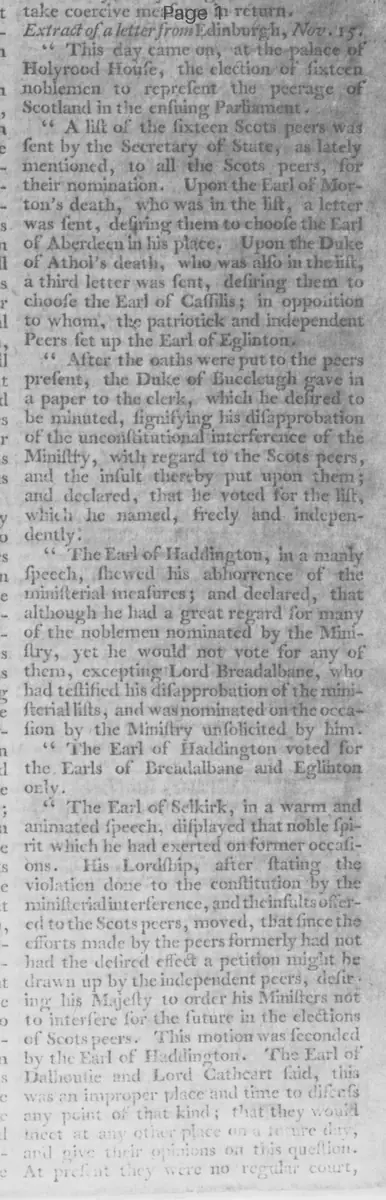
This day came on, at the palace of Holyrood House, the election of sixteen noblemen to represent the peerage of Scotland in the ensuing Parliament.
A list of the sixteen Scots peers was sent by the Secretary of State, as lately mentioned, to all the Scots peers, for their nomination. Upon the Earl of Morton's death, who was in the list, a letter was sent, desiring them to choose the Earl of Aberdeen in his place. Upon the Duke of Athol's death, who was also in the list, a third letter was sent, desiring them to choose the Earl of Cassilis; in opposition to whom, the patriotick and independent Peers set up the Earl of Eglinton.
After the oaths were put to the peers present, the Duke of Buccleugh gave in a paper to the clerk, which he desired to be minuted, signifying his disapprobation of the unconstitutional interference of the Ministry, with regard to the Scots peers, and the insult thereby put upon them; and declared, that he voted for the list which he named, freely and independently:
The Earl of Haddington, in a manly speech, shewed his abhorrence of the ministerial measures; and declared, that although he had a great regard for many of the noblemen nominated by the Ministry, yet he would not vote for any of them, excepting Lord Breadalbane, who had testified his disapprobation of the ministerial lists, and was nominated on the occasion by the Ministry unsolicited by him.
The Earl of Haddington voted for the Earls of Breadalbane and Eglinton only.
The Earl of Selkirk, in a warm and animated speech, displayed that noble spirit which he had exerted on former occasions. His Lordship, after stating the violation done to the constitution by the ministerial interference, and the insults offered to the Scots peers, moved, that since the efforts made by the peers formerly had not had the desired effect a petition might be drawn up by the independent peers, desiring his Majesty to order his Ministers not to interfere for the future in the elections of Scots peers. This motion was seconded by the Earl of Haddington. The Earl of Dalhousie and Lord Cathcart said, this was an improper place and time to discuss any point of that kind; that they would meet at any other place on a future day, and give their opinions on this question. At present they were no regular court; had no press, were subjects to no rules, and, were debates of that kind to take place, the greatest confusion would ensue, and they would become rather like a Popish diet than a meeting of Scots peers. Lord Selkirk replied, that if the present measures were allowed to go on, the election of the peers of Scotland would indeed become like a Popish diet; but, like it too, he hoped the peers, when their liberties were infringed, would justify them with the points of their swords. His Lordship was at length prevailed upon to withdraw his motion for the present. He voted for the Earls of Breadalbane and Eglinton only. Besides the above noblemen, the Earl of Aboyne and Lord Elibank nobly distinguished themselves in the struggle for liberty and independence. The sixteen noblemen elected this day, to represent the peerage of Scotland in Parliament, are the Duke of Gordon, Earl of Cassilis, Earl of Strathmore, Earl of Abercorn, Earl of Galloway, Earl of Loudoun, Earl of Dalhousie, Earl of Breadalbane, Earl of Aberdeen, Earl of March, Earl of Marchmont, Earl of Roseberry, Earl of Bute, Lord Viscount Stormont, Lord Viscount Irvine, and Lord Cathcart. The Earls of Galloway, Dalhousie, Breadalbane, Aberdeen, and Cassilis, are the new ones who come in, in place of the Duke of Athol, Marquis of Lothian, the Earls of Dunmore, Stair, and Errol.
What sub-type of article is it?
What keywords are associated?
What entities or persons were involved?
Where did it happen?
Foreign News Details
Primary Location
Holyrood House, Edinburgh
Event Date
Nov. 15
Key Persons
Outcome
the sixteen noblemen elected to represent the peerage of scotland in parliament are the duke of gordon, earl of cassilis, earl of strathmore, earl of abercorn, earl of galloway, earl of loudoun, earl of dalhousie, earl of breadalbane, earl of aberdeen, earl of march, earl of marchmont, earl of roseberry, earl of bute, lord viscount stormont, lord viscount irvine, and lord cathcart. the earls of galloway, dalhousie, breadalbane, aberdeen, and cassilis are new, replacing the duke of athol, marquis of lothian, earls of dunmore, stair, and errol.
Event Details
At Holyrood House, the election of sixteen Scots peers for Parliament proceeded with controversy over ministerial nominations following deaths of listed peers. Independent peers protested the interference; Duke of Buccleugh submitted a paper of disapprobation, Earl of Haddington spoke against measures and voted only for Breadalbane and Eglinton, Earl of Selkirk proposed a petition against future interference but withdrew it, voting similarly. Earl of Aboyne and Lord Elibank also supported independence.