Thank you for visiting SNEWPapers!
Sign up free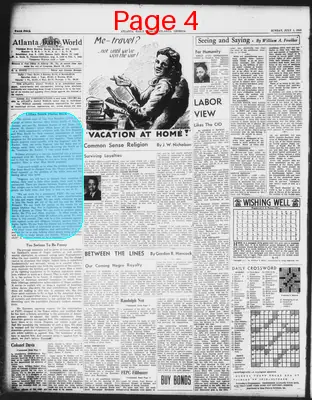
Editorial
July 1, 1945
Atlanta Daily World
Atlanta, Fulton County, Georgia
What is this article about?
This editorial summarizes a letter exchange in The New Republic between Lillian Smith of Georgia and Edmund Rucker of California. Rucker, a white supremacist, questions Smith's advocacy for racial equality without personal practice. Smith responds by refocusing on white prejudices and proposes actions like supporting FEPC, anti-discrimination laws, ending poll tax and white primaries, promoting public works, federal education aid, and joining interracial groups to build bridges between races.
Clipping
OCR Quality
98%
Excellent
Full Text
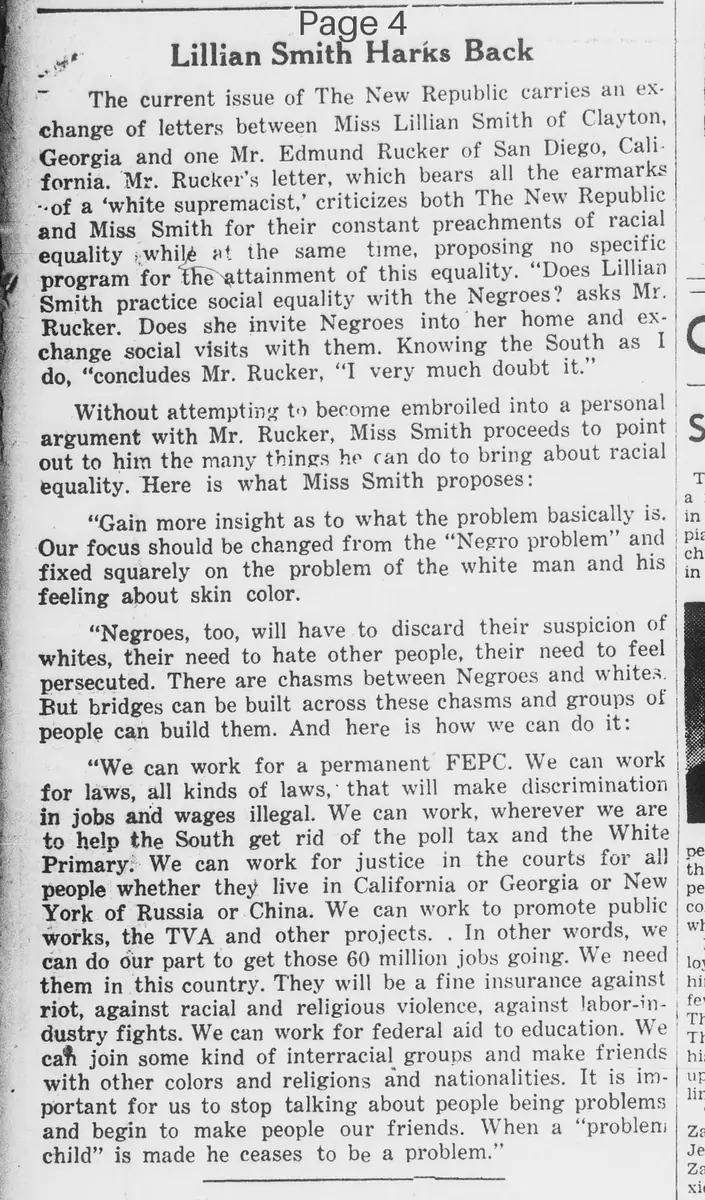
Lillian Smith Harks Back
The current issue of The New Republic carries an exchange of letters between Miss Lillian Smith of Clayton,
Georgia and one Mr. Edmund Rucker of San Diego, California. Mr. Rucker's letter, which bears all the earmarks
of a 'white supremacist,' criticizes both The New Republic
and Miss Smith for their constant preachments of racial
equality while at the same time, proposing no specific
program for the attainment of this equality. "Does Lillian
Smith practice social equality with the Negroes? asks Mr.
Rucker. Does she invite Negroes into her home and exchange social visits with them. Knowing the South as I
do, "concludes Mr. Rucker, "I very much doubt it."
Without attempting to become embroiled into a personal
argument with Mr. Rucker, Miss Smith proceeds to point
out to him the many things he can do to bring about racial
equality. Here is what Miss Smith proposes:
"Gain more insight as to what the problem basically is.
Our focus should be changed from the "Negro problem" and
fixed squarely on the problem of the white man and his
feeling about skin color.
"Negroes, too, will have to discard their suspicion of
whites, their need to hate other people, their need to feel
persecuted. There are chasms between Negroes and whites.
But bridges can be built across these chasms and groups of
people can build them. And here is how we can do it:
"We can work for a permanent FEPC. We can work
for laws, all kinds of laws, that will make discrimination
in jobs and wages illegal. We can work, wherever we are
to help the South get rid of the poll tax and the White
Primary. We can work for justice in the courts for all
people whether they live in California or Georgia or New
York or Russia or China. We can work to promote public
works, the TVA and other projects. In other words, we
can do our part to get those 60 million jobs going. We need
them in this country. They will be a fine insurance against
riot, against racial and religious violence, against labor-industry fights. We can work for federal aid to education. We
can join some kind of interracial groups and make friends
with other colors and religions and nationalities. It is important for us to stop talking about people being problems
and begin to make people our friends. When a "problem
child" is made he ceases to be a problem."
The current issue of The New Republic carries an exchange of letters between Miss Lillian Smith of Clayton,
Georgia and one Mr. Edmund Rucker of San Diego, California. Mr. Rucker's letter, which bears all the earmarks
of a 'white supremacist,' criticizes both The New Republic
and Miss Smith for their constant preachments of racial
equality while at the same time, proposing no specific
program for the attainment of this equality. "Does Lillian
Smith practice social equality with the Negroes? asks Mr.
Rucker. Does she invite Negroes into her home and exchange social visits with them. Knowing the South as I
do, "concludes Mr. Rucker, "I very much doubt it."
Without attempting to become embroiled into a personal
argument with Mr. Rucker, Miss Smith proceeds to point
out to him the many things he can do to bring about racial
equality. Here is what Miss Smith proposes:
"Gain more insight as to what the problem basically is.
Our focus should be changed from the "Negro problem" and
fixed squarely on the problem of the white man and his
feeling about skin color.
"Negroes, too, will have to discard their suspicion of
whites, their need to hate other people, their need to feel
persecuted. There are chasms between Negroes and whites.
But bridges can be built across these chasms and groups of
people can build them. And here is how we can do it:
"We can work for a permanent FEPC. We can work
for laws, all kinds of laws, that will make discrimination
in jobs and wages illegal. We can work, wherever we are
to help the South get rid of the poll tax and the White
Primary. We can work for justice in the courts for all
people whether they live in California or Georgia or New
York or Russia or China. We can work to promote public
works, the TVA and other projects. In other words, we
can do our part to get those 60 million jobs going. We need
them in this country. They will be a fine insurance against
riot, against racial and religious violence, against labor-industry fights. We can work for federal aid to education. We
can join some kind of interracial groups and make friends
with other colors and religions and nationalities. It is important for us to stop talking about people being problems
and begin to make people our friends. When a "problem
child" is made he ceases to be a problem."
What sub-type of article is it?
Slavery Abolition
Social Reform
What keywords are associated?
Racial Equality
Lillian Smith
Edmund Rucker
White Supremacist
Fepc
Poll Tax
White Primary
Interracial Groups
Social Equality
What entities or persons were involved?
Lillian Smith
Edmund Rucker
The New Republic
Editorial Details
Primary Topic
Advocacy For Racial Equality And Practical Steps To Achieve It
Stance / Tone
Supportive Of Racial Integration And Reform
Key Figures
Lillian Smith
Edmund Rucker
The New Republic
Key Arguments
Refocus From 'Negro Problem' To White Prejudices About Skin Color
Negroes Must Discard Suspicion And Hatred Toward Whites
Build Bridges Through Interracial Groups And Friendships
Support Permanent Fepc To End Job Discrimination
Enact Laws Against Discrimination In Jobs And Wages
Eliminate Poll Tax And White Primary In The South
Promote Justice In Courts For All People Globally
Advocate For Public Works Like Tva And 60 Million Jobs To Prevent Violence
Push For Federal Aid To Education
Stop Viewing People As Problems And Make Them Friends