Thank you for visiting SNEWPapers!
Sign up free
The New Hampshire Gazette
Portsmouth, Rockingham County, New Hampshire
What is this article about?
Proceedings of the U.S. House of Representatives from May 16-19, 1797, covering elections of committees and chaplains, unanimous resolution to address the President's speech, appointment of address committee, and reading of 18 State Department documents on U.S.-French relations, Pinckney's mission, and other diplomatic matters. Senate updates on speech response committee.
Merged-components note: These form a single continuous article on Congressional proceedings and related documents, spanning columns.
Clipping
OCR Quality
Full Text
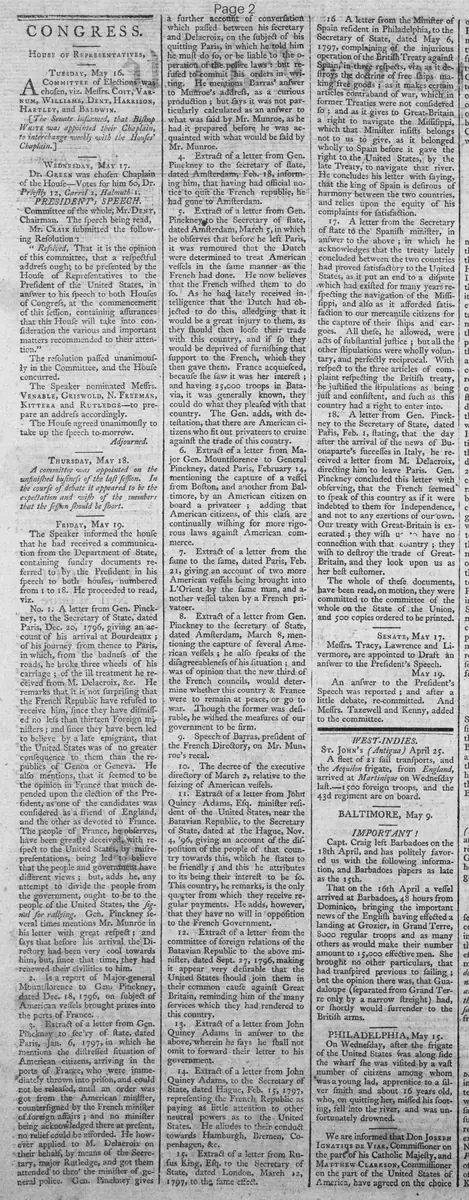
HOUSE OF REPRESENTATIVES.
TUESDAY, May 16.
Committee of Elections was chosen, viz. Messrs. Cobb, Varner, Niles, Williams, Dent, Harrison, Hartley, and Baldwin.
The Senate informed, that Bishop White was appointed their Chaplain, to interchange weekly with the House Chaplain.
WEDNESDAY, MAY 17.
Dr. Green was chosen Chaplain of the House. Votes for him 60, Dr. Priestley 2, Carroll 2, Helmuth 1.
PRESIDENT'S SPEECH.
Committee of the whole, Mr. Dent, Chairman. The speech being read, Mr. Craik submitted the following Resolution:
"Resolved, That it is the opinion of this committee, that a respectful address ought to be presented by the House of Representatives to the President of the United States, in answer to his speech to both Houses of Congress, at the commencement of this session, containing assurances that this House will take into consideration the various and important matters recommended to their attention."
The resolution passed unanimously in the Committee, and the House concurred.
The Speaker nominated Messrs. Venable, Griswold, N. Freeman, Kittera and Rutledge to prepare an address accordingly.
The House agreed unanimously to take up the speech to-morrow.
Adjourned.
THURSDAY, MAY 18.
A committee was appointed on the unfinished business of the last session. In the course of debate it appeared to be the expectation and wish of the members that the session should be short.
FRIDAY, May 19.
The Speaker informed the house that he had received a communication from the Department of State, containing sundry documents referred to by the President in his speech to both houses, numbered from 1 to 18. He proceeded to read, viz.
No. 1. A letter from Gen. Pinckney to the Secretary of State, dated Paris, Dec. 20, 1796, giving an account of his arrival at Bordeaux; of his journey from thence to Paris, in which, from the badness of the roads, he broke three wheels of his carriage; of the ill treatment he received from M. Delacroix, &c. He remarks that it is not surprising that the French Republic have refused to receive him, since they have dismissed no less than thirteen Foreign Ministers; and since they have been led to believe by a late emigrant, that the United States was of no greater consequence to them than the republics of Genoa or Geneva. He also mentions, that it seemed to be the opinion in France that much depended upon the election of the President, as one of the candidates was considered as a friend of England, and the other as devoted to France. The people of France, he observes, have been greatly deceived, with respect to the United States, by misrepresentations, being led to believe that the people and government have different views; but, adds he, any attempt to divide the people from the government, ought to be to the people of the United States, the signal for rallying. Gen. Pinckney several times mentions Mr. Monroe in his letter with great respect; and says that before his arrival the Directory had been very cool towards him, but, since that time, they had renewed their civilities to him.
2. Is a report of Major-general Mountflorence to Gen. Pinckney, dated Dec. 18, 1796, on subject of American vessels brought prizes into the ports of France.
3. Extract of a letter from Gen. Pinckney to Sec'y of State, dated Paris, Jan. 6, 1797, in which he mentions the distressed situation of American citizens, arriving in the ports of France, who were immediately thrown into prison, and could not be released, until an order was got from the American minister, countersigned by the French minister of foreign affairs; and no minister being acknowledged there at present, no relief could be afforded. He however applied to M. Delacroix on their behalf, by means of the Secretary, major Rutledge, and got them attended to thro' the minister of general police. Gen. Pinckney gives a further account of conversation which passed between his secretary and Delacroix, on the subject of his quitting Paris, in which he told him he must do so, or be liable to the operation of the police laws: but refused to commit his orders in writing. He mentions Barras' answer to Monroe's address, as a curious production; but says it was not particularly calculated as an answer to what was said by Mr. Monroe, as he had it prepared before he was acquainted with what would be said by Mr. Monroe.
4. Extract of a letter from Gen. Pinckney to the Secretary of state, dated Amsterdam, Feb. 18, informing him, that having had official notice to quit the French republic, he had gone to Amsterdam.
5. Extract of a letter from Gen. Pinckney to the Secretary of State, dated Amsterdam, March 5, in which he observes that before he left Paris, it was rumoured that the Dutch were determined to treat American vessels in the same manner as the French had done. He now believes that the French wished them to do so. As he had lately received intelligence that the Dutch had objected to do this, alleging that it would be a great injury to them, as they should then lose their trade with this country, and if so they would be deprived of furnishing that support to the French, which they then gave them. France acquiesced, because she saw it was her interest; and having 25,000 troops in Batavia, it was generally known, they could do what they pleased with that country. The Gen. adds, with detestation, that there are American citizens who fit out privateers to cruize against the trade of this country.
6. Extract of a letter from Major Gen. Mountflorence to General Pinckney, dated Paris, February 14, mentioning the capture of a vessel from Boston, and another from Baltimore, by an American citizen on board a privateer; adding that American citizens, of this class are continually wishing for more rigorous laws against American commerce.
7. Extract of a letter from the same to the same, dated Paris, Feb. 21, giving an account of two more American vessels being brought into L'Orient by the same man, and another vessel taken by a French privateer.
8. Extract of a letter from Gen. Pinckney to the Secretary of State, dated Amsterdam, March 8, mentioning the capture of several American vessels: he also speaks of the disagreeableness of his situation; and was of opinion that the new third of the French councils, would determine whether this country & France were to remain at peace, or go to war. Though the former was desirable, he wished the measures of our government to be firm.
9. Speech of Barras, president of the French Directory, on Mr. Monroe's recall.
10. The decree of the executive directory of March 2, relative to the seizing of American vessels.
11. Extract of a letter from John Quincy Adams, Esq. minister resident of the United States, near the Batavian Republic, to the Secretary of State, dated at the Hague, Nov. 4, '96, giving an account of the disposition of the people of that country towards this, which he states to be friendly; and this he attributes to its being their interest to be so. This country, he remarks, is the only quarter from which they receive regular payments. He adds, however, that they have no will in opposition to the French Government.
12. Extract of a letter from the committee of foreign relations of the Batavian Republic to the above minister, dated Sept. 27, 1796, making it appear very desirable that the United States should join them in their common cause against Great Britain, reminding him of the many services which they had rendered to this country.
13. Extract of a letter from John Quincy Adams in answer to the above, wherein he says he shall not omit to forward their letter to his government.
14. Extract of a letter from John Quincy Adams, to the Secretary of State, dated Hague, Feb. 15, 1797, representing the French Republic as paying as little attention to other neutral powers as to the United States. He alludes to their conduct towards Hamburgh, Bremen, Copenhagen, &c.
15. Extract of a letter from Rufus King, Esq. to the Secretary of State, dated London, March 12, 1797, to the same effect.
16. A letter from the Minister of Spain resident in Philadelphia, to the Secretary of State, dated May 6, 1797, complaining of the injurious operation of the British Treaty against Spain, in three respects, viz. as it destroys the doctrine of free ships make free goods: as it makes certain articles contraband of war, which in former Treaties were not considered so; and as it gives to Great-Britain a right to navigate the Mississippi, which that Minister insists belongs not to us to give, as it belonged wholly to Spain before it gave the right to the United States, by the late Treaty, to navigate that river. He concludes his letter with saying, that the king of Spain is desirous of harmony between the two countries, and relies upon the equity of his complaints for satisfaction.
17. A letter from the Secretary of State to the Spanish minister, in answer to the above; in which he acknowledges that the treaty lately concluded between the two countries had proved satisfactory to the United States, as it put an end to a dispute which had existed for many years respecting the navigation of the Mississippi, and also as it afforded satisfaction to our mercantile citizens for the capture of their ships and cargoes. All these, he allowed, were acts of substantial justice: but all the other stipulations were wholly voluntary, and perfectly reciprocal. With respect to the three articles of complaint respecting the British treaty, he justified the stipulations as being just and consistent, and such as this country had a right to enter into.
18. A letter from Gen. Pinckney to the Secretary of State, dated Paris, Feb. 1, stating, that the day after the arrival of the news of Buonaparte's success in Italy, he received a letter from M. Delacroix, directing him to leave Paris. Gen. Pinckney concluded this letter with observing, that the French seemed to speak of this country as if it were indebted to them for Independence, and not to any exertions of our own. Our treaty with Great-Britain is execrated; they wish us to have no connection with that country; they wish to destroy the trade of Great-Britain, and they look upon us as her best customer.
The whole of these documents, have been read, on motion, they were committed to the committee of the whole on the State of the Union, and 500 copies ordered to be printed.
Senate, May 17.
Messrs. Tracy, Lawrence and Livermore, are appointed to Draft an answer to the President's Speech.
May 19.
An answer to the President's Speech was reported; and after a little debate, re-committed. And Messrs. Tazewell and Kenny, added to the committee.
What sub-type of article is it?
What keywords are associated?
What entities or persons were involved?
Domestic News Details
Event Date
May 16 19, 1797
Key Persons
Outcome
committees and chaplains appointed; resolution on president's speech passed unanimously; address committee nominated; state department documents committed to committee of the whole with 500 copies printed; senate committee on speech answer re-committed with additions.
Event Details
The House of Representatives elected the Committee of Elections, appointed chaplains, formed a committee of the whole on the President's speech, passed a resolution for a respectful address, nominated an address committee, appointed a committee on unfinished business, and read and committed 18 documents from the State Department detailing diplomatic issues with France, the Batavian Republic, Spain, and others, including Gen. Pinckney's experiences and vessel captures. The Senate appointed and adjusted a committee to draft a response to the President's speech.