Thank you for visiting SNEWPapers!
Sign up free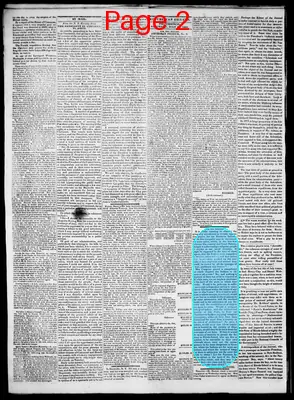
Editorial
July 24, 1830
Republican Herald
Providence, Providence County, Rhode Island
What is this article about?
An editorial defends the policy requiring Southern Indians to obey state laws, criticizing opposition papers' sympathy as misguided. It argues against allowing Indian sovereignty within states, using Rhode Island examples, and states that submission ensures peace.
Clipping
OCR Quality
98%
Excellent
Full Text
FOR THE HERALD
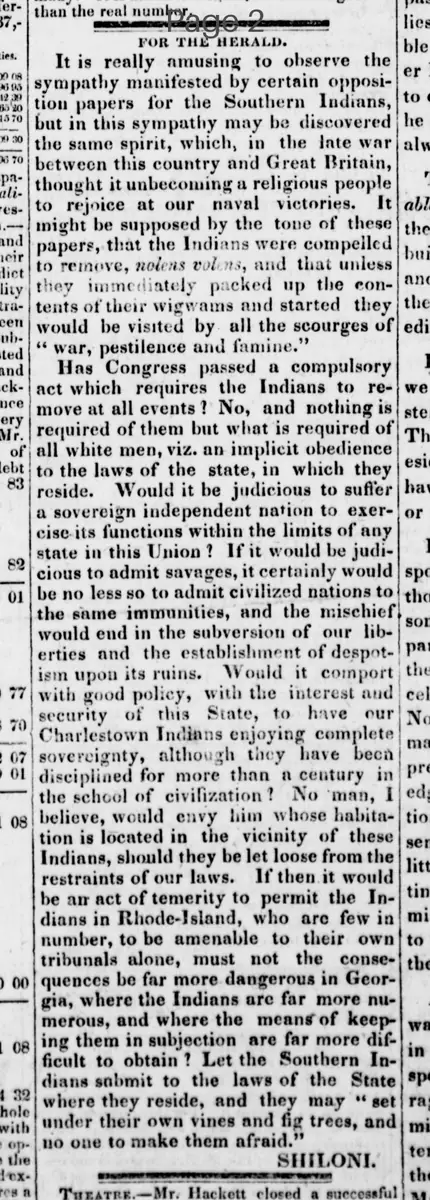
It is really amusing to observe the sympathy manifested by certain opposition papers for the Southern Indians, but in this sympathy may be discovered the same spirit, which, in the late war between this country and Great Britain, thought it unbecoming a religious people to rejoice at our naval victories. It might be supposed by the tone of these papers, that the Indians were compelled to remove, nolens volens, and that unless they immediately packed up the contents of their wigwams and started they would be visited by all the scourges of "war, pestilence and famine."
Has Congress passed a compulsory act which requires the Indians to remove at all events? No, and nothing is required of them but what is required of all white men, viz. an implicit obedience to the laws of the state, in which they reside. Would it be judicious to suffer a sovereign independent nation to exercise its functions within the limits of any state in this Union? If it would be judicious to admit savages, it certainly would be no less so to admit civilized nations to the same immunities, and the mischief would end in the subversion of our liberties and the establishment of despotism upon its ruins. Would it comport with good policy, with the interest and security of this State, to have our Charlestown Indians enjoying complete sovereignty, although they have been disciplined for more than a century in the school of civilization? No man, I believe, would envy him whose habitation is located in the vicinity of these Indians, should they be let loose from the restraints of our laws. If then it would be an act of temerity to permit the Indians in Rhode-Island, who are few in number, to be amenable to their own tribunals alone, must not the consequences be far more dangerous in Georgia, where the Indians are far more numerous, and where the means of keeping them in subjection are far more difficult to obtain? Let the Southern Indians submit to the laws of the State where they reside, and they may "sit under their own vines and fig trees, and no one to make them afraid."
SHILONI.
It is really amusing to observe the sympathy manifested by certain opposition papers for the Southern Indians, but in this sympathy may be discovered the same spirit, which, in the late war between this country and Great Britain, thought it unbecoming a religious people to rejoice at our naval victories. It might be supposed by the tone of these papers, that the Indians were compelled to remove, nolens volens, and that unless they immediately packed up the contents of their wigwams and started they would be visited by all the scourges of "war, pestilence and famine."
Has Congress passed a compulsory act which requires the Indians to remove at all events? No, and nothing is required of them but what is required of all white men, viz. an implicit obedience to the laws of the state, in which they reside. Would it be judicious to suffer a sovereign independent nation to exercise its functions within the limits of any state in this Union? If it would be judicious to admit savages, it certainly would be no less so to admit civilized nations to the same immunities, and the mischief would end in the subversion of our liberties and the establishment of despotism upon its ruins. Would it comport with good policy, with the interest and security of this State, to have our Charlestown Indians enjoying complete sovereignty, although they have been disciplined for more than a century in the school of civilization? No man, I believe, would envy him whose habitation is located in the vicinity of these Indians, should they be let loose from the restraints of our laws. If then it would be an act of temerity to permit the Indians in Rhode-Island, who are few in number, to be amenable to their own tribunals alone, must not the consequences be far more dangerous in Georgia, where the Indians are far more numerous, and where the means of keeping them in subjection are far more difficult to obtain? Let the Southern Indians submit to the laws of the State where they reside, and they may "sit under their own vines and fig trees, and no one to make them afraid."
SHILONI.
What sub-type of article is it?
Indian Affairs
Constitutional
What keywords are associated?
Indian Sovereignty
State Laws
Southern Indians
Opposition Papers
Georgia Indians
Rhode Island Indians
Congress Acts
What entities or persons were involved?
Southern Indians
Opposition Papers
Congress
Charlestown Indians
Rhode Island Indians
Georgia
Editorial Details
Primary Topic
Defense Of State Laws Over Indian Sovereignty
Stance / Tone
Supportive Of Enforcing State Authority On Indians, Critical Of Opposition Sympathy
Key Figures
Southern Indians
Opposition Papers
Congress
Charlestown Indians
Rhode Island Indians
Georgia
Key Arguments
Opposition Sympathy For Indians Mirrors Misguided Reluctance To Celebrate Naval Victories In The Late War
No Compulsory Removal Act By Congress; Indians Must Obey State Laws Like White Men
Allowing Sovereign Indian Nations Within States Would Subvert Liberties And Lead To Despotism
Even Long Civilized Charlestown Indians Should Not Have Sovereignty For State Security
Consequences More Dangerous In Populous Georgia Than Few Rhode Island Indians
Submission To State Laws Allows Indians Peaceful Living Without Fear