Thank you for visiting SNEWPapers!
Sign up free
Literary
June 26, 1891
The Londonderry Sifter
South Londonderry, Windham County, Vermont
What is this article about?
Essay on the proper uses of the Bible—study, search, meditation, belief, love, and living by it—versus abuses like neglect, misquoting for wit, or supporting prejudices. Delivered by Miss Mary O. Pollard at a Baptist convention in South Londonderry, June 17, 1891.
Clipping
OCR Quality
98%
Excellent
Full Text
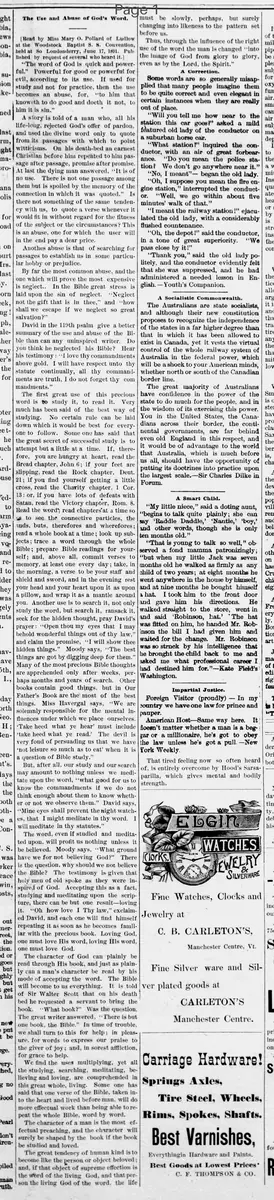
The Use and Abuse of God's Word.
[Read by Miss Mary O. Pollard of Ludlow
at the Woodstock Baptist S. S. Convention,
held at So Londonderry, June 17, 1891. Pub-
lished by request of several who heard it.]
"The word of God is quick and power-
ful." Powerful for good or powerful for
evil, according to its use. If used for
study and not for practice, then the use
becomes an abuse, for, "to him that
knoweth to do good and doeth it not, to
him it is sin."
A story is told of a man who, all his
life-long, rejected God's offer of pardon,
and used the divine word only to quote
from its passages with which to point
witticisms. On his death-bed an earnest
Christian before him repeated to him pas-
sage after passage, promise after promise.
At last the dying man answered, "It is of
no use. There is not one passage among
them but is spoiled by the memory of the
connection in which it was quoted." Is
there not something of the same tenden-
cy with us, to quote a verse whenever it
would fit in without regard for the fitness
of the subject or the circumstances? This
is an abuse, one for which the user will
in the end pay a dear price.
Another abuse is that of searching for
passages to establish us in some particu-
lar hobby or prejudice.
By far the most common abuse, and the
one which will prove the most expensive
is neglect. In the Bible great stress is
laid upon the sin of neglect. "Neglect
not the gift that is in thee," and "how
shall we escape if we neglect so great
salvation?"
David in the 119th psalm gives a better
summary of the use and abuse of the Bi-
ble than can any uninspired writer. Do
you think he neglected his Bible? Hear
his testimony : "I love thy commandments
above gold, I will have respect unto thy
statute continually, all thy commandments
are truth, I do not forget thy com-
mandments."
The first great use of this precious
word is to study it, to read it. Very
much has been said of the best way of
studying. No certain rule can be laid
down which it would be best for every.
one to follow. Some one has said that
the great secret of successful study is to
attempt but a little at a time. If, there-
fore, you are hungry at heart, read the
Bread chapter, John 6; if your feet are
slipping, read the Rock chapter, Deut.
32; if you find yourself getting a little
cross, read the Charity chapter, 1 Cor.
13: or, if you have lots of defeats with
Satan, read the Victory chapter, Rom. 8.
Read the word; read chapters at a time so
as to see the connective particles, the
ands, buts, therefores and wherefores;
read a whole book at a time; look up sub-
jects; trace a word through the whole
Bible; prepare Bible readings for your
self; and, above all, commit verses to
memory, at least one every day; take, in
the morning, a verse to be your staff and
shield and sword, and in the evening rest
your head and your heart upon it as upon
a pillow, and wrap it as a mantle around
you. Another use is to search it, not only
study the word, but search it, ransack it.
seek for the hidden thought, pray David's
prayer: "Open thou my eyes that I may
behold wonderful things out of thy law,"
and claim the promise, "I will show thee
hidden things." Moody says, "The best
things are got by digging deep for them."
Many of the most precious Bible thoughts
are apprehended only after weeks, per-
haps months and years of search. Other
books contain good things, but in Our
Father's Book are the most of the best
things. Miss Havergal says, "We are
solemnly responsible for the mental in-
fluences under which we place ourselves.
Take heed what ye hear' must include
'take heed what ye read.' The devil is
very fond of persuading us that we have
'not leisure so much as to eat' when it is
a question of Bible study."
But, after all, our study and our search
may amount to nothing unless we medi-
tate upon the word, "what good for us to
know the commandments if we do not
think enough about them to know wheth-
er or not we observe them." David says,
"Mine eyes shall prevent the night watch-
es, that I might meditate in thy word. I
will meditate in thy statutes."
The word, even if studied and medita-
ted upon, will profit us nothing unless it
be believed. Moody says, "What ground
have we for not believing God?" There
is the question, why should we not believe
the Bible? The testimony is given that
holy men of old spoke as they were in-
spired of God. Accepting this as a fact,
studying and meditating upon the scrip-
ture, there can be but one result-loving
it. "Oh how love I Thy law," exclaim-
ed David. and each one will find himself
repeating it as soon as he becomes famil-
ior with the precious book. Loving God
one must love His word. loving His word.
one must love God
The character of God can plainly be
read through His book, and just as plain-
ly can a man's character be read by his
mode of accepting the word. The Bible
will become to us everything. It is told
of Sir Walter Scott that on his death
bed he requested a servant to bring the
book. "What book?" Was the question.
The great writer answered, "There is but
one book, the Bible." In time of trouble.
we shall turn to this for help; in pleas-
ure, for words to express our praise to
the giver of joy; and, in sorest affliction.
for grace to help.
We find the uses multiplying, yet all
the studying, searching, meditating, be-
lieving and loving. are comprehended in
this great whole, living. Some one has
said that one verse of the Bible, taken in-
to the heart and lived before man, will do
more effectual work than being able to re-
peat the whole Bible, word by word.
The character of a man is the most ef-
fectual preaching, and the character will
surely be shaped by the book if the book
be studied and loved.
The great tendency of human kind is to
become like the person or object beloved;
and, if that object of supreme affection is
the word of the living God. and that per-
son the living God of the word. the life
must be slowly, perhaps, but surely
changing into likeness to the pattern set
before us.
Thus, through the influence of the right
use of the word the man is changed "into
the image of God from glory to glory,
even as by the Lord, the Spirit."
[Read by Miss Mary O. Pollard of Ludlow
at the Woodstock Baptist S. S. Convention,
held at So Londonderry, June 17, 1891. Pub-
lished by request of several who heard it.]
"The word of God is quick and power-
ful." Powerful for good or powerful for
evil, according to its use. If used for
study and not for practice, then the use
becomes an abuse, for, "to him that
knoweth to do good and doeth it not, to
him it is sin."
A story is told of a man who, all his
life-long, rejected God's offer of pardon,
and used the divine word only to quote
from its passages with which to point
witticisms. On his death-bed an earnest
Christian before him repeated to him pas-
sage after passage, promise after promise.
At last the dying man answered, "It is of
no use. There is not one passage among
them but is spoiled by the memory of the
connection in which it was quoted." Is
there not something of the same tenden-
cy with us, to quote a verse whenever it
would fit in without regard for the fitness
of the subject or the circumstances? This
is an abuse, one for which the user will
in the end pay a dear price.
Another abuse is that of searching for
passages to establish us in some particu-
lar hobby or prejudice.
By far the most common abuse, and the
one which will prove the most expensive
is neglect. In the Bible great stress is
laid upon the sin of neglect. "Neglect
not the gift that is in thee," and "how
shall we escape if we neglect so great
salvation?"
David in the 119th psalm gives a better
summary of the use and abuse of the Bi-
ble than can any uninspired writer. Do
you think he neglected his Bible? Hear
his testimony : "I love thy commandments
above gold, I will have respect unto thy
statute continually, all thy commandments
are truth, I do not forget thy com-
mandments."
The first great use of this precious
word is to study it, to read it. Very
much has been said of the best way of
studying. No certain rule can be laid
down which it would be best for every.
one to follow. Some one has said that
the great secret of successful study is to
attempt but a little at a time. If, there-
fore, you are hungry at heart, read the
Bread chapter, John 6; if your feet are
slipping, read the Rock chapter, Deut.
32; if you find yourself getting a little
cross, read the Charity chapter, 1 Cor.
13: or, if you have lots of defeats with
Satan, read the Victory chapter, Rom. 8.
Read the word; read chapters at a time so
as to see the connective particles, the
ands, buts, therefores and wherefores;
read a whole book at a time; look up sub-
jects; trace a word through the whole
Bible; prepare Bible readings for your
self; and, above all, commit verses to
memory, at least one every day; take, in
the morning, a verse to be your staff and
shield and sword, and in the evening rest
your head and your heart upon it as upon
a pillow, and wrap it as a mantle around
you. Another use is to search it, not only
study the word, but search it, ransack it.
seek for the hidden thought, pray David's
prayer: "Open thou my eyes that I may
behold wonderful things out of thy law,"
and claim the promise, "I will show thee
hidden things." Moody says, "The best
things are got by digging deep for them."
Many of the most precious Bible thoughts
are apprehended only after weeks, per-
haps months and years of search. Other
books contain good things, but in Our
Father's Book are the most of the best
things. Miss Havergal says, "We are
solemnly responsible for the mental in-
fluences under which we place ourselves.
Take heed what ye hear' must include
'take heed what ye read.' The devil is
very fond of persuading us that we have
'not leisure so much as to eat' when it is
a question of Bible study."
But, after all, our study and our search
may amount to nothing unless we medi-
tate upon the word, "what good for us to
know the commandments if we do not
think enough about them to know wheth-
er or not we observe them." David says,
"Mine eyes shall prevent the night watch-
es, that I might meditate in thy word. I
will meditate in thy statutes."
The word, even if studied and medita-
ted upon, will profit us nothing unless it
be believed. Moody says, "What ground
have we for not believing God?" There
is the question, why should we not believe
the Bible? The testimony is given that
holy men of old spoke as they were in-
spired of God. Accepting this as a fact,
studying and meditating upon the scrip-
ture, there can be but one result-loving
it. "Oh how love I Thy law," exclaim-
ed David. and each one will find himself
repeating it as soon as he becomes famil-
ior with the precious book. Loving God
one must love His word. loving His word.
one must love God
The character of God can plainly be
read through His book, and just as plain-
ly can a man's character be read by his
mode of accepting the word. The Bible
will become to us everything. It is told
of Sir Walter Scott that on his death
bed he requested a servant to bring the
book. "What book?" Was the question.
The great writer answered, "There is but
one book, the Bible." In time of trouble.
we shall turn to this for help; in pleas-
ure, for words to express our praise to
the giver of joy; and, in sorest affliction.
for grace to help.
We find the uses multiplying, yet all
the studying, searching, meditating, be-
lieving and loving. are comprehended in
this great whole, living. Some one has
said that one verse of the Bible, taken in-
to the heart and lived before man, will do
more effectual work than being able to re-
peat the whole Bible, word by word.
The character of a man is the most ef-
fectual preaching, and the character will
surely be shaped by the book if the book
be studied and loved.
The great tendency of human kind is to
become like the person or object beloved;
and, if that object of supreme affection is
the word of the living God. and that per-
son the living God of the word. the life
must be slowly, perhaps, but surely
changing into likeness to the pattern set
before us.
Thus, through the influence of the right
use of the word the man is changed "into
the image of God from glory to glory,
even as by the Lord, the Spirit."
What sub-type of article is it?
Essay
What themes does it cover?
Religious
Moral Virtue
What keywords are associated?
Bible Study
Gods Word
Scripture Abuse
Religious Meditation
Christian Devotion
Moral Neglect
What entities or persons were involved?
Miss Mary O. Pollard
Literary Details
Title
The Use And Abuse Of God's Word.
Author
Miss Mary O. Pollard
Subject
Read At The Woodstock Baptist S. S. Convention, Held At So Londonderry, June 17, 1891
Key Lines
"The Word Of God Is Quick And Powerful."
"To Him That Knoweth To Do Good And Doeth It Not, To Him It Is Sin."
"I Love Thy Commandments Above Gold, I Will Have Respect Unto Thy Statute Continually, All Thy Commandments Are Truth, I Do Not Forget Thy Commandments."
"Open Thou My Eyes That I May Behold Wonderful Things Out Of Thy Law,"
"Oh How Love I Thy Law,"