Thank you for visiting SNEWPapers!
Sign up free
The Kentucky Gazette
Lexington, Fayette County, Kentucky
What is this article about?
On February 2, 1797, the Imperial garrison at Mantua capitulated to French forces under General Serrurier. Marshal Wurmser negotiated terms allowing evacuation with honors of war, retention of artillery and personnel, and prisoner exchanges, signed by Wurmser and French commanders under Bonaparte.
Clipping
OCR Quality
Full Text
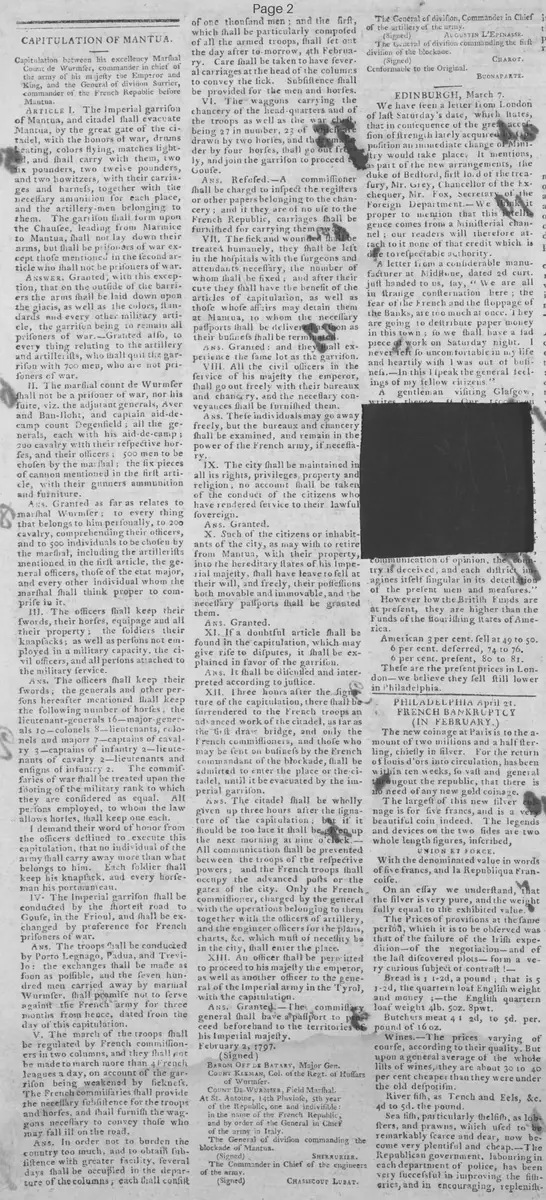
Capitulation between his excellency Marshal Count de Wurmser, commander in chief of the army of his majesty the Emperor and King, and the General of division Serrurier, commander of the French Republic before Mantua.
ARTICLE I. The Imperial garrison of Mantua, and citadel shall evacuate Mantua, by the great gate of the citadel, with the honors of war, drums beating, colors flying, matches lighted, and shall carry with them, two six pounders, two twelve pounders, and two howitzers, with their carriages and harness, together with the necessary ammunition for each piece, and the artillery-men belonging to them. The garrison shall form upon the Chaussée, leading from Marmice to Mantua, shall not lay down their arms, but shall be prisoners of war except those mentioned in the second article who shall not be prisoners of war.
ANSWER. Granted, with this exception, that on the outside of the barriers the arms shall be laid down upon the glacis, as well as the colors, standards and every other military article, the garrison being to remain all prisoners of war.-Granted also, to every thing relating to the artillery and artillerists, who shall quit the garrison with 700 men, who are not prisoners of war.
II. The marshal count de Wurmser shall not be a prisoner of war, nor his suite, viz. the adjutant generals, Aves and Banholst, and captain aid-de-camp count Degenfield; all the generals, each with his aid-de-camp; 200 cavalry with their respective horses, and their officers; 500 men to be chosen by the marshal; the six pieces of cannon mentioned in the first article, with their gunners ammunition and furniture.
Ans. Granted as far as relates to marshal Wurmser; to every thing that belongs to him personally, to 200 cavalry, comprehending their officers, and to 500 individuals to be chosen by the marshal, including the artillerists mentioned in the first article, the general officers, those of the etat major, and every other individual whom the marshal shall think proper to comprise in it.
III. The officers shall keep their swords, their horses, equipage and all their property; the soldiers their knapsacks; as well as persons not employed in a military capacity, the civil officers, and all persons attached to the military service.
Ans. The officers shall keep their swords; the generals and other persons hereafter mentioned shall keep the following number of horses; the lieutenant-generals 6--major-generals 10-colonels 8-lieutenants, colonels and majors 7-captains of cavalry 3-captains of infantry 2-lieutenants of cavalry 2-lieutenants and ensigns of infantry 2. The commissaries of war shall be treated upon the footing of the military rank to which they are considered as equal. All persons employed, to whom the law allows horses, shall keep one each.
I demand their word of honor from the officers destined to execute this capitulation, that no individual of the army shall carry away more than what belongs to him. Each soldier shall keep his knapsack, and every horseman his portmanteau.
IV. The Imperial garrison shall be conducted by the shortest road to Goite, in the Frioul, and shall be exchanged by preference for French prisoners of war.
Ans. The troops shall be conducted by Porto Legnago, Padua, and Treviso: the exchanges shall be made as soon as possible, and the seven hundred men carried away by marshal Wurmser, shall promise not to serve against the French army for three months hence, dated from the day of this capitulation.
V. The march of the troops shall be regulated by French commissioners in two columns, and they shall not be made to march more than 4 French leagues a day, on account of the garrison being weakened by sickness. The French commissaries shall provide the necessary subsistence for the troops and horses, and shall furnish the wagons necessary to convey those who may fall ill on the road.
Ans. In order not to burden the country too much, and to obtain subsistence with greater facility, several days shall be occupied in the departure of the columns; each shall consist of one thousand men; and the first, which shall be particularly composed of all the armed troops, shall set out the day after to-morrow, 4th February. Care shall be taken to have several carriages at the head of the columns to convey the sick. Subsistence shall be provided for the men and horses.
VI. The waggons carrying the chancery of the head-quarters and of the troops as well as the war chest being 27 in number, 23 of which are drawn by two horses, and the remainder by four horses, shall go out freely, and join the garrison to proceed to Goite.
Ans. Refused.-A commissioner shall be charged to inspect the registers or other papers belonging to the chancery; and if they are of no use to the French Republic, carriages shall be furnished for carrying them away.
VII. The sick and wounded shall be treated humanely, they shall be left in the hospitals with the surgeons and attendants necessary, the number of whom shall be fixed; and after their cure they shall have the benefit of the articles of capitulation. as well as those whose affairs may detain them at Mantua, to whom the necessary passports shall be delivered as soon as their business shall be terminated.
ANs. Granted: and they shall experience the same lot as the garrison.
VIII. All the civil officers in the service of his majesty the emperor, shall go out freely with their bureaux and chancery, and the necessary conveyances shall be furnished them.
Ans. These individuals may go away freely, but the bureaux and chancery shall be examined, and remain in the power of the French army, if necessary.
IX. The city shall be maintained in all its rights, privileges, property and religion, no account shall be taken of the conduct of the citizens who have rendered service to their lawful sovereign.
Ans. Granted.
X. Such of the citizens or inhabitants of the city, as may wish to retire from Mantua, with their property, into the hereditary states of his Imperial majesty, shall have leave to sell at their will, and freely, their possessions both movable and immovable, and the necessary passports shall be granted them.
ANs. Granted.
XI. If a doubtful article shall be found in the capitulation, which may give rise to disputes, it shall be explained in favor of the garrison.
C
Ans. It shall be discussed and interpreted according to justice.
XII. Three hours after the signature of the capitulation, there shall be surrendered to the French troops an advanced work of the citadel, as far as the draw bridge, and only the French commissioners, and those who may be sent on business by the French commandant of the blockade, shall be admitted to enter the place or the citadel, until it be evacuated by the imperial garrison.
Ans. The citadel shall be wholly given up three hours after the signature of the capitulation; but if it should be too late it shall be given up the next morning at nine o'clock.-All communication shall be prevented between the troops of the respective powers; and the French troops shall occupy the advanced posts or the gates of the city. Only the French commissioner, charged by the general with the operations belonging to them together with the officers of artillery, and the engineer officers for the plans, charts, &c. which must of necessity be in the city, shall enter the place.
XIII. An officer shall be permitted to proceed to his majesty the emperor, as well as another officer to the general of the Imperial army in the Tyrol, with the capitulation.
Ans. Granted.-The commissary general shall have a passport to proceed beforehand to the territories of his Imperial majesty.
February 2, 1797.
(Signed)
Baron OFF DE BATTY, Major Gen.
Count Kleman, Col. of the Regt. of Hussars of Wurmser.
Count De- Wurmser, Field Marshal.
At St. Antoine, 14th Pluviose, 5th year of the Republic, one and indivisible: in the name of the French Republic, and by order of the General in Chief of the army in Italy.
The General of division commanding the blockade of Mantua.
(Signed)
SERRURIER.
The Commander in Chief of the engineers of the army.
(Signed)
Chassecoeur Lubat.
The General of division, Commander in Chief of the artillery of the army.
(Signed)
AUGUSTIN L'EPINASSE.
The General of division commanding the first division of the blockade.
(Signed)
CHAROT.
Conformable to the Original.
BUONAPARTE.
What sub-type of article is it?
What keywords are associated?
What entities or persons were involved?
Where did it happen?
Foreign News Details
Primary Location
Mantua
Event Date
February 2, 1797
Key Persons
Outcome
imperial garrison evacuates as prisoners of war except 700 men; retention of artillery, horses, and property as per articles; city rights preserved; exchanges for french prisoners.
Event Details
Detailed capitulation terms between Austrian forces under Wurmser and French under Serrurier include evacuation with honors, prisoner status, retention of arms and artillery for select personnel, provisions for sick and wounded, and safeguards for civilians and city privileges.