Thank you for visiting SNEWPapers!
Sign up free
The Enquirer
Richmond, Henrico County, Virginia
What is this article about?
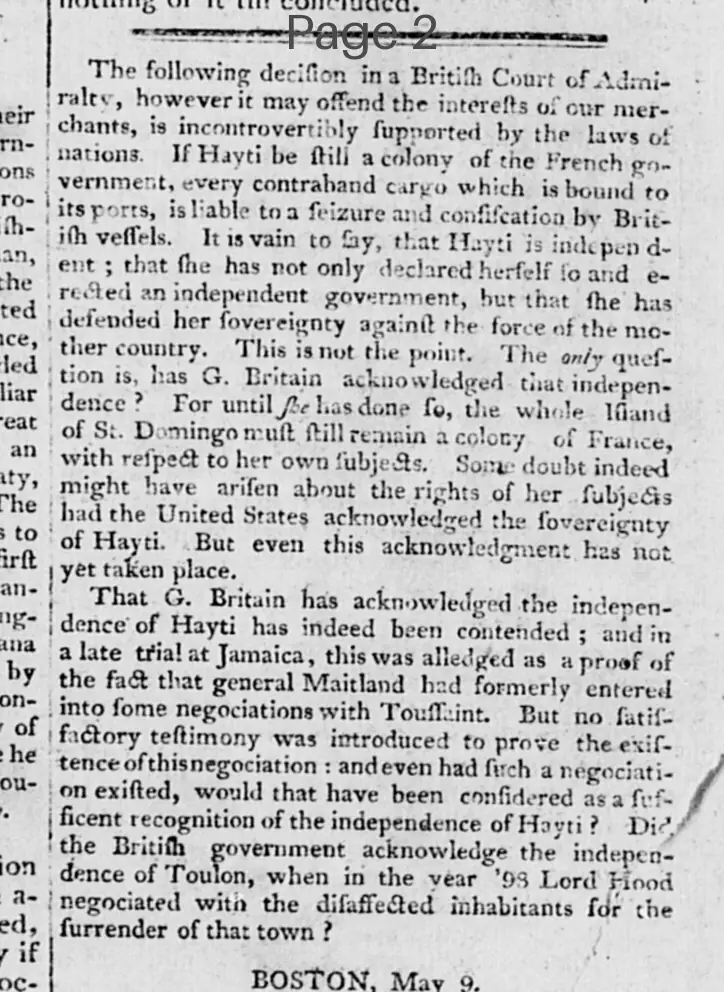
A British Court of Admiralty rules that Hayti remains a French colony for British trade purposes until Britain acknowledges its independence, allowing seizure of contraband cargoes bound there. Discusses lack of recognition by Britain and US, a Jamaica trial, and historical parallels like Toulon in 1793.
Clipping
OCR Quality
Full Text
That G. Britain has acknowledged the independence of Hayti has indeed been contended; and in a late trial at Jamaica, this was alleged as a proof of the fact that general Maitland had formerly entered into some negotiations with Toussaint. But no satisfactory testimony was introduced to prove the existence of this negotiation: and even had such a negotiation existed, would that have been considered as a sufficient recognition of the independence of Hayti? Did the British government acknowledge the independence of Toulon, when in the year '93 Lord Hood negotiated with the disaffected inhabitants for the surrender of that town?
What sub-type of article is it?
What keywords are associated?
What entities or persons were involved?
Where did it happen?
Foreign News Details
Primary Location
Hayti
Key Persons
Outcome
hayti considered a french colony by britain until independence acknowledged, allowing seizure and confiscation of contraband cargoes by british vessels
Event Details
British Court of Admiralty decides that Hayti remains a French colony for British subjects, as Britain has not acknowledged its independence, despite Hayti's declaration and defense of sovereignty. United States has also not acknowledged it. A late Jamaica trial contended British recognition via Maitland's negotiations with Toussaint, but lacked proof and such would not suffice, akin to unacknowledged Toulon negotiations in 1793.