Thank you for visiting SNEWPapers!
Sign up free
Martinsburg Gazette And Public Advertiser
Martinsburg, Berkeley County, West Virginia
What is this article about?
Discussion of England's growing corn imports due to rapid population increase and stagnant agriculture, criticizing corn laws. France proposes modifying corn laws with progressive duties on grain based on bread prices to balance producer and consumer interests. Dated London Oct. 21, 1831, and Paris Oct. 1831.
Clipping
OCR Quality
Full Text
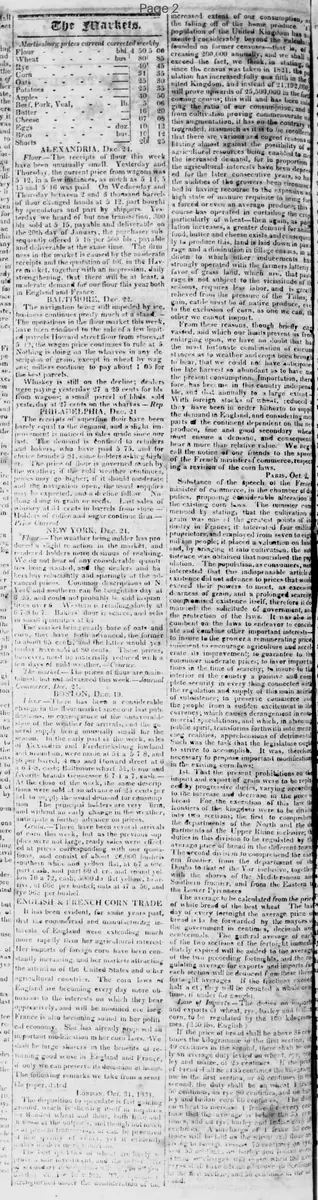
It has been evident, for some years past, that the commercial and manufacturing interests of England were extending much more rapidly than her agricultural interest. Her imports of foreign corn have been constantly increasing and her markets attracting the attention of the United States and other agricultural countries. The corn laws at England are becoming every day more obnoxious to the interests on which they bear oppressively, and will be modified ere long.
France is also becoming sound in her political economy. She has already proposed an important modification in her corn laws. We shall be large sharers in the benefits of returning good sense in England and France, if only we can preserve its dominion at home.
The following remarks we take from a sensible paper, dated
London, Oct. 21, 1831.
The disposition to speculate is fast gaining ground, which is showing itself in buyers at Baltic wheat and flour, both bonded and out of bond, although not with such free prospects as could be desired. The supply of either, yet in sight evidently makes no impression on the consumption, under the increased extent of our consumption, and the falling off of the home produce. The population of the United Kingdom has augmented considerably beyond the calculation founded on former censuses—that is, of increasing 200,000 annually, and we shall exceed the act, we think, in stating, since the census was taken in 1821, the population has increased fully one fifth in the United Kingdom, and instead of 21,192,000 will prove upwards of 25,500,000 in the forthcoming census; this will and has been enlarging the ratio of our consumption, and from cultivation proving commensurate with this augmentation, it has on the contrary retrograded, inasmuch as it is to be recollect that there are various and cogent reasons limiting almost against the possibility of agricultural resources being enabled to meet the increased demand, for in proportion the agricultural interests have been depressed for the later consecutive years, so have the abilities of the growers been circumscribed in having recourse to the expensive and high state of manure requisite to bring forth a forced or even an average produce; this course has operated in curtailing the crop particularly of wheat—then again, as population increases, a greater demand for animal food, butter and cheese exists, and consequently to produce this, land is laid down in pasture and a diminution in tillage ensues, in addition to which other inducements have strongly operated with the farmers latterly in favor of grass land, which are, that pasture is not subject to the vicissitude of the seasons, requires less labor, and is greatly relieved from the pressure of the Tithes; again, cattle must be of native produce, even to the exclusion of corn, as one we can, the other we cannot import.
From these reasons, though briefly canvassed, and which our limits prevent us from enlarging upon, we have no doubt that had the most fortunate combination of circumstances as to weather and crops been brought to bear, that we could not have anticipated the late harvest so abundant as to have met the present consumption. Importation, therefore, has become in this country indispensable, and that annually to a large extent— With foreign stocks of wheat, reduced the they have been in order hitherto to supply the demand in England, and considering most parts the continent dependent on the same produce, fine and good secondary wheat must ensure a demand, and consequently bear a more than relative value. We beg to call the notice of our friends to the speech of the French minister of commerce, respecting a revision of the corn laws.
PARIS, Oct. —.
Substance of the speech of the French minister of commerce, in the chamber of deputies, proposing considerable alteration in the existing corn laws. The minister commenced by stating, that the cultivation of wheat was one of the greatest points of industry in France; it interested our million proprietors, and employed from seven to eight million people; it placed a valuation on land, and, by bringing it into cultivation, the subsistence was obtained that nourished the population. The population, as consumers, were interested that this indispensable article of existence did not advance to prices that would exceed their powers to meet, as excessive dearness of grain, and a prolonged scarcity compromised existence itself, therefore it demanded the solicitude of government, and the protection of the laws. It was also incumbent on the laws to endeavor to conciliate and combine other important interests— to insure to the grower a remunerating price sufficient to encourage agriculture and accelerate its improvement; to guarantee to the consumer moderate prices; to favor importations in the time of scarcity; to insure to the interior of the country a positive and complete security in every thing connected with the regulation and supply of this main article of subsistence; to preserve commerce and the people from a sudden excitement in the currency; which causes derangement in commercial speculations, and which, in alarming public spirit, transforms forthwith into menacing realities, apprehensions of detrimental scarcity.
Such was the task that the legislature ought to strive to accomplish. It was, therefore necessary to propose important modification in the existing corn laws:
1st. That the present prohibitions on the import and export of grain were to be replaced by progressive duties, varying according to the increase and decrease in the price of bread. For the execution of this law the frontiers of the kingdom were to be divided into two sections; the first to comprehend the departments of the North and the departments of the Upper Rhine inclusive; the duties in this division to be regulated by the average price of bread in the different towns. The second division to comprehend the eastern frontier, from the department of the Doubs to that of the Var inclusive, together with the shores of the Mediterranean and southern frontier, and from the Eastern to the Lower Pyrenees. The average to be calculated from the price of white bread of the best wheat. The last day of every fortnight the average price of bread is to be forwarded by the mayors to the government in centimes, decimals and centesimals. The general average of each of the two sections of the fortnight immediately expired will be added to the average of the two preceding fortnights, and the regulating average for exports and imports of each section will be deduced from these three fortnight averages if the fractions exceed half a ct, they will be counted a whole centime, if under for naught.
Law of Imports—The duties on import and exports of wheat, rye, barley and Indian corn, to be regulated by the 100 kilogramme. (210 lbs. English.)
If the price of bread shall be above 35 centimes the kilogramme in the first section, or 40 centimes in the second, there shall be only an average duty levied on wheat, rye, barley and maize, of 20 centimes. If the price of bread shall be at 35 centimes the kilogramme in the first section, or 40 centimes in the second, the duty shall be on wheat 1 franc 5 centimes, on rye 80 centimes, and on barley and Indian corn 60 centimes. The duty on wheat to increase 1 franc for every centime that the average is below the 35 centimes, and on rye, barley and Indian corn 80 centimes. A surcharge of 1 franc 50 centimes will be laid on the import of flour as equivalent on barley, domestic Indian corn, etc. The duties will cease when the average shall fall below 25 centimes in the first section, and 30 in the second.
What sub-type of article is it?
What keywords are associated?
What entities or persons were involved?
Where did it happen?
Foreign News Details
Primary Location
England And France
Event Date
October 1831
Key Persons
Outcome
proposal to replace prohibitions with progressive duties on grain imports/exports varying by bread prices: low duties (20 centimes) above 35/40 centimes per kg; increasing to 1 franc 5 centimes on wheat at 35/40 centimes, rising 1 franc per centime below; duties cease below 25/30 centimes. sections divided for frontiers.
Event Details
England's corn imports rise due to population growth beyond 25,500,000 since 1821, declining agriculture from depressed interests, shift to pasture, and poor harvests, making imports indispensable. Corn laws seen as oppressive and likely to change. France proposes corn law modifications via minister's speech in Chamber of Deputies, emphasizing wheat cultivation's importance to millions, balancing grower remuneration and consumer affordability, favoring imports in scarcity, and stabilizing commerce.