Thank you for visiting SNEWPapers!
Sign up free
Atlanta Daily World
Atlanta, Fulton County, Georgia
What is this article about?
Rep. Edwin Dunaway of Pulaski County, Arkansas, spoke at the Little Rock Exchange Club luncheon, charging that conditions at Arkansas penal farms rival Nazi camps, citing inhumane treatment, lack of vocational training, poor hygiene, inadequate food, and flaws in the trusty and parole systems.
Clipping
OCR Quality
Full Text
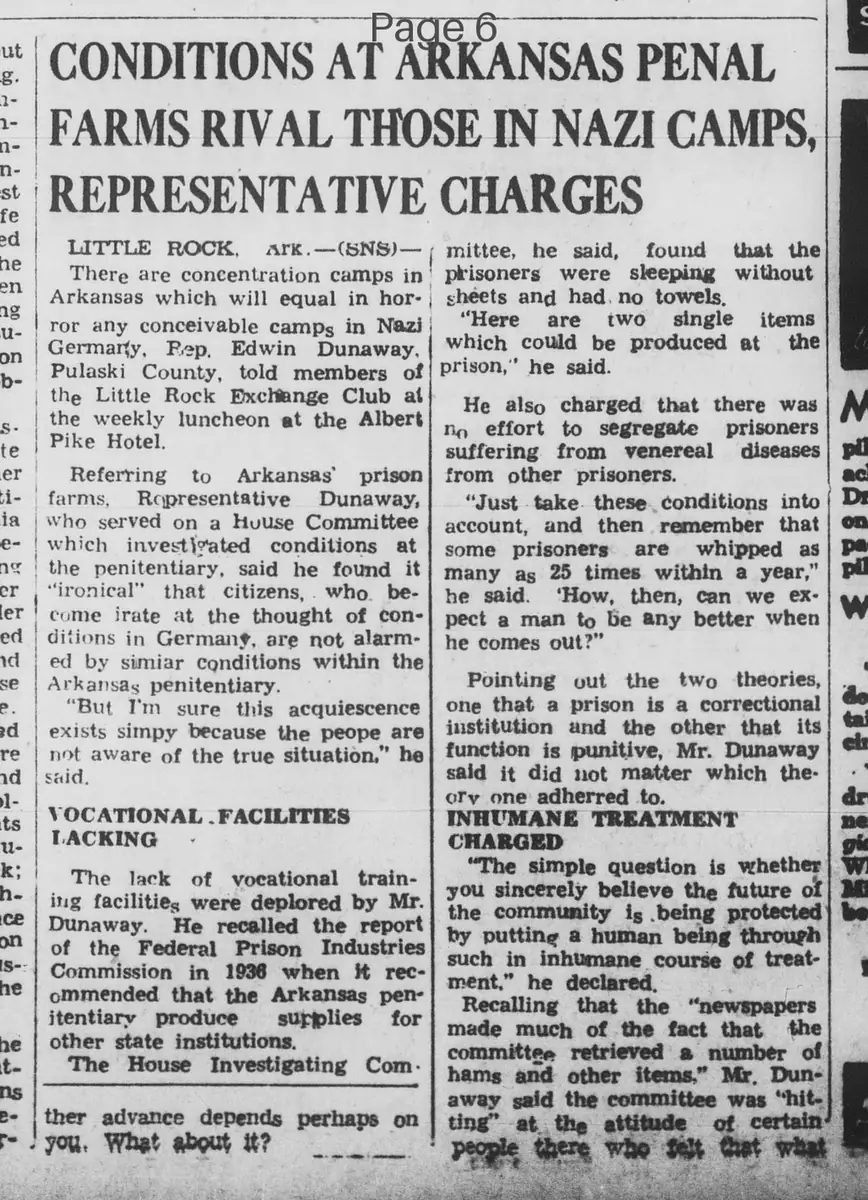
REPRESENTATIVE CHARGES
LITTLE ROCK, ARK.-(SNS)-
There are concentration camps in Arkansas which will equal in horror any conceivable camps in Nazi Germany, Rep. Edwin Dunaway, Pulaski County, told members of the Little Rock Exchange Club at the weekly luncheon at the Albert Pike Hotel.
Referring to Arkansas' prison farms, Representative Dunaway, who served on a House Committee which investigated conditions at the penitentiary, said he found it ironical that citizens, who become irate at the thought of conditions in German, are not alarmed by similar conditions within the Arkansas penitentiary.
"But I'm sure this acquiescence exists simply because the people are not aware of the true situation," he said.
VOCATIONAL FACILITIES LACKING
The lack of vocational training facilities were deplored by Mr. Dunaway. He recalled the report of the Federal Prison Industries Commission in 1936 when it recommended that the Arkansas penitentiary produce supplies for other state institutions.
The House Investigating Committee, he said, found that the prisoners were sleeping without sheets and had no towels.
"Here are two single items which could be produced at the prison," he said.
He also charged that there was no effort to segregate prisoners suffering from venereal diseases from other prisoners.
"Just take these conditions into account, and then remember that some prisoners are whipped as many as 25 times within a year," he said. "How, then, can we expect a man to be any better when he comes out?"
Pointing out the two theories, one that a prison is a correctional institution and the other that its function is punitive, Mr. Dunaway said it did not matter which theory one adhered to.
INHUMANE TREATMENT CHARGED
"The simple question is whether you sincerely believe the future of the community is being protected by putting a human being through such an inhumane course of treatment," he declared
Recalling that the "newspapers made much of the fact that the committee retrieved a number of hams and other items," Mr. Dunaway said the committee was "hitting" at the attitude of certain people there who felt that what belongs to the state is theirs.
"I feel as long as they're feeding prisoners food which I consider high-grade slop, that the officials should be willing to share some of the more edible food products with the prisoners themselves," he declared.
SHOULD GROW FOOD
He urged that there be less cotton and more feed and other products grown which could be utilized by the prisoners and the other state institutions.
"With all that labor and land available," he said, "they could better devote time to raising livestock and food for prisoners rather than half-starving them, and raising cotton so that the penitentiary can be economically self-supporting."
The trusty system was scored by Mr. Dunaway. He charged that the practice of "political friends of inmates applying pressure upon the prison superintendent until the inmate is given an easy job," destroys any possible morale within the encampments.
BOYS' SCHOOL CRITICIZED
Describing the Boys' Industrial School as "a complete flop," Mr. Dunaway said that the same recommended reforms might be applied to it.
"It's no wonder that graduates of the reformatory later are promoted to the penitentiary," he exclaimed.
He also criticized the recently announced policy of the Parole Board to release prisoners 10 days in advance of the end of their term or to provide those who remained, with a suit of clothes and railroad fare home.
"The strategy of this appears," he said, "to be bribing the prisoners to leave early so that the state will be saved the expense of a suit of clothes and railroad fare. It is a poor way to return a man to the community." - (From Arkansas Democrat).
What sub-type of article is it?
What keywords are associated?
What entities or persons were involved?
Where did it happen?
Domestic News Details
Primary Location
Little Rock, Ark.
Key Persons
Outcome
prisoners subjected to whipping up to 25 times a year, sleeping without sheets or towels, no segregation of those with venereal diseases, fed high-grade slop, half-starved; committee retrieved state items misused by officials.
Event Details
Rep. Edwin Dunaway, who served on a House Committee investigating the penitentiary, described horrific conditions at Arkansas prison farms comparable to Nazi camps, including lack of vocational training, failure to produce basic items like sheets and towels, no segregation of diseased prisoners, frequent whippings, poor food production focused on cotton over livestock and feed, corrupt trusty system influenced by politics, and criticism of the Boys' Industrial School as a failure; he questioned whether such treatment protects the community regardless of punitive or correctional prison theories.