Thank you for visiting SNEWPapers!
Sign up free
Twin City Herald
Minneapolis, Robbinsdale, Hennepin County, Minnesota
What is this article about?
NAACP sends affidavit to Justice Department detailing Ku Klux Klan threats against J.C. Williams in connection to the frame-up and conviction of William Anderson for leading Black voter registration in Greenville, S.C. Youth councils contribute funds for defense.
Clipping
OCR Quality
Full Text
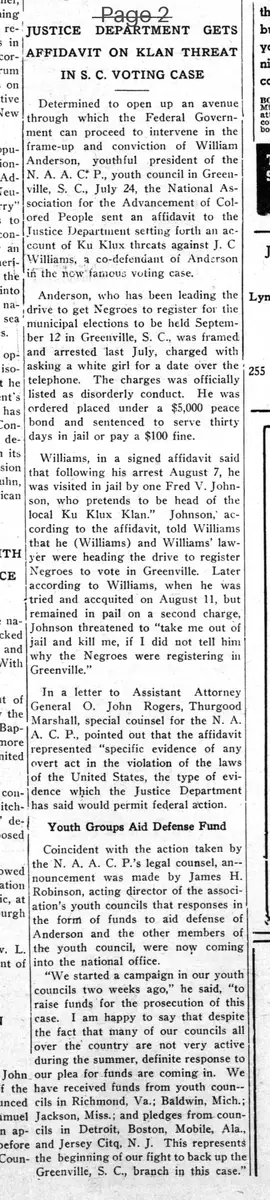
Determined to open up an avenue through which the Federal Government can proceed to intervene in the frame-up and conviction of William Anderson, youthful president of the N. A. A. C. P. youth council in Greenville, S. C., July 24, the National Association for the Advancement of Colored People sent an affidavit to the Justice Department setting forth an account of Ku Klux threats against J. C. Williams, a co-defendant of Anderson in the now famous voting case.
Anderson, who has been leading the drive to get Negroes to register for the municipal elections to be held September 12 in Greenville, S. C., was framed and arrested last July, charged with asking a white girl for a date over the telephone. The charge was officially listed as disorderly conduct. He was ordered placed under a $5,000 peace bond and sentenced to serve thirty days in jail or pay a $100 fine.
Williams, in a signed affidavit said that following his arrest August 7, he was visited in jail by one Fred V. Johnson, who pretends to be head of the local Ku Klux Klan. Johnson, according to the affidavit, told Williams that he (Williams) and Williams' lawyer were heading the drive to register Negroes to vote in Greenville. Later according to Williams, when he was tried and acquitted on August 11, but remained in jail on a second charge, Johnson threatened to "take me out of jail and kill me, if I did not tell him why the Negroes were registering in Greenville."
In a letter to Assistant Attorney General O. John Rogge, Thurgood Marshall, special counsel for the N. A. A. C. P., pointed out that the affidavit represented "specific evidence of any overt act in the violation of the laws of the United States, the type of evidence which the Justice Department has said would permit federal action."
Youth Groups Aid Defense Fund
Coincident with the action taken by the N. A. A. C. P.'s legal counsel, announcement was made by James H. Robinson, acting director of the association's youth councils that responses in the form of funds to aid defense of Anderson and the other members of the youth council, were now coming into the national office.
"We started a campaign in our youth councils two weeks ago," he said, to raise funds for the prosecution of this case. I am happy to say that despite the fact that many of our councils all over the country are not very active during the summer, definite response to our plea for funds are coming in. We have received funds from youth councils in Richmond, Va.; Baldwin, Mich.; Jackson, Miss.; and pledges from councils in Detroit, Boston, Mobile, Ala. and Jersey City, N. J. This represents the beginning of our fight to back up the Greenville, S. C., branch in this case."
What sub-type of article is it?
What keywords are associated?
What entities or persons were involved?
Where did it happen?
Domestic News Details
Primary Location
Greenville, S. C.
Event Date
July 24
Key Persons
Outcome
anderson framed, arrested, ordered under $5,000 peace bond, sentenced to 30 days in jail or $100 fine. williams acquitted on one charge but remained in jail on second; threatened with death by klan member.
Event Details
NAACP sent affidavit to Justice Department on July 24 about Ku Klux Klan threats against J.C. Williams, co-defendant in voting case. Anderson, NAACP youth council president, led Negro registration drive for September 12 municipal elections; arrested last July on disorderly conduct charge for allegedly asking white girl for date. Williams, arrested August 7, visited in jail by Fred V. Johnson, local Klan head, who threatened to kill him if he did not explain Negro registrations. Thurgood Marshall wrote to O. John Rogge highlighting evidence for federal action. Youth councils from various cities sent funds for Anderson's defense.