Thank you for visiting SNEWPapers!
Sign up free
The New York Packet
New York, New York County, New York
What is this article about?
Extract from a December 1786 letter in Cracow, Poland, describes explorers finding preserved human bodies in Kiow grottoes, not as hardened as Egyptian mummies, and praises nearby medicinal waters for curing gout, palsy, and other diseases, noting local longevity and criticizing opposing physicians.
Clipping
OCR Quality
Full Text
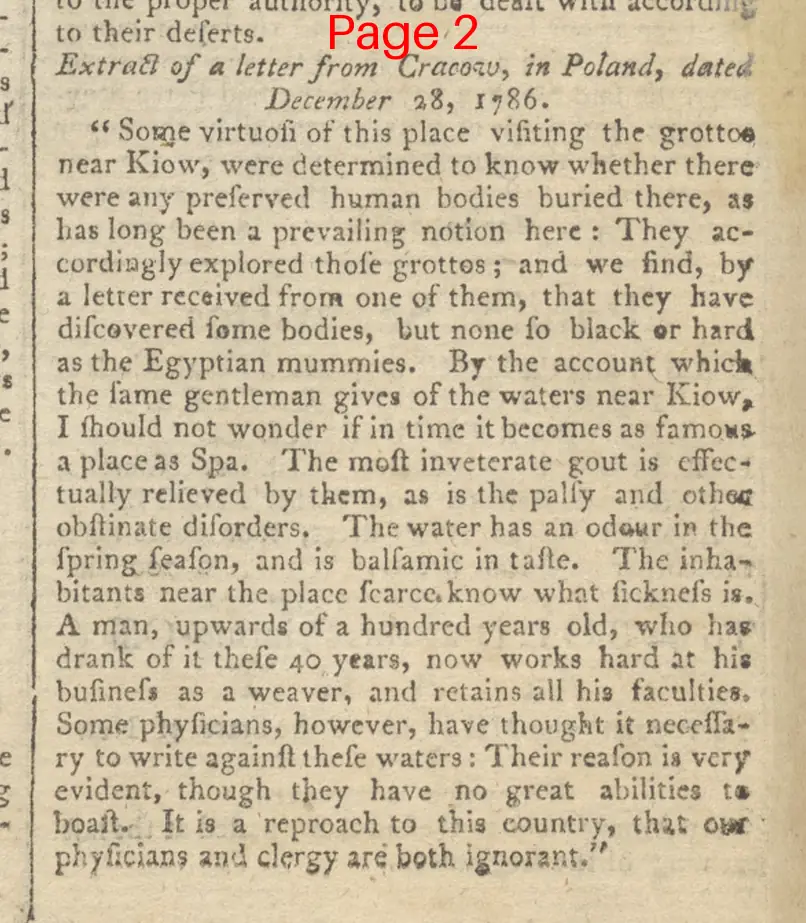
"Some virtuosi of this place visiting the grottoes near Kiow, were determined to know whether there were any preserved human bodies buried there, as has long been a prevailing notion here: They accordingly explored those grottos; and we find, by a letter received from one of them, that they have discovered some bodies, but none so black or hard as the Egyptian mummies. By the account which the same gentleman gives of the waters near Kiow, I should not wonder if in time it becomes as famous a place as Spa. The most inveterate gout is effectually relieved by them, as is the palsy and other obstinate disorders. The water has an odour in the spring season, and is balsamic in taste. The inhabitants near the place scarce know what sickness is. A man, upwards of a hundred years old, who has drank of it these 40 years, now works hard at his business as a weaver, and retains all his faculties. Some physicians, however, have thought it necessary to write against these waters: Their reason is very evident, though they have no great abilities to boast. It is a reproach to this country, that our physicians and clergy are both ignorant."
What sub-type of article is it?
What keywords are associated?
Where did it happen?
Foreign News Details
Primary Location
Kiow
Event Date
December 28, 1786
Outcome
discovered preserved human bodies in grottoes, but none as black or hard as egyptian mummies; medicinal waters reported to relieve gout, palsy, and other disorders, with locals enjoying good health and longevity.
Event Details
Virtuosi from Cracow explored grottoes near Kiow to investigate rumors of preserved bodies, finding some but not comparable to mummies. The letter describes nearby waters as curative for inveterate gout, palsy, and obstinate disorders, with a balsamic taste and spring odor; locals rarely fall ill, exemplified by a centenarian weaver who drinks it and remains active. Some physicians oppose the waters, criticized for ignorance alongside the clergy.