Thank you for visiting SNEWPapers!
Sign up free
The Evening Missourian
Columbia, Boone County, Missouri
What is this article about?
The U.S. Food Administration announced restrictions on metal containers for tea and coffee due to tin scarcity, limiting sales to specific non-metal package sizes. Butter sales in less than one-pound cartons prohibited after January 1, 1919, to save paper and labor.
Clipping
OCR Quality
Full Text
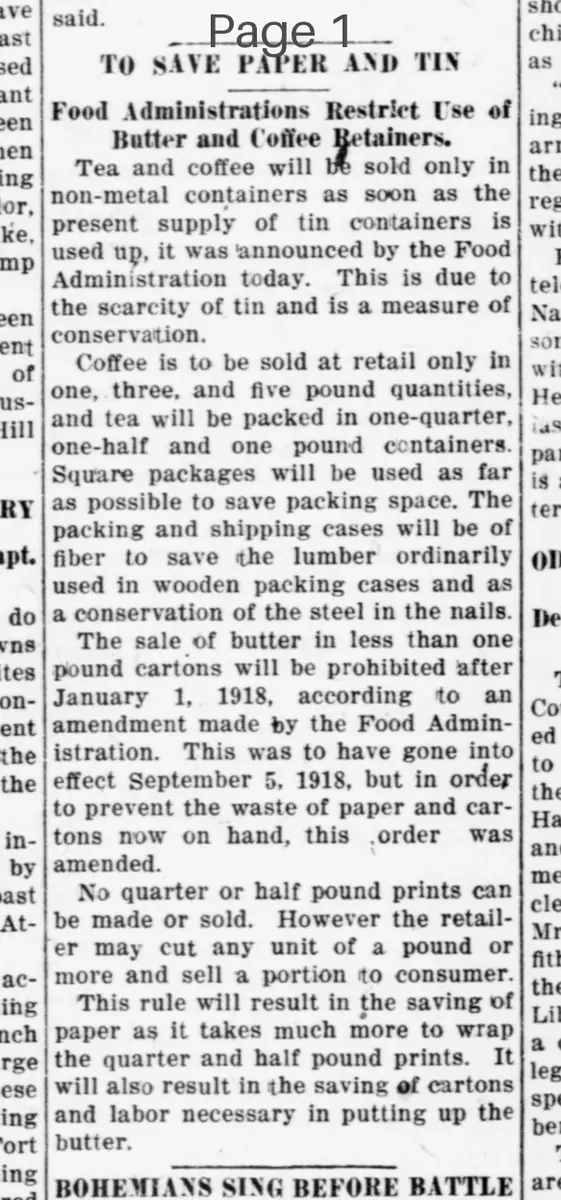
Tea and coffee will be sold only in non-metal containers as soon as the present supply of tin containers is used up, it was announced by the Food Administration today. This is due to the scarcity of tin and is a measure of conservation.
Coffee is to be sold at retail only in one, three, and five pound quantities, and tea will be packed in one-quarter, one-half and one pound containers.
Square packages will be used as far as possible to save packing space. The packing and shipping cases will be of fiber to save the lumber ordinarily used in wooden packing cases and as a conservation of the steel in the nails.
The sale of butter in less than one pound cartons will be prohibited after January 1, 1919, according to an amendment made by the Food Administration. This was to have gone into effect September 5, 1918, but in order to prevent the waste of paper and cartons now on hand, this order was amended.
No quarter or half pound prints can be made or sold. However the retailer may cut any unit of a pound or more and sell a portion to consumer.
This rule will result in the saving of paper as it takes much more to wrap the quarter and half pound prints. It will also result in the saving of cartons and labor necessary in putting up the butter.
What sub-type of article is it?
What keywords are associated?
Domestic News Details
Event Date
Announced Today; Butter Restriction After January 1, 1919
Outcome
restrictions on packaging to conserve tin, paper, lumber, steel, and labor; no casualties
Event Details
Food Administration restricts tea and coffee to non-metal containers in specified sizes once tin supply is depleted; square packages and fiber cases to save space and materials; butter sales prohibited in less than one-pound cartons after January 1, 1919, with retailers allowed to cut larger units