Thank you for visiting SNEWPapers!
Sign up free
Story
July 23, 1831
Alabama State Intelligencer
Tuscaloosa, Tuscaloosa County, Alabama
What is this article about?
Historical overview of Halley's Comet's sightings from 1465 to 1759, including orbital periods, distances from the sun, and predictions for its 1834 return, potentially delayed to 1835-1836 due to planetary influences.
Clipping
OCR Quality
98%
Excellent
Full Text
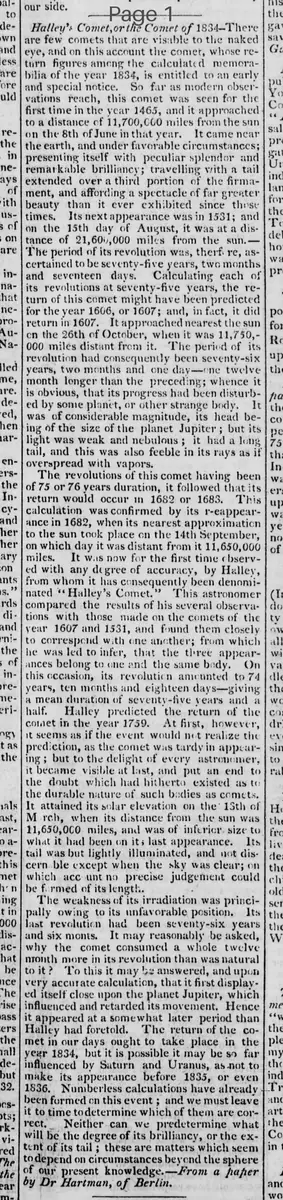
Halley's Comet, or the Comet of 1834—There are few comets that are visible to the naked eye, and on this account the comet, whose return figures among the calculated memorabilia of the year 1834, is entitled to an early and special notice. So far as modern observations reach, this comet was seen for the first time in the year 1465, and it approached to a distance of 11,700,000 miles from the sun on the 8th of June in that year. It came near the earth, and under favorable circumstances: presenting itself with peculiar splendor and remarkable brilliancy; travelling with a tail extended over a third portion of the firmament, and affording a spectacle of far greater beauty than it ever exhibited since those times. Its next appearance was in 1531; and on the 15th day of August, it was at a distance of 21,600,000 miles from the sun.—The period of its revolution was, therefore, ascertained to be seventy-five years, two months and seventeen days. Calculating each of its revolutions at seventy-five years, the return of this comet might have been predicted for the year 1606, or 1607; and, in fact, it did return in 1607. It approached nearest the sun on the 26th of October, when it was 11,750,000 miles distant from it. The period of its revolution had consequently been seventy-six years, two months and one day—one twelve month longer than the preceding; whence it is obvious, that its progress had been disturbed by some planet, or other strange body. It was of considerable magnitude, its head being of the size of the planet Jupiter; but its light was weak and nebulous; it had a long tail, and this was also feeble in its rays as if overspread with vapors.
The revolutions of this comet having been of 75 or 76 years duration, it followed that its return would occur in 1682 or 1683. This calculation was confirmed by its re-appearance in 1682, when its nearest approximation to the sun took place on the 14th September, on which day it was distant from it 11,650,000 miles. It was now for the first time observed with any degree of accuracy, by Halley, from whom it has consequently been denominated "Halley's Comet." This astronomer compared the results of his several observations with those made on the comets of the year 1607 and 1531, and found them closely to correspond with one another; from which he was led to infer, that the three appearances belong to one and the same body. On this occasion, its revolution amounted to 74 years, ten months and eighteen days—giving a mean duration of seventy-five years and a half. Halley predicted the return of the comet in the year 1759. At first, however, it seems as if the event would not realize the prediction, as the comet was tardy in appearing; but to the delight of every astronomer, it became visible at last, and put an end to the doubt which had hitherto existed as to the durable nature of such bodies as comets. It attained its solar elevation on the 13th of March, when its distance from the sun was 11,650,000 miles, and was of inferior size to what it had been on its last appearance. Its tail was but lightly illuminated, and not discernible except when the sky was clear; on which account no precise judgement could be formed of its length.
The weakness of its irradiation was principally owing to its unfavorable position. Its last revolution had been seventy-six years and six months. It may reasonably be asked, why the comet consumed a whole twelve month more in its revolution than was natural to it? To this it may be answered, and upon very accurate calculation, that it first displayed itself close upon the planet Jupiter, which influenced and retarded its movement. Hence it appeared at a somewhat later period than Halley had foretold. The return of the comet in our days ought to take place in the year 1834, but it is possible it may be so far influenced by Saturn and Uranus, as not to make its appearance before 1835, or even 1836. Numberless calculations have already been formed on this event; and we must leave it to time to determine which of them are correct. Neither can we predetermine what will be the degree of its brilliancy, or the extent of its tail; these are matters which seem to depend on circumstances beyond the sphere of our present knowledge.—From a letter by Dr Hartman, of Berlin.
The revolutions of this comet having been of 75 or 76 years duration, it followed that its return would occur in 1682 or 1683. This calculation was confirmed by its re-appearance in 1682, when its nearest approximation to the sun took place on the 14th September, on which day it was distant from it 11,650,000 miles. It was now for the first time observed with any degree of accuracy, by Halley, from whom it has consequently been denominated "Halley's Comet." This astronomer compared the results of his several observations with those made on the comets of the year 1607 and 1531, and found them closely to correspond with one another; from which he was led to infer, that the three appearances belong to one and the same body. On this occasion, its revolution amounted to 74 years, ten months and eighteen days—giving a mean duration of seventy-five years and a half. Halley predicted the return of the comet in the year 1759. At first, however, it seems as if the event would not realize the prediction, as the comet was tardy in appearing; but to the delight of every astronomer, it became visible at last, and put an end to the doubt which had hitherto existed as to the durable nature of such bodies as comets. It attained its solar elevation on the 13th of March, when its distance from the sun was 11,650,000 miles, and was of inferior size to what it had been on its last appearance. Its tail was but lightly illuminated, and not discernible except when the sky was clear; on which account no precise judgement could be formed of its length.
The weakness of its irradiation was principally owing to its unfavorable position. Its last revolution had been seventy-six years and six months. It may reasonably be asked, why the comet consumed a whole twelve month more in its revolution than was natural to it? To this it may be answered, and upon very accurate calculation, that it first displayed itself close upon the planet Jupiter, which influenced and retarded its movement. Hence it appeared at a somewhat later period than Halley had foretold. The return of the comet in our days ought to take place in the year 1834, but it is possible it may be so far influenced by Saturn and Uranus, as not to make its appearance before 1835, or even 1836. Numberless calculations have already been formed on this event; and we must leave it to time to determine which of them are correct. Neither can we predetermine what will be the degree of its brilliancy, or the extent of its tail; these are matters which seem to depend on circumstances beyond the sphere of our present knowledge.—From a letter by Dr Hartman, of Berlin.
What sub-type of article is it?
Curiosity
Historical Event
What themes does it cover?
Exploration
Nature
What keywords are associated?
Halley Comet
Comet Appearances
Astronomical Calculations
Revolution Periods
Predictions
What entities or persons were involved?
Halley
Dr Hartman
Story Details
Key Persons
Halley
Dr Hartman
Event Date
1465, 1531, 1607, 1682, 1759; Predicted 1834 1836
Story Details
Account of Halley's Comet's observed appearances in 1465, 1531, 1607, 1682, and 1759, with details on distances from sun, revolution periods, and Halley's predictions for its return in 1834, possibly delayed by planets.