Thank you for visiting SNEWPapers!
Sign up free
Literary
August 31, 1786
Fowle's New Hampshire Gazette And General Advertiser
Portsmouth, Rockingham County, New Hampshire
What is this article about?
This essay from 1784 discusses the nature of sleep, citing scientific theory and historical anecdotes of prolonged sleep and sleepwalking. It satirically critiques political inactivity by describing a fictional African society that reveres great sleepers, implying a call for wakefulness in governance.
Merged-components note: Continuation of the same essay on sleep, sequential reading order and coherent text flow.
Clipping
OCR Quality
98%
Excellent
Full Text
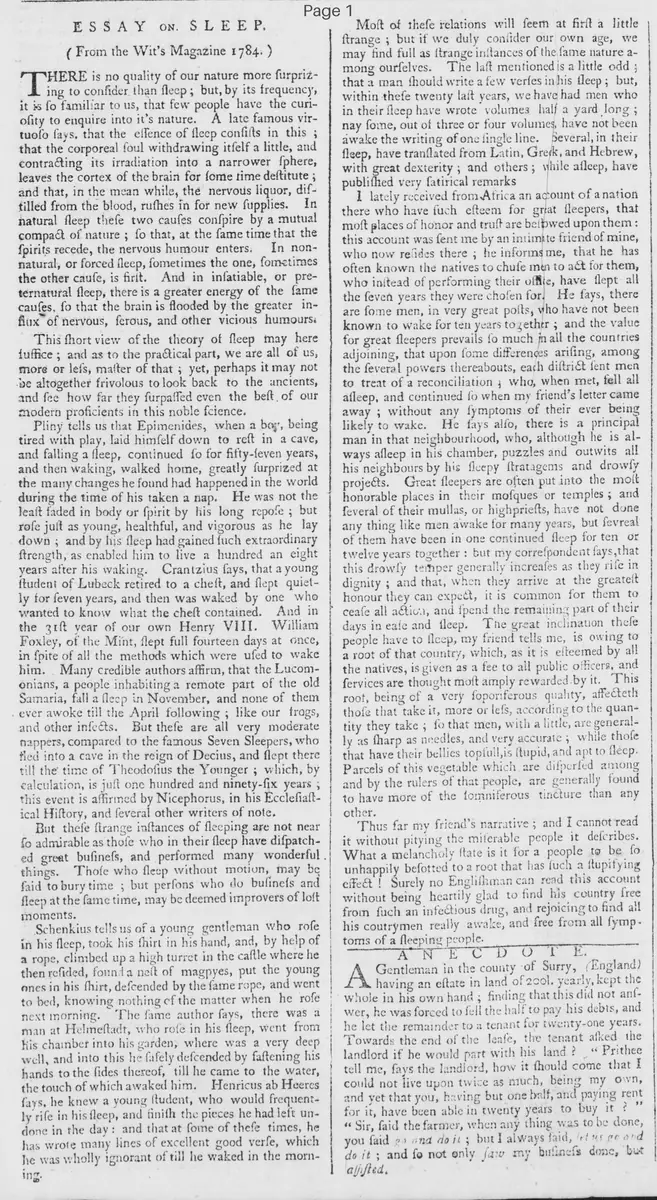
ESSAY ON SLEEP.
(From the Wit's Magazine 1784.)
There is no quality of our nature more surprizing to consider than sleep; but, by its frequency, it is so familiar to us, that few people have the curiosity to enquire into its nature. A late famous virtuoso says, that the essence of sleep consists in this: that the corporeal soul withdrawing itself a little, and contracting its irradiation into a narrower sphere, leaves the cortex of the brain for some time destitute; and that, in the mean while, the nervous liquor, distilled from the blood, rushes in for new supplies. In natural sleep these two causes conspire by a mutual compact of nature; so that, at the same time that the spirits recede, the nervous humour enters. In non-natural, or forced sleep, sometimes the one, sometimes the other cause, is first. And in insatiate, or preternatural sleep, there is a greater energy of the same causes, so that the brain is flooded by the greater influx of nervous, serous, and other vicious humours.
This short view of the theory of sleep may here suffice; and as to the practical part, we are all of us, more or less, master of that; yet, perhaps it may not be altogether frivolous to look back to the ancients, and see how far they surpassed even the best of our modern proficients in this noble science.
Pliny tells us that Epimenides, when a boy, being tired with play, laid himself down to rest in a cave, and falling asleep, continued so for fifty-seven years, and then waking, walked home, greatly surprised at the many changes he found had happened in the world during the time of his taking a nap. He was not the least faded in body or spirit by his long repose; but rose just as young, healthful, and vigorous as he lay down; and by his sleep had gained such extraordinary strength, as enabled him to live a hundred and eight years after his waking. Crantzius says, that a young student of Lubeck retired to a chest, and slept quietly for seven years, and then was waked by one who wanted to know what the chest contained. And in the 31st year of our own Henry VIII. William Foxley, of the Mint, slept full fourteen days at once, in spite of all the methods which were used to wake him. Many credible authors affirm, that the Lucumonians, a people inhabiting a remote part of the old Samaria, fall asleep in November, and none of them ever awoke till the April following; like our frogs, and other insects. But these are all very moderate nappers, compared to the famous Seven Sleepers, who fled into a cave in the reign of Decius, and slept there till the time of Theodosius the Younger; which, by calculation, is just one hundred and ninety-six years; this event is affirmed by Nicephorus, in his Ecclesiastical History, and several other writers of note.
But these strange instances of sleeping are not near so admirable as those who in their sleep have dispatched great business, and performed many wonderful things.
Those who sleep without motion, may be said to bury time; but persons who do business and sleep at the same time, may be deemed improvers of lost moments.
Schenkius tells us of a young gentleman who rose in his sleep, took his shirt in his hand, and, by help of a rope, climbed up a high turret in the castle where he then resided, found a nest of magpies, put the young ones in his shirt, descended by the same rope, and went to bed, knowing nothing of the matter when he rose next morning. The same author says, there was a man at Helmstadt, who rose in his sleep, went from his chamber into his garden, where was a very deep well, and into this he safely descended by fastening his hands to the sides thereof, till he came to the water, the touch of which awaked him. Henricus ab Heeres says, he knew a young student, who would frequently rise in his sleep, and finish the pieces he had left undone in the day: and that at some of these times, he has wrote many lines of excellent good verse, which he was wholly ignorant of till he waked in the morning.
Most of these relations will seem at first a little strange; but if we duly consider our own age, we may find full as strange instances of the same nature among ourselves. The last mentioned is a little odd; that a man should write a few verses in his sleep; but, within these twenty last years, we have had men who in their sleep have wrote volumes half a yard long; nay some, out of three or four volumes, have not been awake the writing of one single line. Several, in their sleep, have translated from Latin, Greek, and Hebrew, with great dexterity; and others, while asleep, have published very satirical remarks.
I lately received from Africa an account of a nation there who have such esteem for great sleepers, that most places of honor and trust are bestowed upon them: this account was sent me by an intimate friend of mine, who now resides there; he informs me, that he has often known the natives to chuse men to act for them, who instead of performing their office, have slept all the seven years they were chusen for. He says, there are some men, in very great posts, who have not been known to wake for ten years together; and the value for great sleepers prevails so much in all the countries adjoining, that upon some differences arising, among the several powers thereabouts, each district sent men to treat of a reconciliation; who, when met, fell all asleep, and continued so when my friend's letter came away; without any symptoms of their ever being likely to wake. He says also, there is a principal man in that neighbourhood, who, although he is always asleep in his chamber, puzzles and outwits all his neighbours by his sleepy stratagems and drowsy projects. Great sleepers are often put into the most honorable places in their mosques or temples; and several of their mullas, or high priests, have not done any thing like men awake for many years, but several of them have been in one continued sleep for ten or twelve years together: but my correspondent says, that this drowsy temper generally increases as they rise in dignity; and that, when they arrive at the greatest honour they can expect, it is common for them to cease all action, and spend the remaining part of their days in ease and sleep. The great inclination these people have to sleep, my friend tells me, is owing to a root of that country, which, as it is esteemed by all the natives, is given as a fee to all public officers, and services are thought most amply rewarded by it. This root, being of a very soporiferous quality, affecteth those that take it, more or less, according to the quantity they take; so that men, with a little, are generally as sharp as needles, and very accurate; while those that have their bellies topfull, is stupid, and apt to sleep. Parcels of this vegetable which are dispersed among and by the rulers of that people, are generally found to have more of the somniferous tincture than any other.
Thus far my friend's narrative; and I cannot read it without pitying the miserable people it describes. What a melancholy state is it for a people to be so unhappily besotted to a root that has such a stupifying effect! Surely no Englishman can read this account without being heartily glad to find his country free from such an infectious drug, and rejoicing to find all his countrymen really awake, and free from all symptoms of a sleeping people.
(From the Wit's Magazine 1784.)
There is no quality of our nature more surprizing to consider than sleep; but, by its frequency, it is so familiar to us, that few people have the curiosity to enquire into its nature. A late famous virtuoso says, that the essence of sleep consists in this: that the corporeal soul withdrawing itself a little, and contracting its irradiation into a narrower sphere, leaves the cortex of the brain for some time destitute; and that, in the mean while, the nervous liquor, distilled from the blood, rushes in for new supplies. In natural sleep these two causes conspire by a mutual compact of nature; so that, at the same time that the spirits recede, the nervous humour enters. In non-natural, or forced sleep, sometimes the one, sometimes the other cause, is first. And in insatiate, or preternatural sleep, there is a greater energy of the same causes, so that the brain is flooded by the greater influx of nervous, serous, and other vicious humours.
This short view of the theory of sleep may here suffice; and as to the practical part, we are all of us, more or less, master of that; yet, perhaps it may not be altogether frivolous to look back to the ancients, and see how far they surpassed even the best of our modern proficients in this noble science.
Pliny tells us that Epimenides, when a boy, being tired with play, laid himself down to rest in a cave, and falling asleep, continued so for fifty-seven years, and then waking, walked home, greatly surprised at the many changes he found had happened in the world during the time of his taking a nap. He was not the least faded in body or spirit by his long repose; but rose just as young, healthful, and vigorous as he lay down; and by his sleep had gained such extraordinary strength, as enabled him to live a hundred and eight years after his waking. Crantzius says, that a young student of Lubeck retired to a chest, and slept quietly for seven years, and then was waked by one who wanted to know what the chest contained. And in the 31st year of our own Henry VIII. William Foxley, of the Mint, slept full fourteen days at once, in spite of all the methods which were used to wake him. Many credible authors affirm, that the Lucumonians, a people inhabiting a remote part of the old Samaria, fall asleep in November, and none of them ever awoke till the April following; like our frogs, and other insects. But these are all very moderate nappers, compared to the famous Seven Sleepers, who fled into a cave in the reign of Decius, and slept there till the time of Theodosius the Younger; which, by calculation, is just one hundred and ninety-six years; this event is affirmed by Nicephorus, in his Ecclesiastical History, and several other writers of note.
But these strange instances of sleeping are not near so admirable as those who in their sleep have dispatched great business, and performed many wonderful things.
Those who sleep without motion, may be said to bury time; but persons who do business and sleep at the same time, may be deemed improvers of lost moments.
Schenkius tells us of a young gentleman who rose in his sleep, took his shirt in his hand, and, by help of a rope, climbed up a high turret in the castle where he then resided, found a nest of magpies, put the young ones in his shirt, descended by the same rope, and went to bed, knowing nothing of the matter when he rose next morning. The same author says, there was a man at Helmstadt, who rose in his sleep, went from his chamber into his garden, where was a very deep well, and into this he safely descended by fastening his hands to the sides thereof, till he came to the water, the touch of which awaked him. Henricus ab Heeres says, he knew a young student, who would frequently rise in his sleep, and finish the pieces he had left undone in the day: and that at some of these times, he has wrote many lines of excellent good verse, which he was wholly ignorant of till he waked in the morning.
Most of these relations will seem at first a little strange; but if we duly consider our own age, we may find full as strange instances of the same nature among ourselves. The last mentioned is a little odd; that a man should write a few verses in his sleep; but, within these twenty last years, we have had men who in their sleep have wrote volumes half a yard long; nay some, out of three or four volumes, have not been awake the writing of one single line. Several, in their sleep, have translated from Latin, Greek, and Hebrew, with great dexterity; and others, while asleep, have published very satirical remarks.
I lately received from Africa an account of a nation there who have such esteem for great sleepers, that most places of honor and trust are bestowed upon them: this account was sent me by an intimate friend of mine, who now resides there; he informs me, that he has often known the natives to chuse men to act for them, who instead of performing their office, have slept all the seven years they were chusen for. He says, there are some men, in very great posts, who have not been known to wake for ten years together; and the value for great sleepers prevails so much in all the countries adjoining, that upon some differences arising, among the several powers thereabouts, each district sent men to treat of a reconciliation; who, when met, fell all asleep, and continued so when my friend's letter came away; without any symptoms of their ever being likely to wake. He says also, there is a principal man in that neighbourhood, who, although he is always asleep in his chamber, puzzles and outwits all his neighbours by his sleepy stratagems and drowsy projects. Great sleepers are often put into the most honorable places in their mosques or temples; and several of their mullas, or high priests, have not done any thing like men awake for many years, but several of them have been in one continued sleep for ten or twelve years together: but my correspondent says, that this drowsy temper generally increases as they rise in dignity; and that, when they arrive at the greatest honour they can expect, it is common for them to cease all action, and spend the remaining part of their days in ease and sleep. The great inclination these people have to sleep, my friend tells me, is owing to a root of that country, which, as it is esteemed by all the natives, is given as a fee to all public officers, and services are thought most amply rewarded by it. This root, being of a very soporiferous quality, affecteth those that take it, more or less, according to the quantity they take; so that men, with a little, are generally as sharp as needles, and very accurate; while those that have their bellies topfull, is stupid, and apt to sleep. Parcels of this vegetable which are dispersed among and by the rulers of that people, are generally found to have more of the somniferous tincture than any other.
Thus far my friend's narrative; and I cannot read it without pitying the miserable people it describes. What a melancholy state is it for a people to be so unhappily besotted to a root that has such a stupifying effect! Surely no Englishman can read this account without being heartily glad to find his country free from such an infectious drug, and rejoicing to find all his countrymen really awake, and free from all symptoms of a sleeping people.
What sub-type of article is it?
Essay
Satire
What themes does it cover?
Political
Moral Virtue
What keywords are associated?
Sleep
Historical Anecdotes
Sleepwalking
Political Satire
Somnambulism
Prolonged Sleep
What entities or persons were involved?
From The Wit's Magazine 1784.
Literary Details
Title
Essay On Sleep.
Author
From The Wit's Magazine 1784.
Key Lines
There Is No Quality Of Our Nature More Surprizing To Consider Than Sleep; But, By Its Frequency, It Is So Familiar To Us, That Few People Have The Curiosity To Enquire Into Its Nature.
Those Who Sleep Without Motion, May Be Said To Bury Time; But Persons Who Do Business And Sleep At The Same Time, May Be Deemed Improvers Of Lost Moments.
Surely No Englishman Can Read This Account Without Being Heartily Glad To Find His Country Free From Such An Infectious Drug, And Rejoicing To Find All His Countrymen Really Awake, And Free From All Symptoms Of A Sleeping People.