Thank you for visiting SNEWPapers!
Sign up free
The Daily State Register
Carson City, Ormsby County, Carson City County, Nevada
What is this article about?
In Salt Lake, Utah, Mormon polygamist Hawkins is convicted of adultery for his two additional marriages, based on a complaint by his first wife. The verdict sets a dangerous precedent against polygamy, raising legal questions about intent, statutes, and jury composition, potentially leading to a social revolution in Mormon society.
Merged-components note: Direct textual continuation of the article on the Hawkins polygamy case.
Clipping
OCR Quality
Full Text
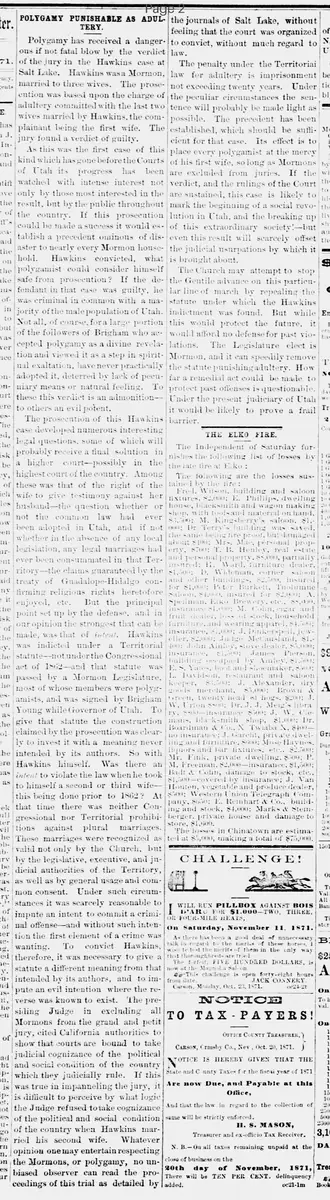
Polygamy has received a dangerous if not fatal blow by the verdict of the jury in the Hawkins case at Salt Lake. Hawkins was a Mormon, married to three wives. The prosecution was based upon the charge of adultery committed with the last two wives married by Hawkins, the complainant being the first wife. The jury found a verdict of guilty.
As this was the first case of this kind which has gone before the Courts of Utah its progress has been watched with intense interest not only by those most interested in the result, but by the public throughout the country. If this prosecution could be made a success it would establish a precedent ominous of disaster to nearly every Mormon household. Hawkins convicted, what polygamist could consider himself safe from prosecution? If the defendant in that case was guilty, he was criminal in common with a majority of the male population of Utah. Not all, of course, for a large portion of the followers of Brigham who accepted polygamy as a divine revelation and viewed it as a step in spiritual exaltation, have never practically adopted it, deterred by lack of pecuniary means or natural feeling. To these this verdict is an admonition—to others an evil portent.
The prosecution of this Hawkins case developed numerous interesting legal questions, some of which will probably receive a final solution in a higher court—possibly in the highest court of the country. Among these was that of the right of the wife to give testimony against her husband—the question whether or not the common law had ever been adopted in Utah, and if not whether in the absence of any local legislation, any legal marriages had ever been consummated in that Territory—the claims guaranteed by the treaty of Guadalupe-Hidalgo confirming religious rights heretofore enjoyed, etc. But the principal point set up by the defense, and in our opinion the strongest that can be made, was that of intent. Hawkins was indicted under a Territorial statute—not under the Congressional act of 1862—and that statute was passed by a Mormon Legislature, most of whose members were polygamists, and was signed by Brigham Young while Governor of Utah. To give that statute the construction claimed by the prosecution was clearly to invest it with a meaning never intended by its authors. So with Hawkins himself. Was there an intent to violate the law when he took to himself a second or third wife—this being done prior to 1862? At that time there was neither Congressional nor Territorial prohibitions against plural marriages. These marriages were recognized as valid not only by the Church, but by the legislative, executive, and judicial authorities of the Territory, as well as by general usage and common consent. Under such circumstances it was scarcely reasonable to impute an intent to commit a criminal offense—and without such intention the first element of a crime was wanting. To convict Hawkins, therefore, it was necessary to give a statute a different meaning from that intended by its authors, and to impute an evil intention where the reverse was known to exist. The presiding Judge in excluding all Mormons from the grand and petit jury, cited California authorities to show that courts are bound to take judicial cognizance of the political and social condition of the country which they judicially rule. If this was true in impaneling the jury, it is difficult to perceive by what logic the Judge refused to take cognizance of the political and social condition of the country when Hawkins married his second wife. Whatever opinion one may entertain respecting the Mormons, or polygamy, no unbiased observer can read the proceedings of this trial as detailed by
the journals of Salt Lake, without feeling that the court was organized to convict, without much regard to law.
The penalty under the Territorial law for adultery is imprisonment not exceeding twenty years. Under the peculiar circumstances the sentence will probably be made light as possible. The precedent has been established, which should be sufficient for that case. Its effect is to place every polygamist at the mercy of his first wife, so long as Mormons are excluded from juries. If the verdict, and the rulings of the Court are sustained, this case is likely to mark the beginning of a social revolution in Utah, and the breaking up of this extraordinary society!—but even this result will scarcely offset the judicial usurpations by which it is brought about.
The Church may attempt to stop the Gentile advance on this particular line of march by repealing the statute under which the Hawkins indictment was found. But while this would protect the future, it would afford no defense for past violations. The Legislature elect is Mormon, and it can speedily remove the statute punishing adultery. How far a remedial act could be made to protect past offenses is questionable. Under the present judiciary of Utah it would be likely to prove a frail barrier.
What sub-type of article is it?
What themes does it cover?
What keywords are associated?
What entities or persons were involved?
Where did it happen?
Story Details
Key Persons
Location
Salt Lake, Utah
Story Details
Mormon Hawkins, married to three wives, is prosecuted for adultery by his first wife regarding the other two; convicted under territorial statute, setting precedent against polygamy despite defenses of intent and historical recognition, with implications for Mormon society and potential appeals.