Thank you for visiting SNEWPapers!
Sign up free
Editorial
February 2, 1828
Richmond Enquirer
Richmond, Richmond County, Virginia
What is this article about?
Satirical catechism from the Boston Statesman mocking John Adams and John Quincy Adams' writings, portraying their views as favoring aristocracy, nobility, monarchy, and executive power over democracy and the common people.
Clipping
OCR Quality
95%
Excellent
Full Text
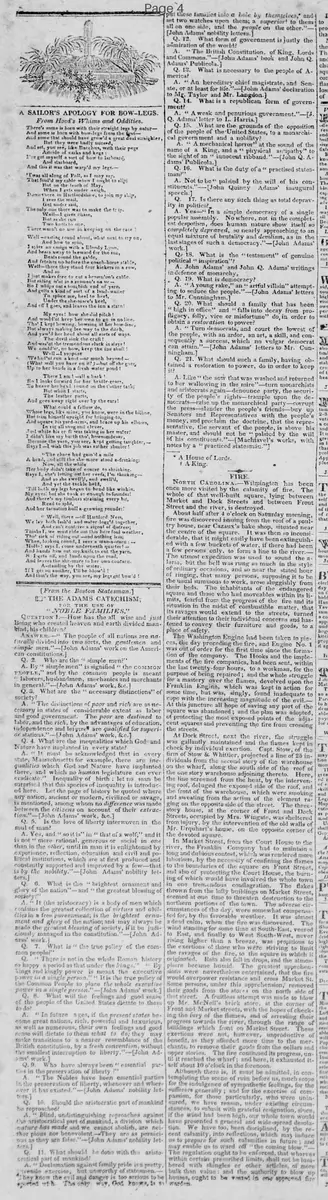
[From the Boston Statesman.]
THE ADAMS CATECHISM;
FOR THE USE OF
"NOBLE FAMILIES."
Question 1.—How has the all wise and just
Being who created heaven and earth divided man-
kind, his children?
Answer.—"The people of all nations are na-
turally divided into two sorts, the gentlemen and
simple men."—[John Adams' work on the Ameri-
can constitutions.
Q. 2. Who are the "simple men?"
A. By "simple men" is signified "the common
people," and by the common people is meant
"laborers, husbandmen, mechanics and merchants
in general."—[John Adams' work, &c.]
Q. 3. What are the "necessary distinctions" of
society?
A. "The distinctions of poor and rich are as ne-
cessary in states of considerable extent as labor
and good government. The poor are destined to
labor, and the rich, by the advantages of education,
independence and leisure are qualified for superi-
or stations."—[John Adams' work, &c.]
Q. 4. What are the inequalities which God and
Nature have implanted in every state?
A. "It must be acknowledged that in every
state, Massachusetts for example, there are ine-
qualities which God and Nature have implanted
there, and which no human legislature can ever
eradicate." Inequality of birth: let no man be
surprised that this species of inequality is introduc-
ed here. Let the page of history be quoted where
any nation, ancient or modern, civilized or savage,
is mentioned, among whom no difference was made
between the citizens on account of their extrac-
tion."—[John Adams' work, &c.]
Q. 5. Is the love of liberty interwoven in the
soul of man?
A. Yes, and "so it is" in "that of a wolf;" and it
is not "more rational, generous or social in one
than in the other, until in man it is enlightened by
experience, reflection, education and civil and po-
lifical institutions, which are at first produced and
constantly supported and improved by a few—that
is by the nobility."—[John Adams' nobility let-
ters.]
Q. 6. What is the "brightest ornament and
glory of the nation"—and "the greatest blessing of
society?"
A. "It (the aristocracy) is a body of men which
contains the greatest collection of virtues and abil-
ities in a free government; is the brightest orna-
ment and glory of the nation; and may always be
made the greatest blessing of society, if it be judi-
ciously managed in the constitution."—[John Ad-
ams' work.
Q. 7. What is "the true policy of the com-
mon people?"
A. "There is nothing in the whole Roman history
so happy a period as that under the kings." "By
kings and kingly power is meant the executive
power in a single person." "It is the true policy of
the Common People to place the whole executive
power in a single person."—[John Adams' work.]
Q. 8. What will the feelings and good sense
of the people of the United States dictate to them
to do?
A. "In future ages, if the present states be-
come great nations, rich, powerful and luxurious,
as well as numerous, their own feelings and good
sense will dictate to them what to do; they may
make transitions to a nearer resemblance of the
British constitution, by a fresh convention, without
the smallest interruption to liberty."—[John Ad-
ams' work.]
Q. 9. Who have always been "essential par-
ties in the preservation of liberty"
A. "The Nobles have been essential parties
in the preservation of liberty, wherever it has existed."—[John Adams' nobility let-
tors.]
Q. 10. Should the aristocratic part of mankind
be reproached?
A. "Blind, undistinguishing reproaches against
the aristocratical part of mankind, a division which
nature has made and we cannot abolish, are nei-
ther pious nor benevolent. They are as pernici-
ous as they are false."—[John Adams' nobility let-
ters.]
Q. 11. What should be done with the aristo-
cratical part of mankind?
A. "Declamation against family pride is a pretty,
juvenile exercise, but unworthy of statesmen.—
I may know the evil and danger is too serious to be
coquetted with. The only way, God knows, is to
put these families into a hole by themselves," and
set two watches upon them; a superior to them
all on one side, and the people on the other."—
[John Adams' nobility letters.
Q. 12. What form of
government is justly the
admiration of the world?
A. "The British Constitution of King, Lords
and Commons."—[John Adams' book and John Q.
Adams' Publicola.
Q. 13.
What is necessary
to
the people of A-
merica?
A. "An hereditary chief magistrate, and Sen-
ate, or at least for life." [John Adams' declaration
to Mr. Taylor and Mr. Langdon.]
Q. 14. What is a republican form of govern-
ment?
A. "A weak and penurious government."—[J.
Q. Adams' letter to L. Harris.]
Q. 15. What are the grounds of the opposition
of the people of the United States, to a monarchi-
cal government and a nobility?
A. "A mechanical horror" at the sound of the
name of a King, and a "physical antipathy" to
the sight of an "innocent ribband."—[John Q. A-
dams' Publicola.]
Q. 16. What is the duty of a "practised states-
man?"
A. Not to be "palsied by the will of his con-
stituents."—[John Quincy Adams' inaugural
speech.]
Q. 17. Is there any such thing as total deprav-
ity in politics?
A. Yes—"In a simple democracy of a single
popular assembly. No where, not in the complet-
est despotism, does human nature show itself so
completely depraved, so nearly approaching to an
equal mixture of brutality and devilism, as in the
last stages of such a democracy."—[John Adams'
work.]
Q. 18. What is the "testament" of genuine
political "inspiration"?
A. John Adams' and John Q. Adams' writings
in defence of monarchy,
Q. 19. What is democracy?
A. "A young rake," an "artful villain" attempt-
ing to seduce the people."—[John Adams' letters
to Mr. Cunningham.
Q. 20. What should a family that has been
"high in office" and "falls into decay from pro-
fligacy, folly, vice or misfortune" do in order to
obtain a restoration to power?
A. "Turn democrats, and court the lowest of
the people, with an ardor, an art, a skill, and con-
sequently a success, which no vulgar democrat
can attain."—[John Adams' letters to Mr. Cun-
ningham.*
Q. 21. What should such a family, having ob-
tained a restoration to power, do in order to keep
it?
A. Like "the sow that was washed and returned
to her wallowing in the mire"—turn monarchists
and aristocrats again—denounce party, the securi-
ty of the people's rights—trample upon the de-
moerats—raise up the monarchical party—corrupt
the press—slander the people's friends—buy up
Senators and Representatives with the people's
money, and proclaim the doctrine, that the repre-
sentative, the servant of the people, is above his
master, and should not be "palsied by the will
of his constituents."—[Machiavelli's works, with
notes by a "practised statesman."
* A House of Lords.
t A King.
THE ADAMS CATECHISM;
FOR THE USE OF
"NOBLE FAMILIES."
Question 1.—How has the all wise and just
Being who created heaven and earth divided man-
kind, his children?
Answer.—"The people of all nations are na-
turally divided into two sorts, the gentlemen and
simple men."—[John Adams' work on the Ameri-
can constitutions.
Q. 2. Who are the "simple men?"
A. By "simple men" is signified "the common
people," and by the common people is meant
"laborers, husbandmen, mechanics and merchants
in general."—[John Adams' work, &c.]
Q. 3. What are the "necessary distinctions" of
society?
A. "The distinctions of poor and rich are as ne-
cessary in states of considerable extent as labor
and good government. The poor are destined to
labor, and the rich, by the advantages of education,
independence and leisure are qualified for superi-
or stations."—[John Adams' work, &c.]
Q. 4. What are the inequalities which God and
Nature have implanted in every state?
A. "It must be acknowledged that in every
state, Massachusetts for example, there are ine-
qualities which God and Nature have implanted
there, and which no human legislature can ever
eradicate." Inequality of birth: let no man be
surprised that this species of inequality is introduc-
ed here. Let the page of history be quoted where
any nation, ancient or modern, civilized or savage,
is mentioned, among whom no difference was made
between the citizens on account of their extrac-
tion."—[John Adams' work, &c.]
Q. 5. Is the love of liberty interwoven in the
soul of man?
A. Yes, and "so it is" in "that of a wolf;" and it
is not "more rational, generous or social in one
than in the other, until in man it is enlightened by
experience, reflection, education and civil and po-
lifical institutions, which are at first produced and
constantly supported and improved by a few—that
is by the nobility."—[John Adams' nobility let-
ters.]
Q. 6. What is the "brightest ornament and
glory of the nation"—and "the greatest blessing of
society?"
A. "It (the aristocracy) is a body of men which
contains the greatest collection of virtues and abil-
ities in a free government; is the brightest orna-
ment and glory of the nation; and may always be
made the greatest blessing of society, if it be judi-
ciously managed in the constitution."—[John Ad-
ams' work.
Q. 7. What is "the true policy of the com-
mon people?"
A. "There is nothing in the whole Roman history
so happy a period as that under the kings." "By
kings and kingly power is meant the executive
power in a single person." "It is the true policy of
the Common People to place the whole executive
power in a single person."—[John Adams' work.]
Q. 8. What will the feelings and good sense
of the people of the United States dictate to them
to do?
A. "In future ages, if the present states be-
come great nations, rich, powerful and luxurious,
as well as numerous, their own feelings and good
sense will dictate to them what to do; they may
make transitions to a nearer resemblance of the
British constitution, by a fresh convention, without
the smallest interruption to liberty."—[John Ad-
ams' work.]
Q. 9. Who have always been "essential par-
ties in the preservation of liberty"
A. "The Nobles have been essential parties
in the preservation of liberty, wherever it has existed."—[John Adams' nobility let-
tors.]
Q. 10. Should the aristocratic part of mankind
be reproached?
A. "Blind, undistinguishing reproaches against
the aristocratical part of mankind, a division which
nature has made and we cannot abolish, are nei-
ther pious nor benevolent. They are as pernici-
ous as they are false."—[John Adams' nobility let-
ters.]
Q. 11. What should be done with the aristo-
cratical part of mankind?
A. "Declamation against family pride is a pretty,
juvenile exercise, but unworthy of statesmen.—
I may know the evil and danger is too serious to be
coquetted with. The only way, God knows, is to
put these families into a hole by themselves," and
set two watches upon them; a superior to them
all on one side, and the people on the other."—
[John Adams' nobility letters.
Q. 12. What form of
government is justly the
admiration of the world?
A. "The British Constitution of King, Lords
and Commons."—[John Adams' book and John Q.
Adams' Publicola.
Q. 13.
What is necessary
to
the people of A-
merica?
A. "An hereditary chief magistrate, and Sen-
ate, or at least for life." [John Adams' declaration
to Mr. Taylor and Mr. Langdon.]
Q. 14. What is a republican form of govern-
ment?
A. "A weak and penurious government."—[J.
Q. Adams' letter to L. Harris.]
Q. 15. What are the grounds of the opposition
of the people of the United States, to a monarchi-
cal government and a nobility?
A. "A mechanical horror" at the sound of the
name of a King, and a "physical antipathy" to
the sight of an "innocent ribband."—[John Q. A-
dams' Publicola.]
Q. 16. What is the duty of a "practised states-
man?"
A. Not to be "palsied by the will of his con-
stituents."—[John Quincy Adams' inaugural
speech.]
Q. 17. Is there any such thing as total deprav-
ity in politics?
A. Yes—"In a simple democracy of a single
popular assembly. No where, not in the complet-
est despotism, does human nature show itself so
completely depraved, so nearly approaching to an
equal mixture of brutality and devilism, as in the
last stages of such a democracy."—[John Adams'
work.]
Q. 18. What is the "testament" of genuine
political "inspiration"?
A. John Adams' and John Q. Adams' writings
in defence of monarchy,
Q. 19. What is democracy?
A. "A young rake," an "artful villain" attempt-
ing to seduce the people."—[John Adams' letters
to Mr. Cunningham.
Q. 20. What should a family that has been
"high in office" and "falls into decay from pro-
fligacy, folly, vice or misfortune" do in order to
obtain a restoration to power?
A. "Turn democrats, and court the lowest of
the people, with an ardor, an art, a skill, and con-
sequently a success, which no vulgar democrat
can attain."—[John Adams' letters to Mr. Cun-
ningham.*
Q. 21. What should such a family, having ob-
tained a restoration to power, do in order to keep
it?
A. Like "the sow that was washed and returned
to her wallowing in the mire"—turn monarchists
and aristocrats again—denounce party, the securi-
ty of the people's rights—trample upon the de-
moerats—raise up the monarchical party—corrupt
the press—slander the people's friends—buy up
Senators and Representatives with the people's
money, and proclaim the doctrine, that the repre-
sentative, the servant of the people, is above his
master, and should not be "palsied by the will
of his constituents."—[Machiavelli's works, with
notes by a "practised statesman."
* A House of Lords.
t A King.
What sub-type of article is it?
Satire
Partisan Politics
Constitutional
What keywords are associated?
Adams Catechism
Aristocracy
Monarchy
Democracy
Nobility
Political Satire
Constitutional Views
What entities or persons were involved?
John Adams
John Quincy Adams
Adams Family
Editorial Details
Primary Topic
Satirical Critique Of Adams Family's Aristocratic And Monarchical Views
Stance / Tone
Satirical Mockery Of Aristocracy And Monarchy
Key Figures
John Adams
John Quincy Adams
Adams Family
Key Arguments
People Naturally Divided Into Gentlemen And Simple Men
Rich Qualified For Superior Stations Due To Education And Leisure
Inequalities Of Birth Are Natural And Ineradicable
Aristocracy Is The Brightest Ornament Of The Nation
Common People Should Place Executive Power In A Single Person
Future America May Adopt British Constitution Resembling Monarchy
Nobles Essential To Preserving Liberty
Reproaches Against Aristocracy Are Pernicious
Aristocratic Families Should Be Isolated And Watched
British Constitution Of King, Lords, And Commons Is Admirable
Hereditary Chief Magistrate And Senate Necessary For America
Republican Government Is Weak And Penurious
Opposition To Monarchy Stems From Irrational Horror
Statesmen Should Not Be Bound By Constituents' Will
Simple Democracy Leads To Total Depravity
Democracy Is Like A Seductive Villain
Decayed Aristocratic Families Regain Power By Posing As Democrats Then Reverting To Monarchism